
Circe Myths: Witchcraft, Transformation, and Exile
Greek Mythology
Circe is often introduced like a hazard sign nailed to a mast: sorceress ahead, men turned to animals, proceed with caution. The Odyssey made her famous, yes, but it did not make her simple. Circe belongs to an older, stranger divine line than the swaggering Olympians. She is elder-blooded and half exiled by the story itself, a woman-goddess in a world that punishes women for having power that cannot be married off, bargained down, or politely ignored.
Her myths are a fever-dream of perfume and poison, moonlit thresholds and gleaming cups, desire that curdles into punishment, and knowledge that costs something every time you use it. If you have ever felt the pull of a door you should not open, you already understand why Circe endures.

Not a mortal witch: Circe’s elder line
Circe is not a village wise-woman who learned a few tricks and got blamed for the weather. In many ancient traditions, she is the daughter of Helios, the sun who sees everything, and the Oceanid Perse (or Perseis). That parentage matters. Helios is not merely bright. He is incriminating. He watches, remembers, and reports.
Circe’s siblings deepen the spellwork around her. She is often counted as sister to Aeëtes (keeper of the Golden Fleece in Colchis) and Pasiphaë (queen of Crete, later entangled in the Minotaur’s horror), and sometimes a brother, Perses, appears in the family shadows as well. A family tree like that does not produce harmless people.
Calling her a “witch” is not wrong, but it is incomplete. Circe is a goddess or goddess-like figure in epic tradition, and her art is an extension of what she is. In Greek terms, she is closer to a weather-front than a criminal. You do not arrest a storm. You survive it, or you do not.
Aeaea: the island that feels like a sentence
Circe’s home, Aeaea, is one of those mythic locations that behaves like a mood. It is lush, remote, and unnervingly self-contained, as if the sea itself is trying to keep it hidden.
In Homer, she sings at her loom in a house of polished stone, and wolves and lions lounge around her like an audience that has already learned the rules. They do not behave like predators. They behave like proof.
Those animals are not only aesthetic menace. They are often understood as the residue of previous arrivals, humans turned into beasts and then kept close, tamed by a power that is both intimate and terrifying. Aeaea is not simply where she lives. It is where outcomes are stored.
Aeaea is what happens when a god lives too far from other gods: the solitude grows teeth.
Why exile? The myths do not always give one clean courtroom charge, because Greek mythology rarely does. Some later tellings imply she was pushed outward for dangerous arts. Others simply present Aeaea as her dwelling, no explanation offered, as if distance is the natural climate around her.
The Odyssey, with Circe at the center
The transformation of Odysseus’ men
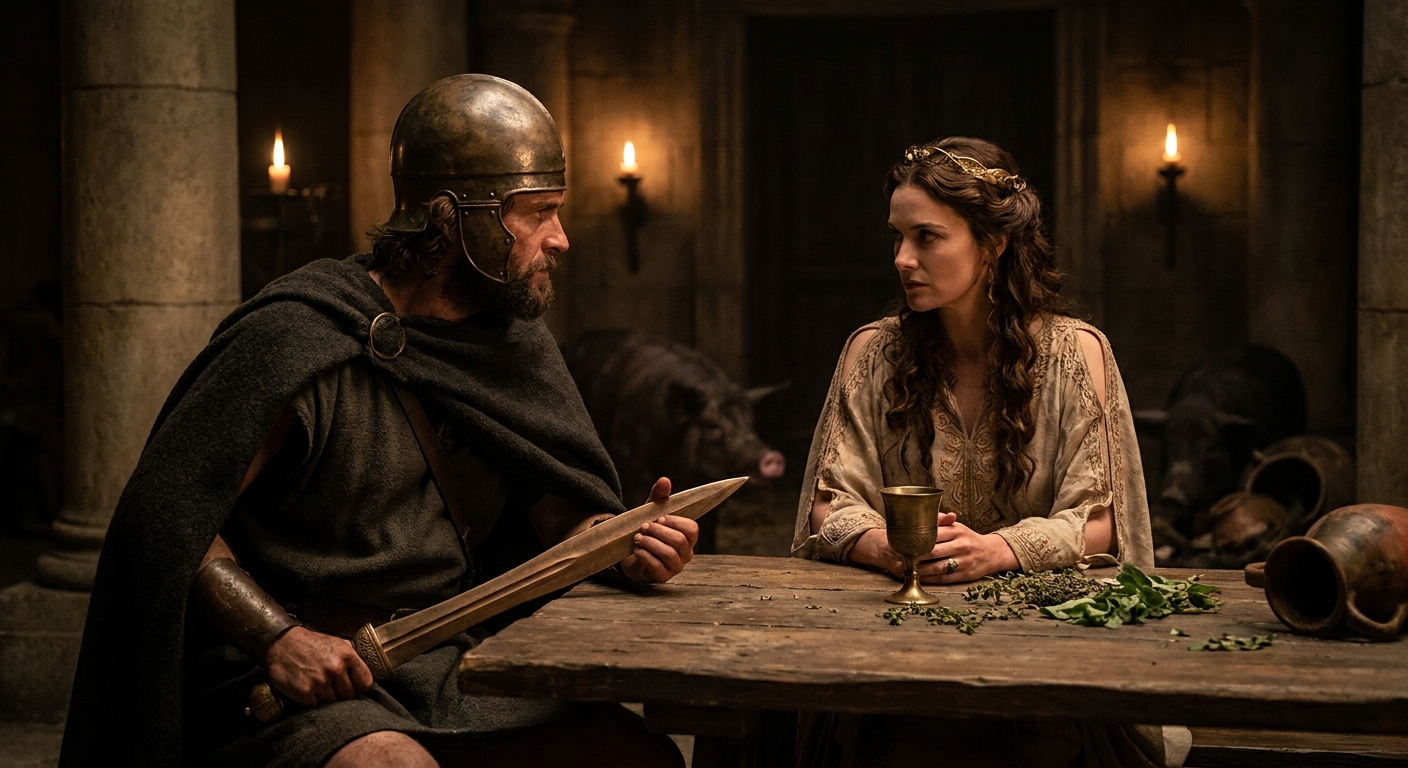
In Homer’s Odyssey, Odysseus sends a small party to scout the island. They walk into Circe’s hall hungry and uninvited, and they receive what looks like hospitality: food, drink, warmth. Then the spell bites. With wand and potion, Circe turns them into swine while leaving their minds intact, an especially cruel detail. The body changes, the shame remains, the human consciousness trapped behind animal eyes.
It is easy to read this as simple villainy, but Circe’s episode is also a lesson in how myths treat appetite, intrusion, and entitlement. Men arrive expecting to be fed. Circe answers in the language of the gods: transformation, not negotiation.
Hermes, moly, and the counterspell
Odysseus survives because the universe briefly decides he is worth saving. Hermes appears and offers the herb moly, a rare moment where the myth admits that magic has rules and counters. Odysseus drinks Circe’s potion without falling, then forces a bargain at swordpoint.
That detail matters: Circe is not defeated by brute strength. She is compelled into a divine bargain. She swears an oath, and only then does Odysseus share her bed and table. The episode becomes less “hero defeats witch” and more “two dangerous intelligences negotiate terms.”
Prophecy as payment: the Underworld route
Circe does not only restore what she broke. She becomes the navigator no one else can be. She directs Odysseus to the Underworld, to consult the prophet Tiresias. In other words, she aims him toward the darkest threshold in the epic.
Her most frightening spell is not transformation. It is direction.
She later warns him about the Sirens and the narrow passage of Scylla and Charybdis. And she does not stop there. Circe also names the bright, ordinary-looking danger that belongs to her father: Helios’ cattle on Thrinacia. Do not touch them. Do not bargain with hunger. The sea has teeth, but the sun has a memory.
This is Circe at her most revealing: she is not just a hazard on the road. She is a keeper of maps that are written in consequences, and she knows exactly which consequence bears Helios’ signature.
Glaucus and Scylla
If you want Circe’s emotional mythology, look beyond Odysseus. One of her most famous stories appears in later sources, especially in Ovid’s Metamorphoses, where the sea-god Glaucus begs Circe for help. He loves the nymph Scylla. Circe listens, and then she wants Glaucus for herself.
Scylla refuses, and Circe responds not with heartbreak alone but with punishment disguised as craft. She poisons the waters where Scylla bathes, and the nymph becomes a monster: a ring of barking dogs or snapping heads erupting from her waist, the beautiful body turned into a coastal nightmare.

This myth is often told as a warning against jealousy, but it also exposes something darker. Circe’s magic is not separate from her emotions. She does not cast spells like a detached scientist. She casts them like a goddess who expects the world to bend when she hurts.
Telegonus and the wound that returns
Circe’s story does not end with Odysseus sailing away. In later tradition, she bears him a son, Telegonus. The child grows, as children in myth do, into a weapon aimed at the past. He goes in search of his father and, through the cruel mechanics of recognition tales, kills Odysseus by accident, sometimes with a spear tipped by a stingray spine.
The tragedy is almost too perfect for Greek myth: the hero who survived Cyclopes and shipwrecks is brought down by a son he never knew. Fate does not always arrive as thunder. Sometimes it arrives as family.
In Greek mythology, the future often looks like a stranger with your eyes.
Some versions continue into an uneasy afterlife of reconciliation. Telegonus brings Odysseus’ body, along with Penelope and Telemachus, back to Aeaea. In some late accounts, Circe makes them immortal, and the marriages are rearranged into a tidy knot that still feels like a spell. Telegonus takes Penelope. Telemachus takes Circe. Myth tries to stitch shut a wound it cannot truly heal.
Whether you treat those endings as consolation or as one more unnerving solution depends on your tolerance for divine repair. Circe’s gift is rarely simple. It tends to come with an undertone: nothing goes back to how it was.
What Circe really transforms
Circe is remembered for turning men into animals, but the deeper transformation in her myths is social and psychological. She tests how easily the “civilized” can become feral. She reveals what happens when appetite is given a body that matches it. She also exposes the thinness of heroic control. Odysseus, master of strategy, still needs a god to hand him an antidote.
Circe herself is a transformation story. Depending on the author, she is a predator, a teacher, a lonely queen, a jealous rival, a lover, an exile, a maker of monsters. Those are not contradictions in Greek myth. They are the point.
- Witchcraft in her stories is not stage magic. It is divine power expressed through herbs, voice, and ritual, where cure and poison share a root.
- Transformation is both punishment and revelation. The body becomes the truth no one wanted to say aloud.
- Exile is not only geography. It is the emotional weather around a woman who cannot be controlled.
Why writers return to her
Circe’s literary afterlife is long because she solves a problem storytellers never stop having: how to write female power without turning it into a lesson for men. Ancient authors already disagreed about her. Homer frames her as a peril that becomes an ally. Later poets, especially Ovid, lean into the sensual cruelty of metamorphosis, making Circe a sophisticated engine of change and damage.
In modern retellings, Circe often becomes the protagonist because the island finally looks like what it always was: a stage where a woman with divine blood tries to make a life in a world that would rather she be a rumor.
That is why “Circe myths” cannot be reduced to one scene with pigs. Circe is a whole constellation of stories about power, desire, punishment, knowledge, and the particular loneliness of being too formidable to belong.
Circe, seen clearly
If you want a single image of Circe to keep, make it this: a torchlit hall on Aeaea, sea wind worrying the curtains, bronze bowls gleaming like small suns, and a goddess who knows the names of every herb that heals and every herb that ruins. She is not a one-scene villain. She is a sovereign figure in the old Greek mode, beautiful, volatile, and exacting.
Circe does not simply transform others. She forces the world to admit what it is, and what it wants. And then she lives with the consequences, alone on her island, with Helios watching from above like an unblinking eye.