Helios Myths: Sun Chariot, Cattle, and Divine Sight
Greek Mythology
In Greek myth, the sun is not a background detail. It is a living gaze that crosses the world every day, unblinking, golden, and hard to lie to.
That gaze belongs to Helios, a Titan whose presence is almost deceptively simple: he rises, he shines, he sets. But simplicity in Greek mythology is often just the polite mask of something terrifying. Helios is a god of motion and measurement, of daily inevitability, of divine sight that makes secrets feel temporary.
If Apollo is the polished god of music and prophecy, Helios is genealogically older, harsher, and more literal. He does not predict. He sees.

Who Is Helios?
Helios belongs to the Titan generation, the luminous son of Hyperion and Theia, brother to Selene (Moon) and Eos (Dawn). He is not merely associated with sunlight. In much early Greek thinking, he is the sun, driving it like a bronze-bright marvel across the vault of heaven.
And unlike many Olympians who specialize in a mood, a city, or a particular category of human heartbreak, Helios is everywhere. The myths treat him as unavoidable, like salt on the wind near sea cliffs, or temple smoke that finds your clothes and refuses to leave.
The Sun Chariot
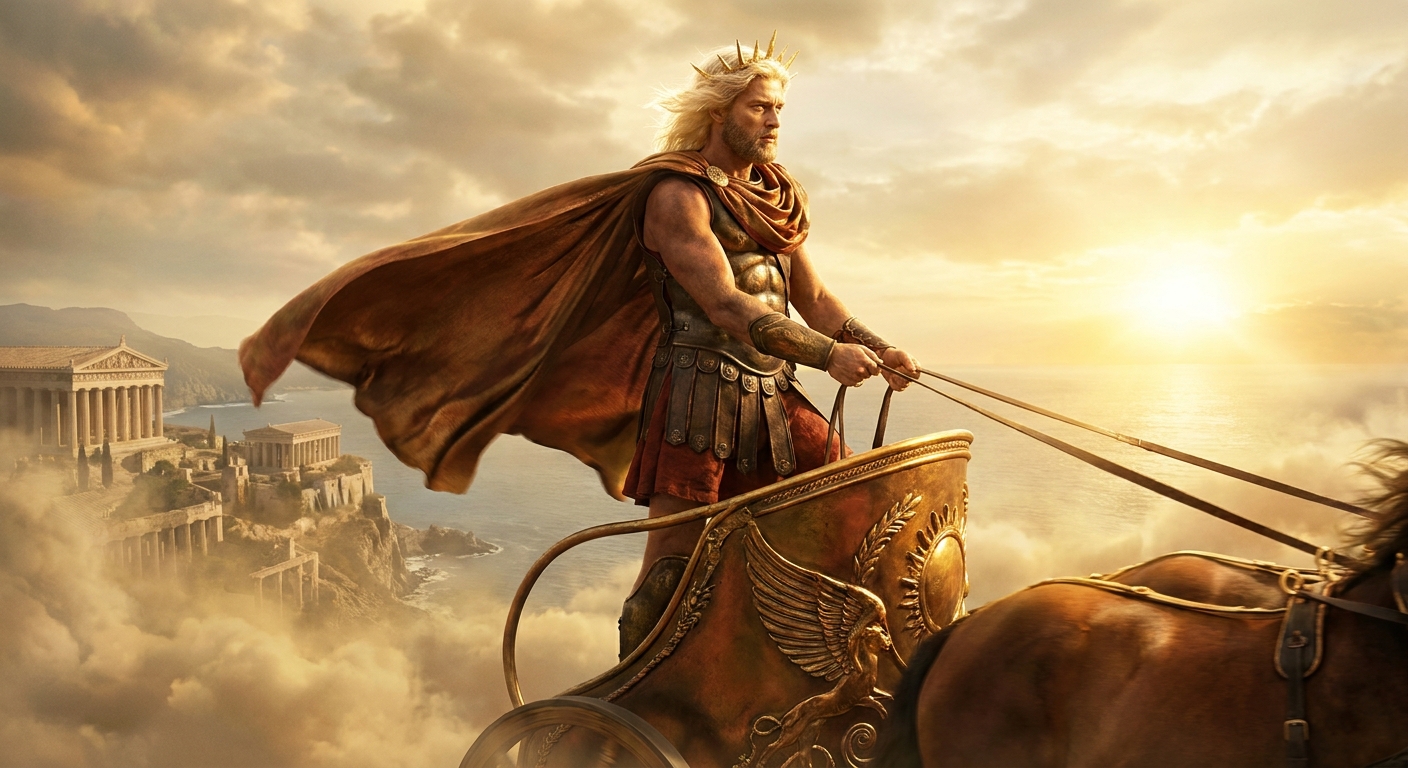
The central image is so vivid it feels like a mural that never stopped drying: Helios in a radiant chariot, usually drawn by fiery horses, pouring daylight over the world.
In Homeric epic, Helios is presented as the sun who sees and hears what happens beneath his course. Not an oracle with riddles, but a presence that passes over every roof and every oath.
Later poets and artists give the scene richer machinery. The horses are named in different traditions, the reins flash, the horizon burns. Sometimes Helios wears a crown of rays. Sometimes he looks like a young man with too much power in his hands, beautiful and dangerous as molten metal.
By night, in later poetic tradition, he returns by sea in a golden cup or vessel, crossing the dark waters back to the east. In other words, the sun does not simply vanish. It travels. It completes its circuit. It keeps its appointments.
In a world that worshipped fate, Helios was the daily proof that the cosmos still remembered its route.
Phaethon
If you want the purest Helios myth about hubris, you want Phaethon.
The story is Greek in its bones, even if the most influential surviving full narrative is preserved by the Roman poet Ovid. In the best-known version, Phaethon is Helios’s son, desperate to prove his parentage.
Helios, caught in the oldest trap in the divine family playbook, swears an oath to grant the boy a request. Phaethon asks for the one thing that should never be loaned, not even to love: the sun chariot.
Helios tries to warn him. The path is steep. The beasts are violent. The sky itself has turns only a god trained by eternity can hold. But the oath is spoken. Sworn oaths bind, even gods.
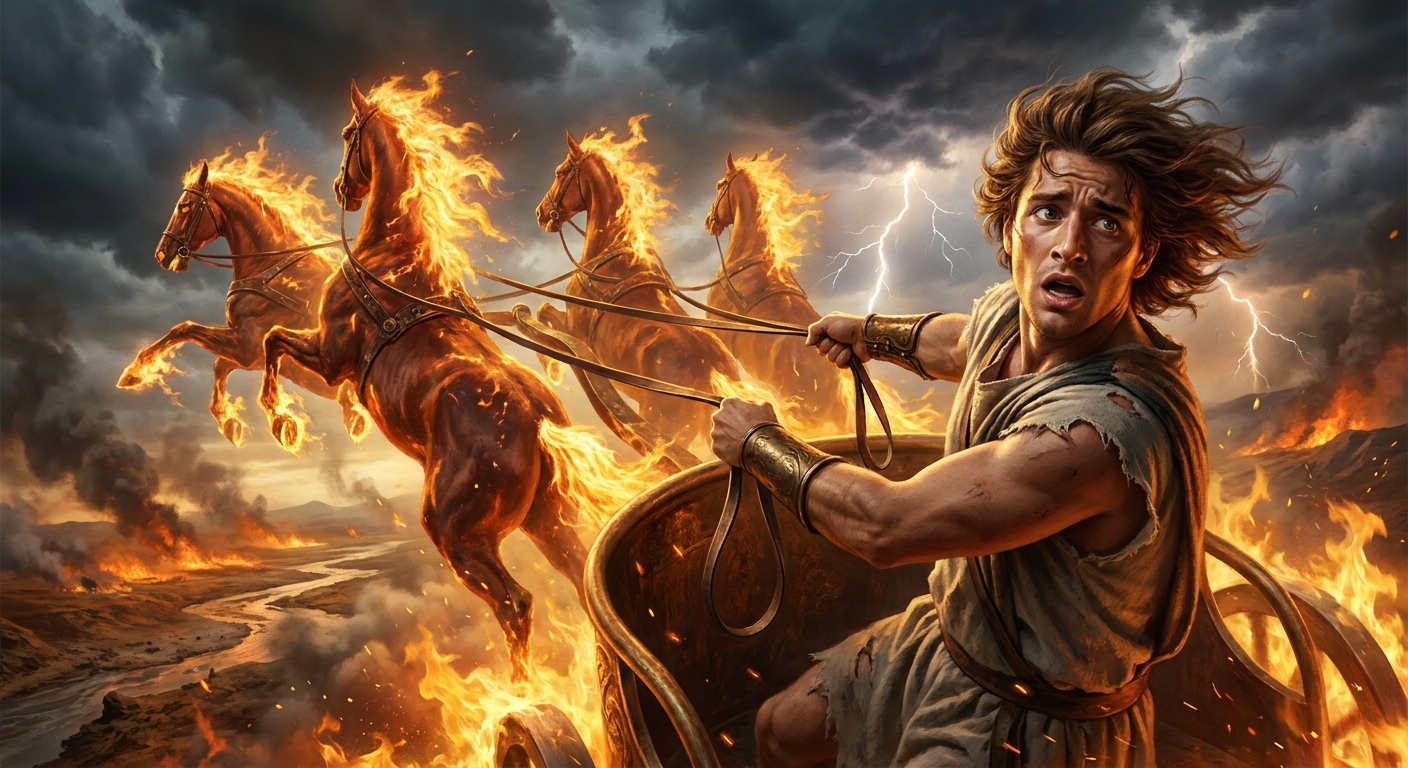
Phaethon cannot hold the course. The chariot plunges too close to the earth, scorching fields and cracking the world like fired clay. It rises too high, chilling regions that were never meant to know such cold. The heavens become a catastrophe of smoke and light, a ruin you can see from every shore.
Eventually Zeus intervenes, striking Phaethon down with a thunderbolt to stop the cosmic wreck. The boy falls, the world exhales, and Helios, in some tellings, mourns so fiercely that day itself feels delayed.
Thrinacia
Helios is also the owner of one of the most consequential herds in ancient literature: the sacred cattle of Thrinacia. In the Odyssey, Odysseus and his crew reach the island after too many storms, too many hungers, too many chances already spent.
The warning is explicit. Do not touch the cattle. Not one. Not even if the sea keeps you trapped and your stomach argues like an angry god.
It is never the hunger that ruins them. It is the moment they decide the warning was meant for someone else.
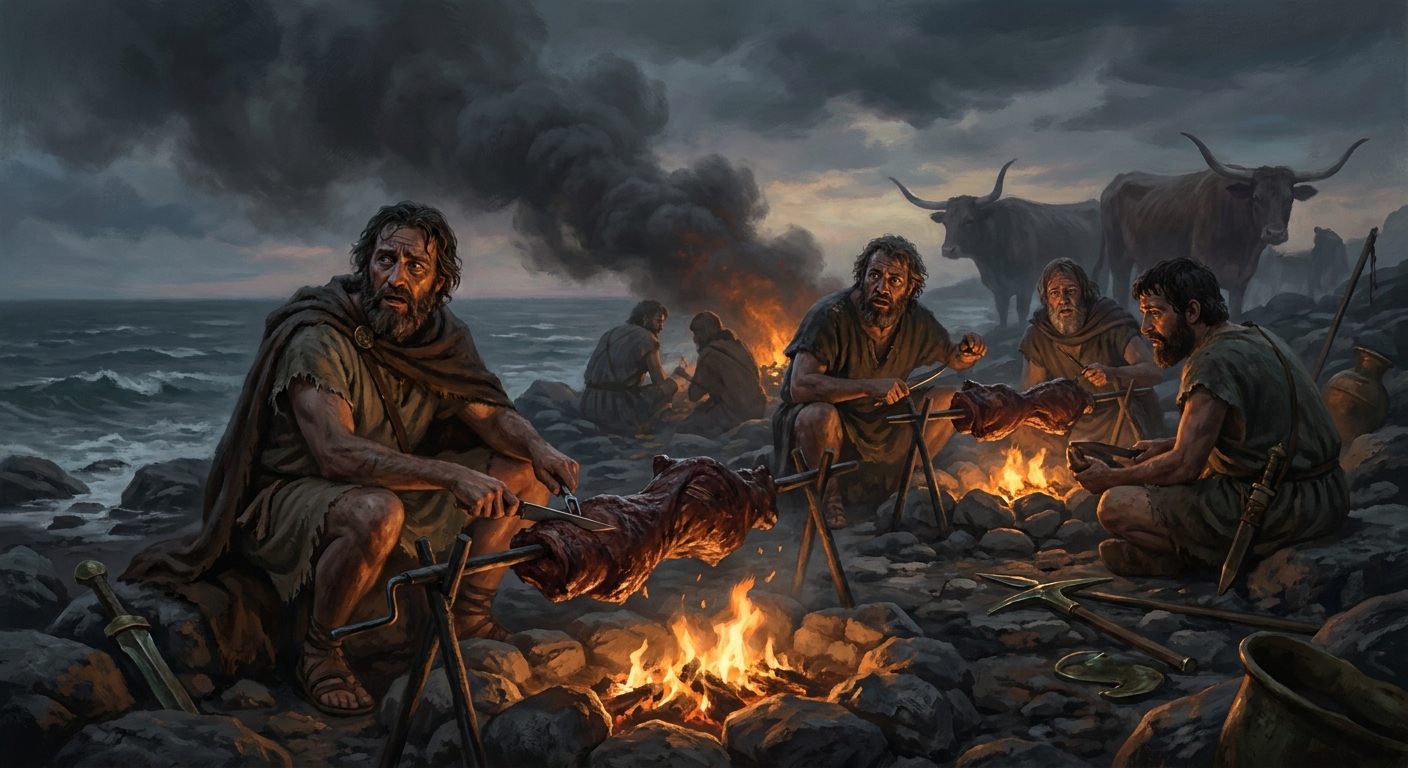
Odysseus’s men slaughter the cattle anyway. In Homer’s telling, the scene is uncanny: the hides crawl, the meat bellows on the spits. Myth loves an omen you can smell and hear. This one does not whisper.
Helios, seeing the violation, threatens to withdraw his light, to go shine among the dead instead, unless Zeus enforces justice. Zeus complies. Once the ship leaves Thrinacia, a storm shatters it. Odysseus alone survives.
Notice what is happening beneath the plot: Helios is not acting like a distant sun. He is an injured owner and a divine force whose property is also a boundary marker. Cross it, and the world reorganizes itself around the consequence.
Helios the Witness
Greek myth is crowded with gods who punish. Helios is different. He is the god you cannot plausibly deceive, because his work is to traverse everything. He is treated, again and again, as a witness.
That is why Helios appears when truth must be dragged into the open. In the Odyssey, he knows what happened to his cattle. In the same epic tradition, Helios also sees Aphrodite and Ares in their affair and informs Hephaestus, who answers with the kind of net only a wounded craftsman-god would devise.
It is not that Helios is morally pure. Greek gods are rarely interested in tidy human ethics. It is that his sight is structurally important to the cosmos. The sun becomes a guarantor of reality, a luminous record keeper.
Early and Later Helios
In Homer, Helios is already grand and dangerous, but he is still a figure who fits neatly into the epic world: a god with cattle, anger, and leverage. He feels like a divine aristocrat whose wealth happens to be daylight.
In later Greek, and especially Hellenistic and Roman-era thought, Helios can expand into something even larger. Philosophical and religious currents start treating the sun as a kind of cosmic intellect, a visible sign of order. Poets and hymn-writers frame Helios as the eye of the world, the regulator of seasons, the driver of time itself.
And as Apollo’s identity swells in later periods, the two can blur in popular imagination, even if Helios remains the more literal sun-god in many texts. The overlap is not a clean replacement so much as a merger of symbols, like two offerings smoking on the same altar.
- Epic focus: Helios as a powerful deity with property, wrath, and authority to demand punishment.
- Later focus: Helios as a cosmic presence, a witness, a metaphysical principle in gold.
- Enduring core: the sun’s route as a daily act of dominion, and the sun’s sight as a threat to secrecy.
Rhodes and the Colossus
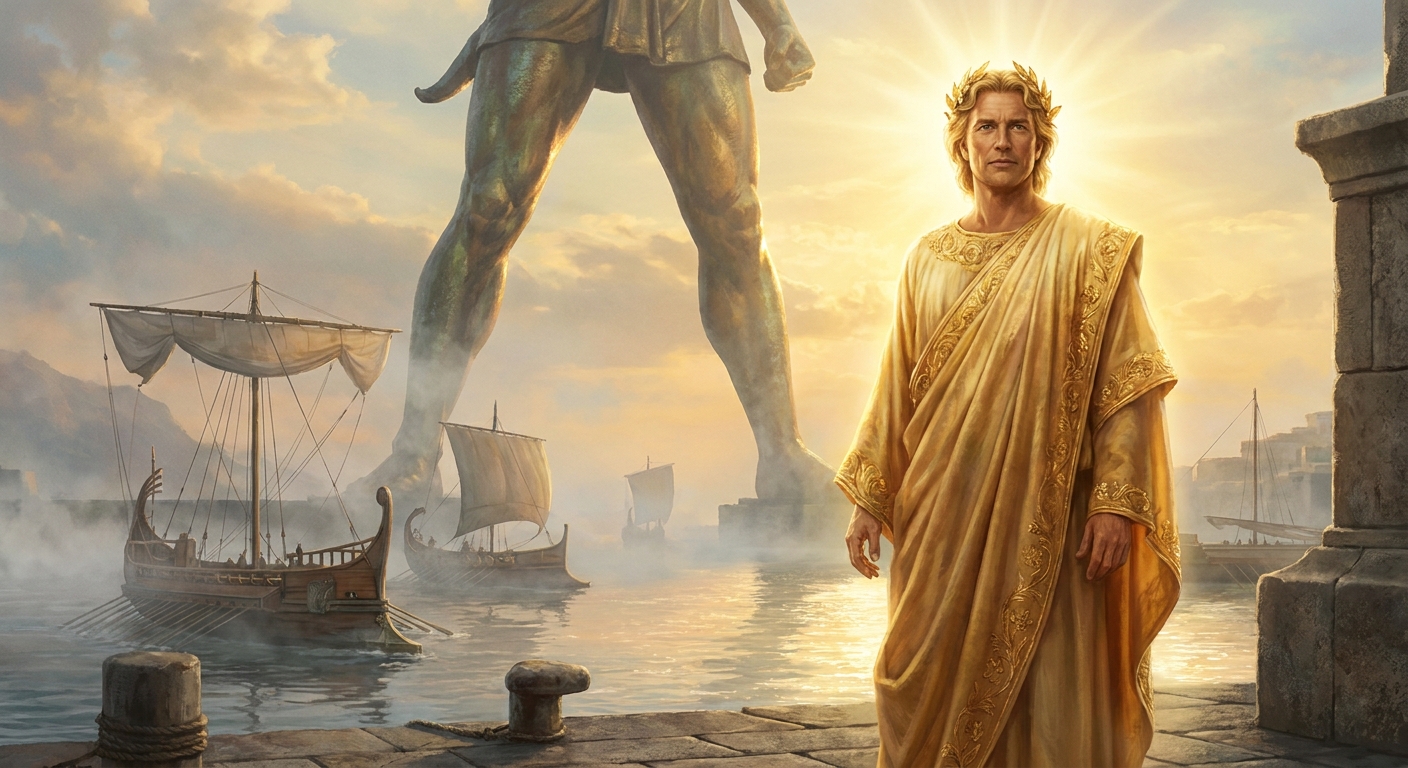
If Helios has a city that loves him with the fierce pride of a shoreline kingdom, it is Rhodes. The island’s traditions elevate Helios as a patron, and later cultural memory fastens him to one of the ancient world’s most famous wonders: the Colossus of Rhodes.
Historically, the Colossus was a monumental statue associated with Helios, raised in celebration after Rhodes resisted siege. Mythically, it feels like something even more intimate: a city attempting to anchor daylight in bronze, to make the sun not just a visitor but a resident.
Helios was honored beyond Rhodes too, though rarely with the same headline devotion. His cult presence appears in scattered places and hymns, as steady as sunrise itself: not always the loudest god in the city, but the one no city can escape.
What Helios Means
Helios is not a gentle daylight aesthetic. He is the mythic force that makes humans and gods accountable to the fact that the world is visible.
His myths return to three obsessions:
- Control: the chariot must be driven, the path must be held, the cosmos must not veer.
- Boundaries: the cattle are not food, they are a sacred line in the sand.
- Revelation: secrets survive at night, but the sun is patient and inevitable.
To read Helios is to feel how the Greeks imagined power without romance. Not the power that seduces, like Aphrodite. Not the power that strategizes, like Athena. Helios is the power that arrives regardless of your plans, flooding your courtyard and your conscience in the same indifferent blaze.