Ares Myths: War, Rage, and Scandalous Affairs
Greek Mythology
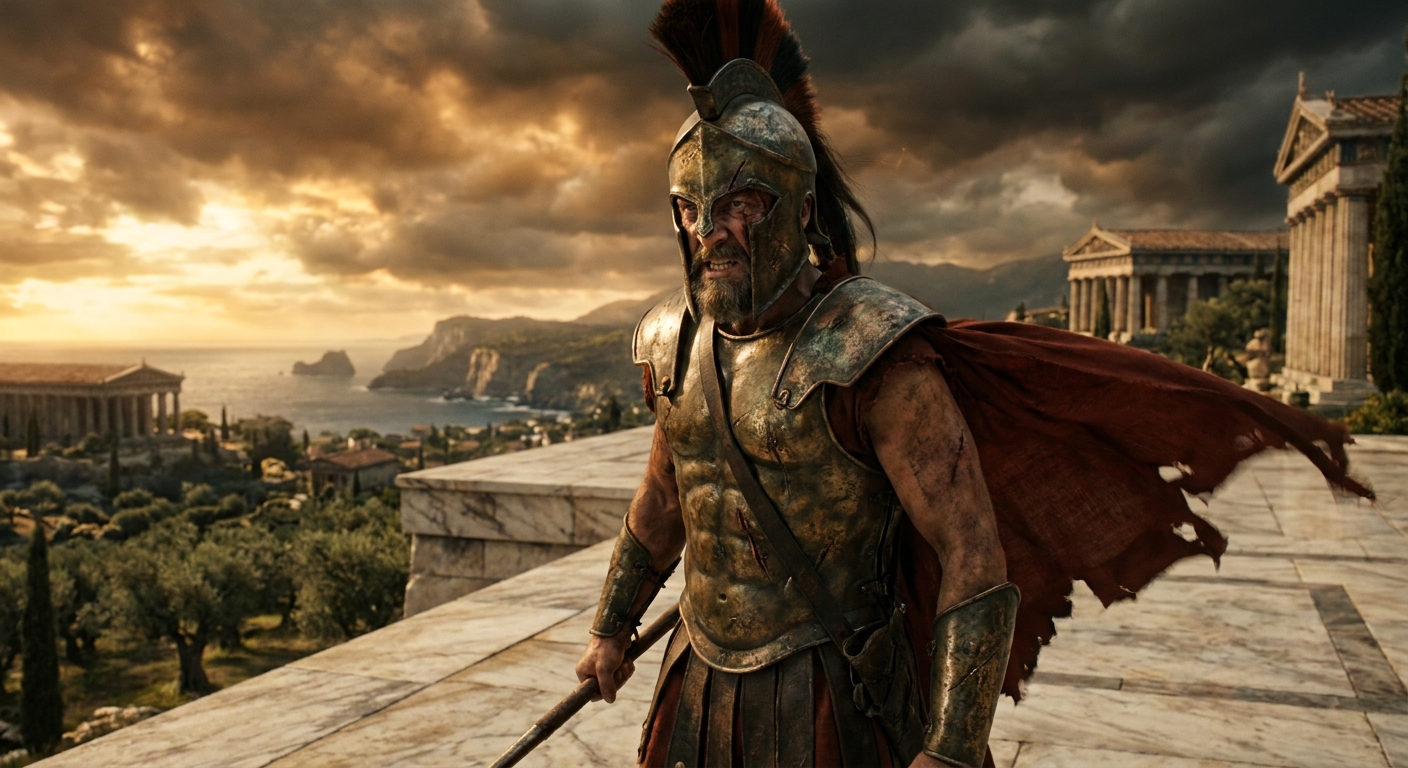
Ares arrives in Greek myth like a spear thrown too hard. Not the clean geometry of victory, not the civic pride of banners and treaties, but the raw noise of impact: rage, blood, and the kind of courage that curdles into cruelty when no one is watching.
He is called the god of war, yes. But that title is almost too polite. Ares is what war feels like in the body. The pounding temples. The narrowed vision. The moment when reason steps back and something hotter takes the throne.
And because Olympus is never content with a single genre, the myths of Ares are not only battlefield epics. They are also scandal, humiliation, and divine politics. He is feared. He is mocked. He is desired. He is beaten. He is, in the most Greek way possible, impossible to ignore.

Who Ares Is
In Homer, Ares can be magnificent and terrifying, but he is rarely admired. He is a god who loves the clash itself, not the order that might come after it. Many Greek poets and storytellers could honor martial strength and still distrust the kind of violence that spills over its boundaries.
That is why Athena stands as his perfect foil. If Ares is the roar of a shield wall collapsing, Athena is the general who never lets the wall collapse in the first place. Ares is impulse. Athena is consequence.
Even Ares’s family tree carries tension. He is commonly described as a son of Zeus and Hera. Yet Zeus, in the Iliad, speaks of him with particular disgust, calling him the most hateful of the gods to him because of his love of strife.
Aphrodite and Ares
If Ares is bronze and heat, Aphrodite is silk and gravity. Their affair is one of the most famous in Greek mythology, not because it is tender, but because it is reckless. The goddess of love married to the god of craft, slipping away with the god of war, as if the cosmos itself wanted to test how much scandal the heavens could hold.
In the Odyssey, the story is told with a kind of amused cruelty. Hephaestus, Aphrodite’s husband and the divine smith, learns of the betrayal and does what craftsmen do best: he builds the consequences.
He forges a net, so fine it is nearly invisible, and arranges it over the bed. When Aphrodite and Ares meet there, the trap falls and binds them. Not a weapon. Not a duel. A display.
Desire, on Olympus, rarely stays private.

Hephaestus calls the gods to witness the capture, turning humiliation into public record. The assembled Olympians laugh. Poseidon plays mediator. The point lands harder than any spear: Ares can overpower bodies, but not reputation. Not spectacle. Not a trap made by patience.
The myth lingers because it sets techne, the maker’s craft, against brute appetite. In a world where gods can bleed and heal, shame becomes its own wound. Ares learns that some battles are lost in laughter, not in blood.
Ares at Troy
When the Trojan War erupts, Ares does what he always does. He drifts toward the side that promises heat. In the Iliad, he enters the fighting on Troy’s side, drawn in by divine ties and by the war itself like a moth to torchlight, though the poem also shows how quickly divine allegiance can turn and retreat when the cost arrives.
He is not the only god to meddle. Olympus splits into factions, each with favorites, grudges, and old vows still smoldering under the marble.
But Ares is distinct because he does not merely guide or advise. He steps onto the plain as violence incarnate. And yet he is not written as invincible. He can be hurt. He can be driven back. The battlefield is not his throne so much as his hunger.
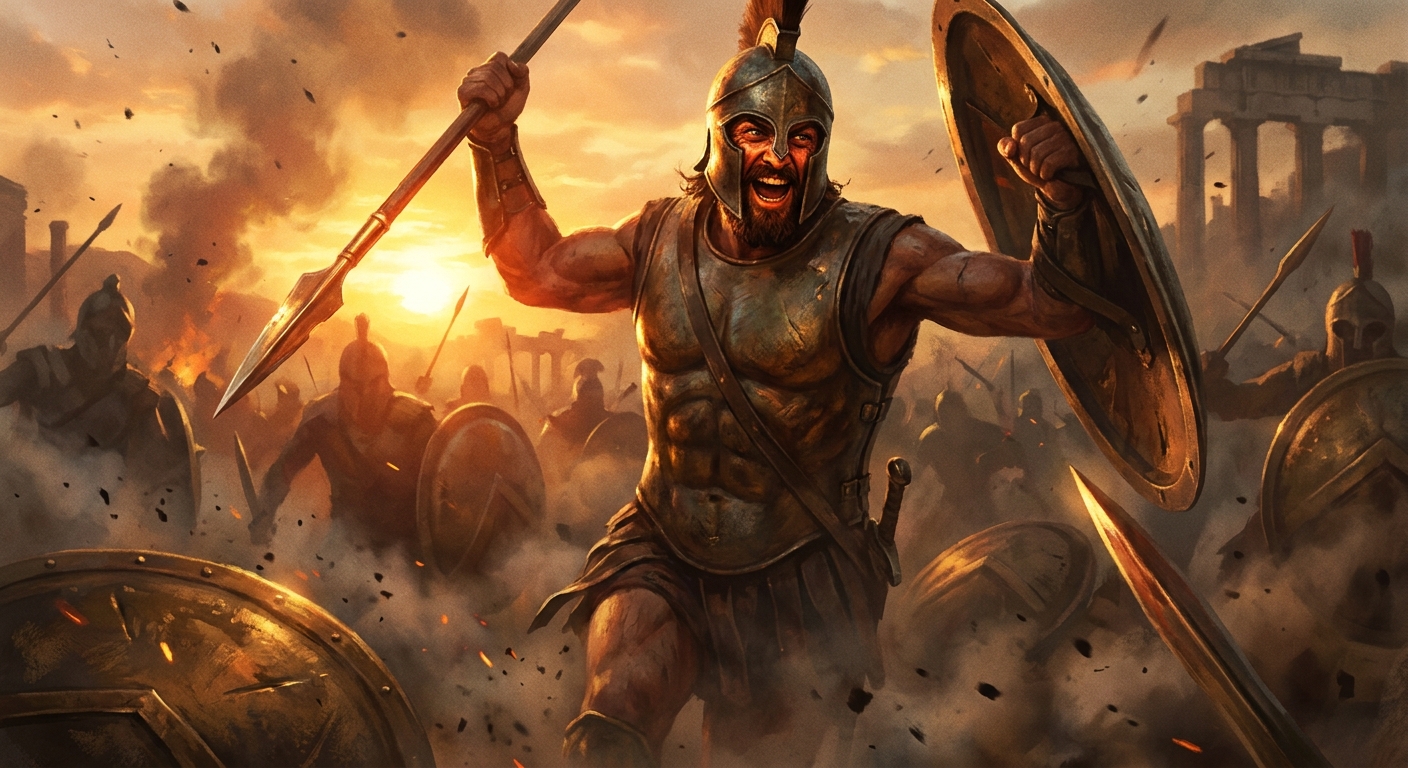
Ares does not bring victory. He brings volume.
Athena vs Ares
If you want the clearest mythic contrast between the two kinds of war, watch what happens when Athena confronts Ares. In the Iliad, he is wounded in battle and cries out with a voice like an army, then flees to Olympus to complain to Zeus.
It reads almost like comedy, until you remember what it signals. Ares is what happens when emotion drives the chariot. Athena is what happens when the chariot has a plan.
These victories are not only personal rivalry. They are commentary. The story keeps insisting that war without thought is a plague with a face.
Phobos and Deimos
Ares’s presence is not limited to his own spear arm. He multiplies. In myth, his sons Phobos (Fear) and Deimos (Terror) ride with him. They are not simply companions. They are what he releases into human bodies right before impact, when the mouth goes dry and the world narrows to a single point of panic.
Their mother is often given as Aphrodite, though ancient sources do not always agree on the finer edges of divine family. The pairing still bites with irony: love and fear sharing a household, desire birthing dread.
When Ares appears with Phobos and Deimos, the story is telling you that the worst part of war is not only the wound. It is the anticipation, the shiver of the soul before the blade arrives.

The Trial on the Hill
One Ares story surprises readers who only know him as a brawl with a name. When Halirrhothius violates Alcippe, Ares kills him. The gods demand judgment, and Ares is tried on a hill in Athens that later bears his shadowed title: the Areopagus.
It is a strange hinge of myth and civic memory. The war god, hauled into a court. Violence forced to stand still long enough to be measured.
Even Ares can be summoned, made to answer, and made to wait.
More Than a Villain
It is tempting to treat Ares as a simple antagonist, the divine embodiment of everything we prefer not to be. But Greek mythology rarely gives clean moral silhouettes. Ares persists because he names something real: the part of humanity that can be provoked, intoxicated by force, seduced by the purity of conflict.
And he is not always punished for it. Sometimes he is simply present, like a drumbeat behind the world. The myths do not claim that war is noble. They claim it is persistent.
In a pantheon full of dazzling rhetoric and polished prophecy, Ares is blunt honesty. He is the god who proves that the Olympians are not ideals. They are magnified emotions, wearing marble and gold, ruining lives with impeccable light.
Quick Guide
- Ares and Aphrodite: Desire turned into public scandal.
- Hephaestus’s net: Ares trapped and ridiculed through craft, not combat.
- Ares at Troy: He enters the war hungry for clash, then is checked and driven back.
- Athena’s victories: Strategy wounds frenzy, and Zeus’s patience wears thin.
- Phobos and Deimos: Fear and terror as war’s entourage.
- The Areopagus trial: The war god forced into judgment, myth brushing against civic law.
If you came looking for “Ares myths” expecting a straightforward war god, this is your revelation: Ares is not simply violence. He is war’s mood. He is scandal in the halls of marble, panic on the plain of Troy, and the bitter truth that strength without thought can turn itself into spectacle.