
Myths of Divine Disguise: Loom, Door, Mask
Greek Mythology
There are myths that feel like clean morality plays, neatly tied with a ribbon of consequence.
And then there is Arachne, standing over a loom like it is an altar, staring down Athena with the kind of confidence that makes the air go thin.
People love to tell this story as if it were merely about hubris, that favorite Greek warning label. But the truth is sharper. This was a contest staged inside a world where gods do not lose gracefully, and mortals do not get to be right out loud.

The goddess in a borrowed face
Athena does not always descend with thunder. Sometimes she chooses something more unsettling: a veil of ordinary life.
In this tale, she approaches in disguise, appearing as an old woman. It is a familiar divine habit in Greek myth, this love of masks and borrowed faces. The point is never fashion. The point is the test.
A disguised god changes the rules of the room. Suddenly every word is evidence. Every glance becomes a verdict waiting to happen.
A god in plain clothing is still a god. The disguise only makes the blade harder to see.
And Arachne, brilliant with her hands and loud with her pride, does not bow the way the world expects. She does what mortals do when talent begins to feel like invincibility: she dares.
Two looms, two sermons
The contest unfolds like a duel where neither fighter lifts a sword. The battlefield is thread. The audience is silence.
Athena crafts a piece that shimmers with the glory and might of the gods. It is not just about aesthetics. It is a visual sermon on divine grandeur, stitched to leave no room for mortal folly.
Then Arachne answers with something far more dangerous than bad technique.
Her work is no less brilliant, but it is woven with scandal, the cheeky playboy conduct of Olympus’s finest, a daring swipe at the gods’ well-kept secrets. Not a hymn. Not a bow. A mirror held up to divine faces that prefer flattering light.

Not a fair contest
Here is the detail that makes the whole myth hiss like a candlewick in a draft: Athena recognizes the skill.
This is not the simple story of a mortal losing because her work is inferior. The wound is deeper. Arachne’s hands can match the goddess’s hands, at least in craftsmanship, and that is precisely what makes the room unbearable.
Because what is the contest really about?
- Not whether the tapestry is beautiful.
- Not whether the images are true.
- But whether a mortal is permitted to judge Olympus without being crushed for it.
In a universe built on divine hierarchy, that kind of truth is not “critique.” It is insubordination.
Arachne did not only weave pictures. She wove a question: what if Olympus deserves to be judged?
The punishment
The myth does not linger in deliberation. It snaps.
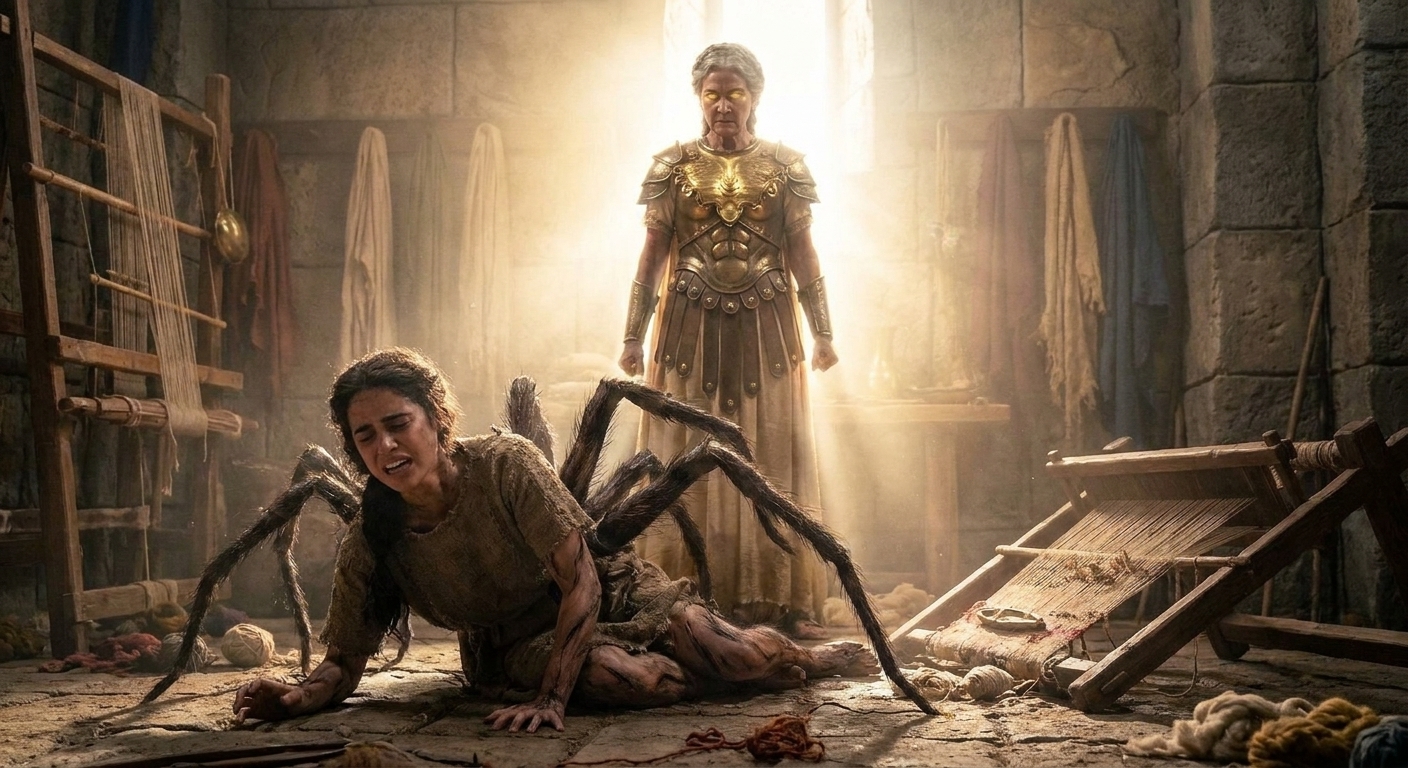
Athena’s rage arrives with the swiftness gods reserve for boundary-crossing mortals. Arachne is punished and transformed into a spider, condemned to weave forever, a poignant symbol of overstepping boundaries.
It is a punishment that pretends to fit the crime, as Greek punishments often do. You loved weaving? Then weave eternally. But underneath the poetic symmetry is something colder: containment.
Arachne’s craft survives, but her voice does not. The weaver is reduced to instinct and labor, her story narrowed into a single image crawling in corners.
Zeus and Hermes at the door
But Athena is not the only one who wears a borrowed face. Greek gods have a penchant for playing dress-up, descending in altered forms to test mortals or simply for the thrill of it.
Take Zeus and Hermes, the ultimate undercover pair, stepping onto Earth in disguise to see what happens when humanity is asked to practice xenia, the sacred code of hospitality.
In the myth recounted in Ovid’s Metamorphoses, they wander into Phrygia dressed as ordinary travelers. Door after door closes. Faces harden. Voices go flat with refusal.
Then they reach the humble home of Philemon and Baucis, an elderly couple who welcome them in with what little they have.

While others slammed the door, Philemon and Baucis offered everything they could, even sacrificing their plucky little goose for dinner. Impressed, the gods reveal their true forms and grant a divine reward: turning the simple home into a golden temple and granting the couple a wish.
In these stories, the knock at the door is never just a knock.
It is an ancient moral litmus test, not subtle about its pressure. You do not know who stands in your doorway. That is the point. The disguise turns every ordinary choice into a verdict.
Dionysus and the mask
If Athena uses disguise like a blade and Zeus uses it like a scale, Dionysus uses it like a stage light. He is the god of wine and theater, a patron of transformation with a dual nature that can feel like celebration and threat in the same breath.
His penchant for disguise makes him the mythic poster child for masking. He is the god you do not see coming, slipping into town to spread ritual ecstasy, or to unveil something more primal.
The connection between Dionysus and theater is not decorative. Theater is built on stepping into another persona, and Dionysus is the kind of god who would applaud the moment you forget where the costume ends and the self begins.
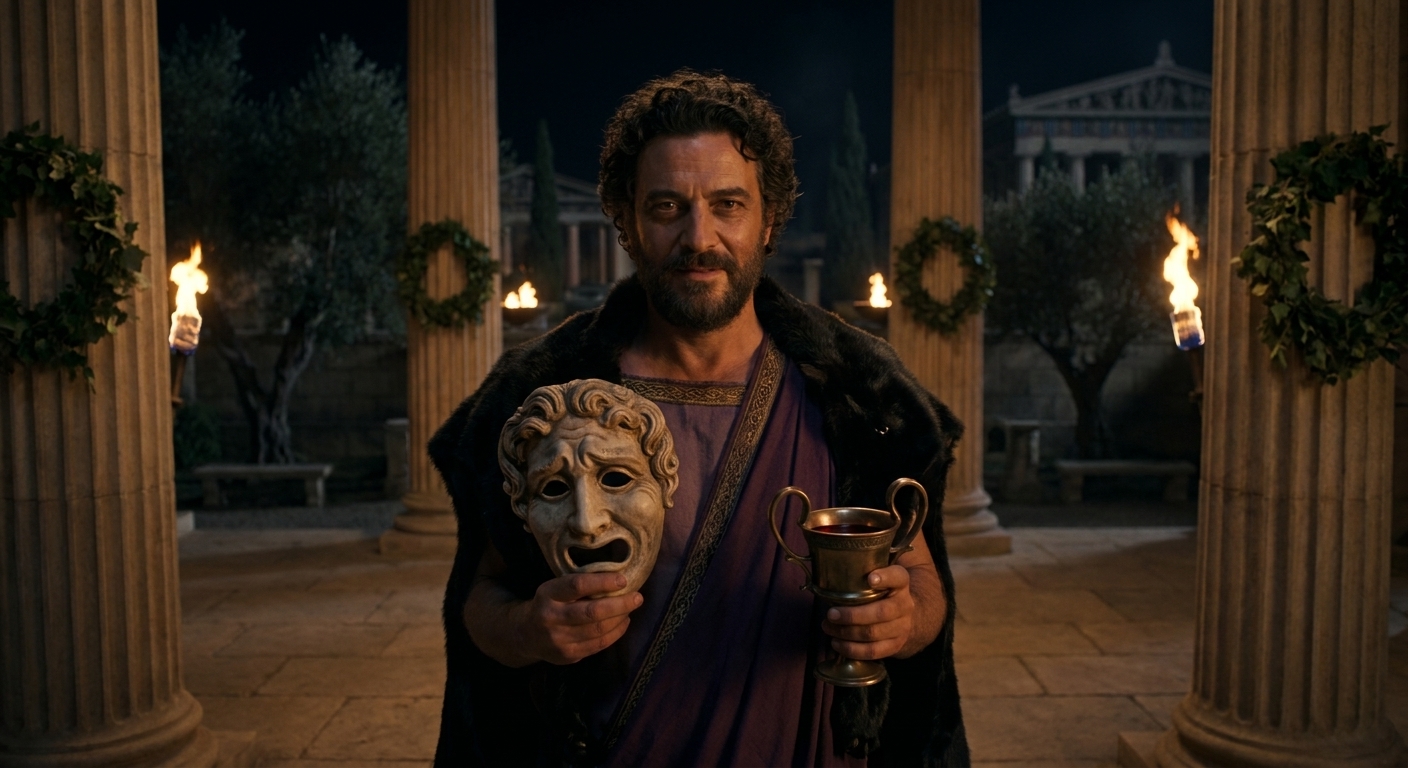
From the outside, it can look like chaos when Dionysus arrives. But there is an artful method to it. He reveals hidden layers of emotion and consciousness, pushing mortals to look beyond the masks they wear daily and ask what is underneath.
The thread that remains
Across these myths, disguise is never just a clever trick. It is a method of control, a way for the immortal to move without accountability, to turn a room, a doorstep, a city street into a test without informed consent.
And yet the stories also keep insisting on a stranger truth: the disguise reveals.
It reveals who will offer kindness when no reward is promised. It reveals who will speak boldly when silence would be safer. It reveals what happens when power is forced to look at itself.
The ancient world did not leave these tales sealed in amber. They keep leaking into modern language. Arachne lives on in the scientific classification of spiders, Arachnida. And Themis, goddess of divine law, still has her name invoked in modern legal contexts.
So yes, these are old myths. But they remain a knitted pattern of lessons, a reflection of human flaws and divine expectations. The loom, the threshold, the mask.
Different scenes. Same question.