Dionysus Myths: Wine, Madness, and Mortal Punishment
Greek Mythology
Dionysus is the god who arrives like a new season and ruins the old one.
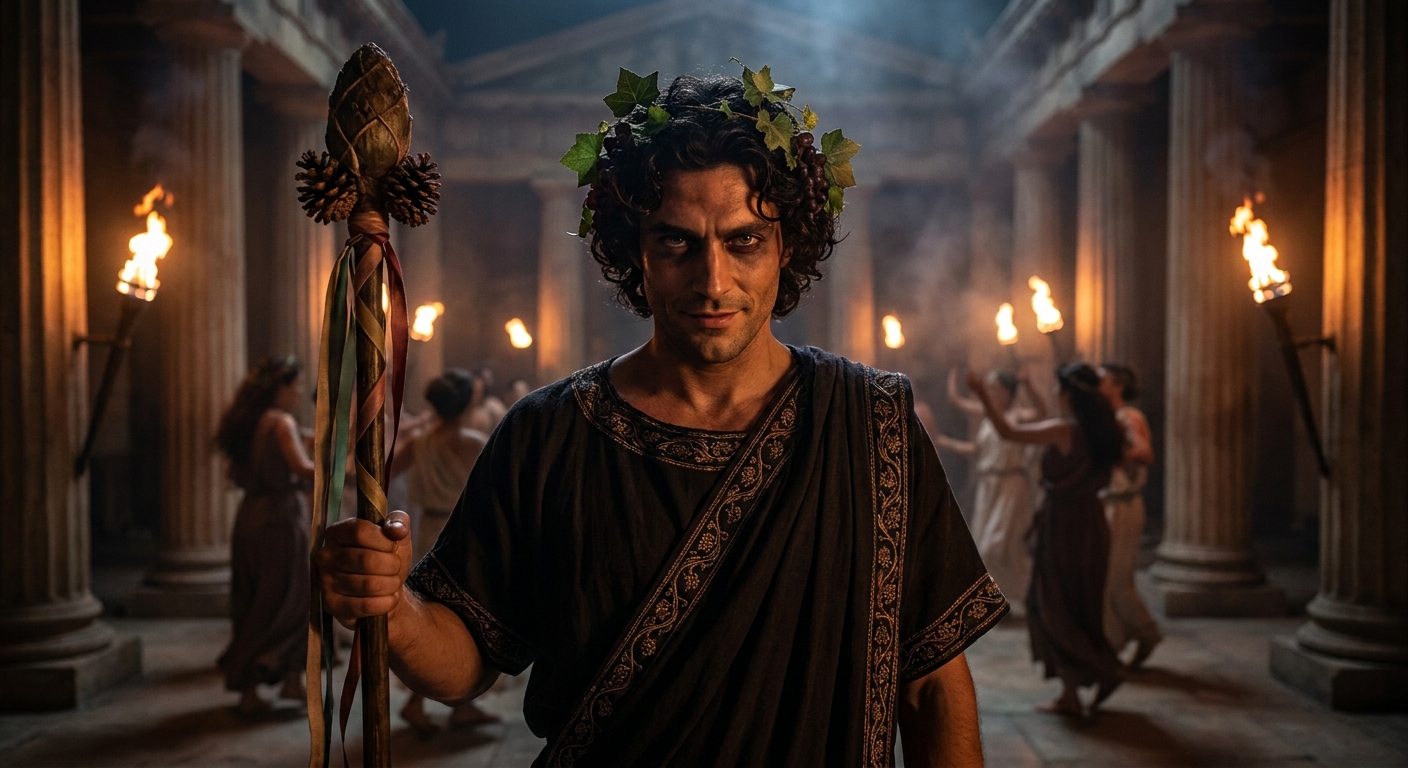
He comes in with ivy curling around marble columns, with wine dark as pomegranate seeds, with drums that sound like a heartbeat you forgot you had. And then the trouble begins. Because Dionysus is not merely a party. He is a theological scandal: a god of ecstasy and madness, of release and possession, of the city that pretends it is civilized and the mountain that never agreed to those terms.
In Greek myth, he is the boundary-dissolver. Where you want clean categories, he offers perfume and smoke. Where you want law, he offers trance. Where you want a mortal to stay mortal, he offers a vine that climbs straight into divinity.

The Twice-Born God
Dionysus begins with a contradiction, as if fate could not decide which world he belonged to.
His mother is Semele, daughter of Cadmus and Harmonia, a mortal princess of Thebes. His father is Zeus, who collects lovers the way storms collect ships. When Semele becomes pregnant, the story does what Greek stories do: it invites Hera to notice. And Hera, patron saint of righteous fury, does not miss a thing.
In the most familiar tradition, Hera convinces Semele to demand proof of Zeus’s identity. Zeus, bound by an oath, appears in divine splendor. Semele, being mortal, is not built for it.
The bargain is simple and fatal: ask to see a god as a god, and your human body becomes the offering.
Semele perishes in the blaze. Zeus salvages the unborn child, sewing him into his own thigh until the time is finished. Dionysus is born once from a mortal womb, and again from the body of Olympus itself. He is twice-born, stitched together from two realms that do not usually share blood.
That origin matters. Dionysus is a god who knows what it is to be vulnerable. He knows what it is to be hunted by jealousy, hidden away, smuggled past divine politics. When he punishes, it is not the distant cruelty of a thunderer. It is intimate. It is personal. It is the wrath of someone whose existence was questioned at birth.
Arrival and Recognition
Dionysus does not simply “have a cult.” He arrives. And the arrival is always the test.
Thebes becomes the model: a city that tries to treat a god like a rumor, and learns what rumors can do when they are divine. Myths and drama remember him as a god who comes from elsewhere, bringing unfamiliar rites, foreign music, and a kind of worship that looks suspiciously like losing control. Sometimes he is said to have wandered widely, even to the East, before returning to claim his place in Greece. Wherever he has been, he returns with something the city both wants and fears.
Because Dionysus offers a relief valve for the human soul. The polis demands order. The household demands obedience. The law demands a straight spine and a quiet mouth. Dionysus offers the opposite, and calls it sacred.
His worship often centers on the Bacchae, a name for his female followers in general, and on the maenads of myth, women who leave domestic space behind and climb into the wild places, where torches burn against pine and the night becomes a stage. In art and story, they carry the thyrsus, wear ivy and fawnskins, and move like a storm with faces that look blissful until you notice they are also dangerous.

Wine and the Threshold
Dionysus is the god of wine, yes, but wine in myth is never just a drink. It is an instrument for changing the mind.
In its gentler aspect, it is hospitality, laughter, song, and the sudden warmth of a symposium that turns strangers into friends. Wine is civilization’s polished ritual, poured into cups that gleam like bronze.
But Dionysus’s wine has another face. It can be ecstasy that becomes amnesia, celebration that becomes possession, liberation that becomes a tearing-away of restraint until the self is unrecognizable. The Greeks understood intoxication as a threshold. Dionysus is the god standing on it, smiling like he has always been there.
Pentheus in Thebes
If you want Dionysus at his most terrifying, you go to Thebes.
The story, most famous through Euripides’ Bacchae, turns on a mortal mistake: the belief that if something is disruptive, it must be illegitimate. Pentheus, king of Thebes, rejects Dionysus’s rites as moral contagion. He treats the god like a foreign instigator, a threat to public order. He tries to control the uncontrollable with chains and decrees.
Dionysus, in many tellings, arrives in Thebes in a disarming form: youthful, beautiful, scented with ritual, carrying the softness that makes rigid minds flinch. Pentheus sees only disorder, missing the older truth that softness can be a mask for power.
This is the turn Greek tragedy loves: the king thinks he is in charge, and the god lets him keep thinking that for just a little longer.
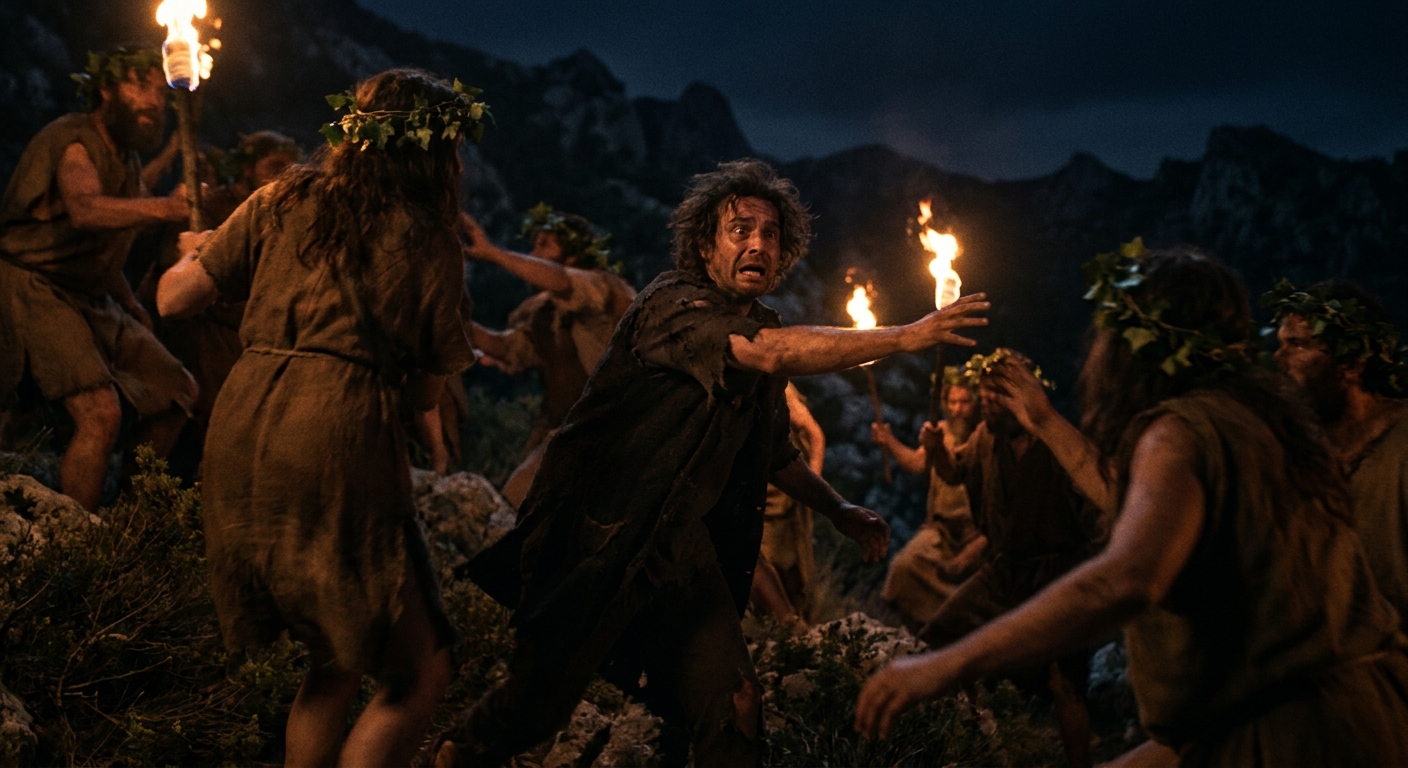
What follows is a masterpiece of divine reversal. Pentheus becomes obsessed with the very frenzy he condemns. He is lured toward spying on the maenads on Mount Cithaeron, toward watching what he insists he hates. In Euripides, Dionysus even persuades him to dress in women’s clothing, a humiliation and a revelation at once: the rigid king made pliable, the watcher becoming spectacle.
Then comes the punishment, and it is not clean. It is not heroic. It is dismemberment.
In the heights, the maenads are in a state of divine mania. They see Pentheus not as a man, not as their king, but as prey. He is torn apart by hands that should have been human, and the cruelest detail is the one mythology cannot resist: Agave, his own mother, is among them, carrying the aftermath as if it were a hunting trophy, until the trance breaks and reality returns like daylight’s bitterness.
Lycurgus and the Vine
Not every Dionysian punishment is wrapped in glamour and theatrical irony. Some are blunt, like an axe.
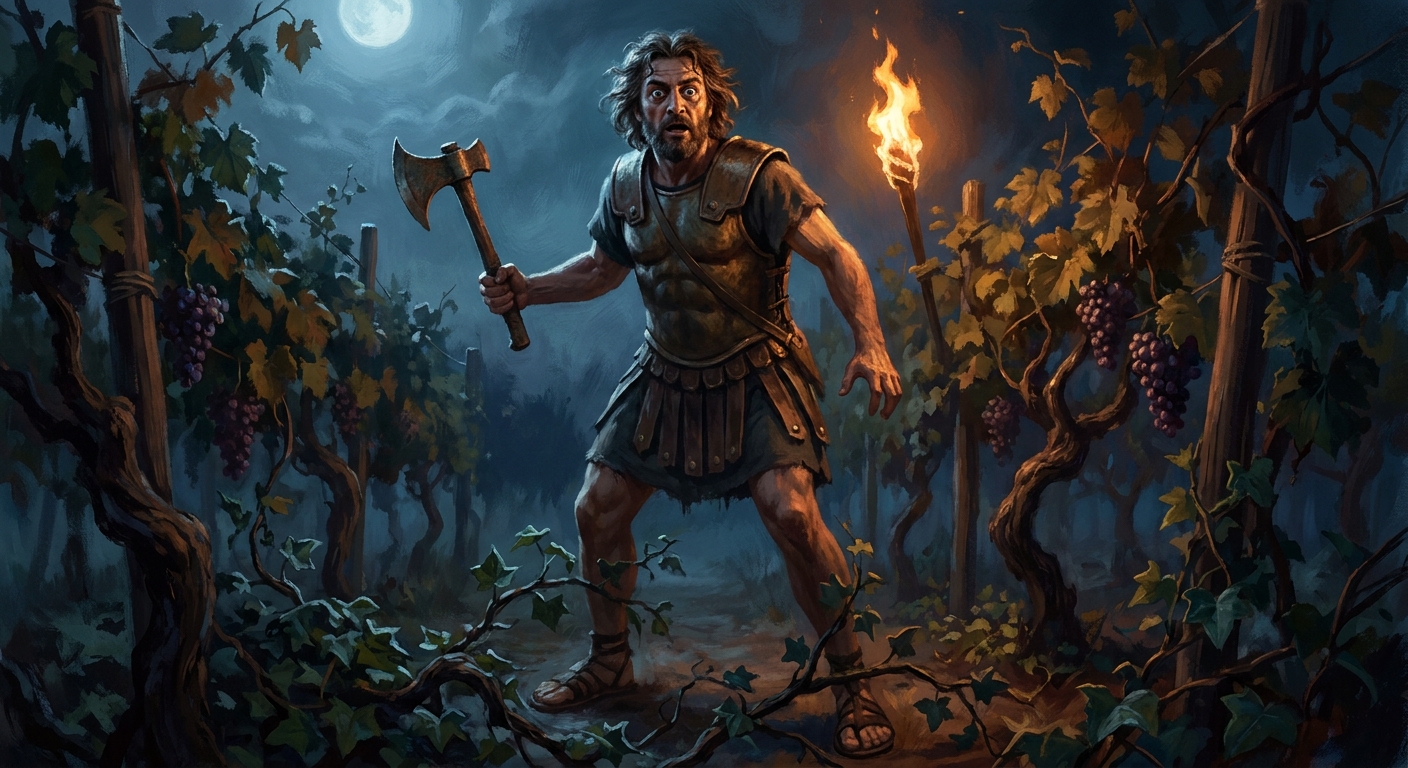
Lycurgus, a king associated with Thrace in several traditions, resists Dionysus with open violence. In Homer, he attacks the god’s nurses, scattering the holy company. Later tellings grow darker, adding flight, sea refuge, and ruined harvests. The sequence changes by source, but the moral stays steady: a mortal tries to beat back a god with force.
Greek myth does not reward the mortal who “wins” a round against Olympus. Lycurgus is struck with madness, and the madness is pointed. It makes a symbol out of him.
In some versions, he hacks at vines as if they were enemies. In others, he mistakes what is precious for what is hostile and destroys it, even cutting down his own son in the fog of frenzy. The boundary between protection and ruin collapses. The king becomes the threat he claimed to be preventing.
Dionysus does not always kill you directly. Sometimes he makes you unrecognizable to yourself, and lets your own hands finish the story.
The Maenads
The maenads are easy to flatten into a single idea. “Wild women.” “Drunk worshippers.” “A cautionary tale.” Greek myth is rarely that lazy.
Maenads, in story and cult imagination, represent a sanctioned rupture. They step outside the expected roles of wife, daughter, weaver of household order. They become something else for a night or a season. That “something else” can look like freedom, and it can look like threat, depending on who is doing the watching.
In myth, their strength becomes superhuman. They are said to soothe and nurse wild creatures, and in Euripides the mountain answers them with miraculous flows, milk and honey and wine where there should be stone. They can also tear apart living things in sparagmos, the rending that makes Pentheus’s end feel like a ritual gone feral. Dionysus gives them joy, and Dionysus gives them teeth.
For the Greeks, this was part of the point: the wild is not outside the city. The wild lives inside the city, inside the body, inside the mind that pretends it is purely rational. Dionysus does not create that wildness. He opens the door and insists you stop lying about what is already in the room.
Masks and Boundaries
Dionysus is often called the god of contradictions because he refuses the categories that make Olympian society feel manageable.
- Mortal and divine: born of a human mother, reborn from Zeus, he carries both fragility and supremacy.
- Civilized and wild: wine belongs to agriculture and craft, but also to delirium and loss.
- Mask and truth: he is tied to theater and disguise, yet he is also a god of brutal honesty, the kind that arrives when inhibition dies.
- Joy and punishment: he offers ecstasy that can heal, and he destroys those who meet him with contempt.
Even his iconography is a boundary-crossing dream: ivy on marble, leopard skin against temple smoke, a god who can look gentle right up until the moment you realize you have underestimated him.
And beyond the hillside rites, his name sits inside the city’s own ceremonies. The great festivals of drama were held for him, as if Athens itself admitted that the stage was a civic vessel for Dionysian force: masks, choruses, and the safe peril of watching the self come undone, then returning to daylight with the lesson still burning.
That is why Dionysus persists. Because he is not merely ancient religion. He is the mythic name for a human reality: the self that wants to be good, and the self that wants to be free, and the terrifying question of what happens when both selves demand to be fed.
The Lesson of Thebes
Greek myth does not ask you to approve of Dionysus. It asks you to recognize him.
Pentheus and Lycurgus are not punished for prudishness. They are punished for a deeper arrogance: the belief that reality is only what their laws can hold. Dionysus is the god who proves, with a smile as sharp as a sacrificial knife, that the world is larger than any city’s self-control.
If you want a single image to keep from these myths, let it be this: a cup of wine in lamplight, beautiful and ordinary, and behind it, just barely visible, ivy climbing the stone. The god is already here. The only question is whether you will welcome him, or challenge him, and discover what your mind does when it is pulled past its own borders.