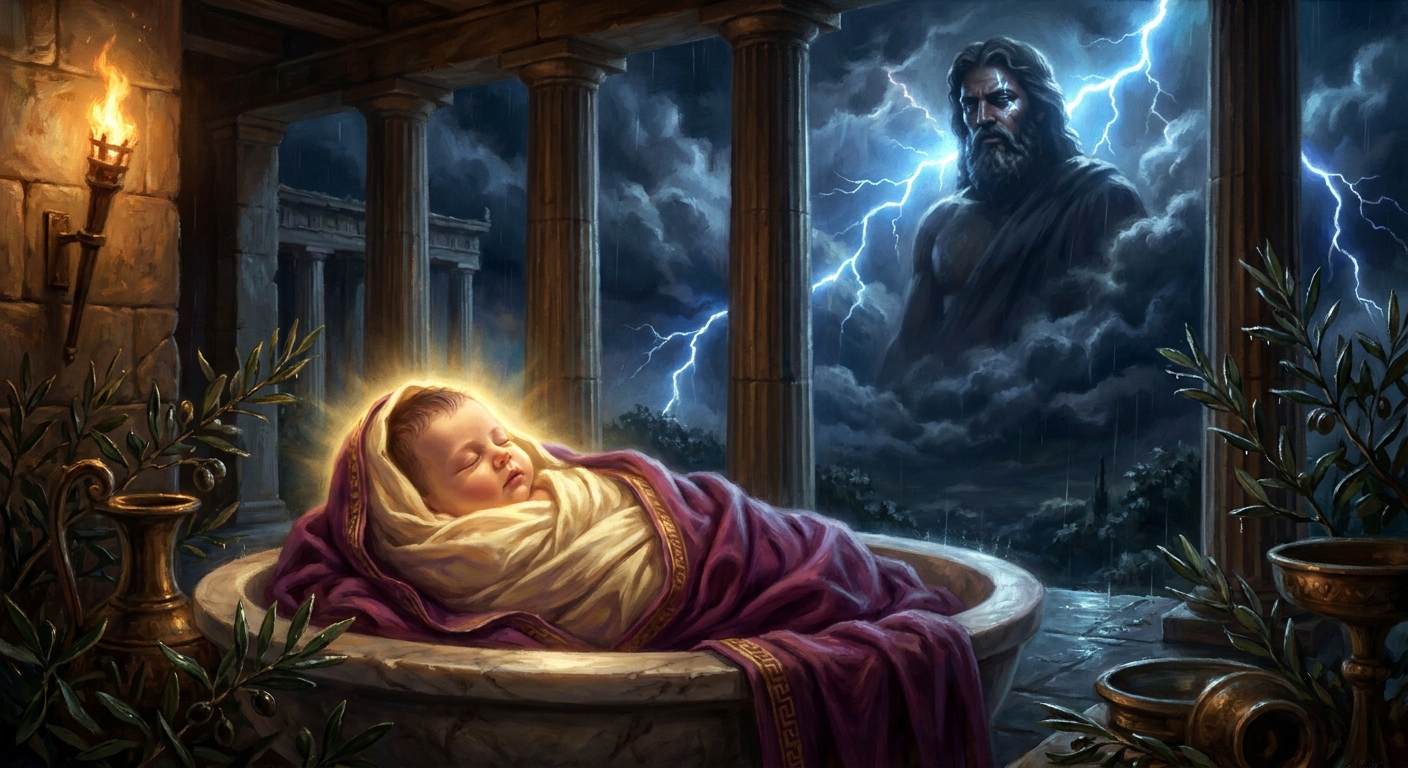
The Birth of Dionysus
Greek Mythology
Dionysus arrives in Greek myth the way he arrives in a city at midnight: not gently, not quietly, and not with anyone’s permission. His followers hail him as Liberator, a god of joy who loosens knots in the human chest. His enemies call him foreign, dangerous, contagious.
But before the ivy crown, before the wine-dark ecstasy and the theater masks, there is a birth story that reads like a divine crime scene. A mortal woman charred into legend. An unborn god stitched into Zeus. A secret childhood on Nysa. And Hera, circling the whole thing like a storm that refuses to spend itself.

Semele and the love that invited lightning
His first mother is Semele, a Theban princess. Not a nymph, not a goddess, not one of those convenient immortal romances Olympus prefers. A mortal. Which in Greek mythology means she is brave in the way candles are brave.
Zeus comes to her in secret, the king of gods practicing his favorite art form: vows. Semele becomes pregnant, and the world tilts just slightly because a mortal womb is carrying something that does not belong to mortality.
And then, inevitably, Hera notices.
In the most famous version of the tale, Hera does not strike immediately. She does something colder. She whispers doubt. Disguised, she plants a question in Semele’s mind that sounds, at first, like self-respect.
A mortal asked for proof of a god. Olympus answered the way it always does: with consequences.
Semele demands that Zeus show himself as he truly is. Zeus, trapped by his own divine oath, complies. The result is not romance. It is revelation as violence. Semele is consumed by Zeus’s lightning, destroyed by the unbearable radiance of a god unveiled.
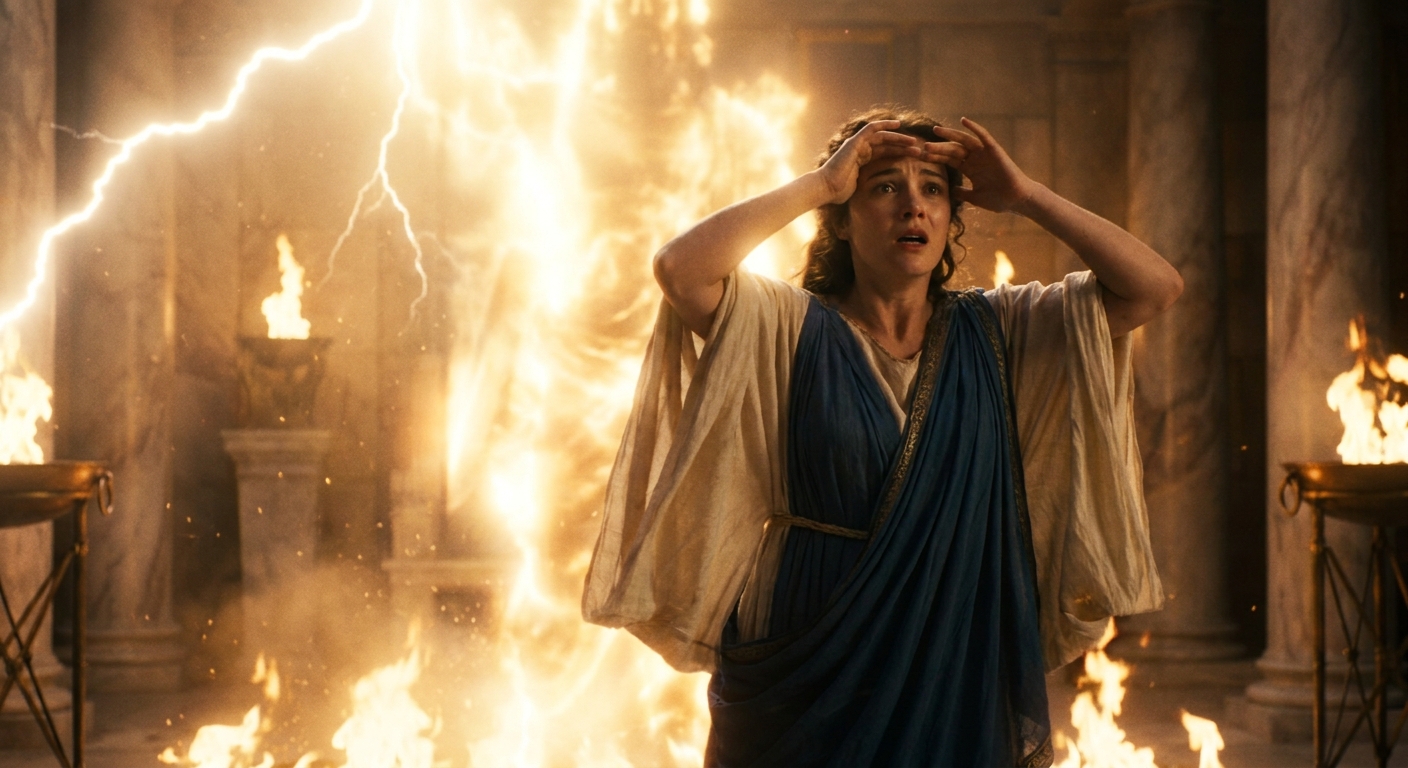
The stitched pregnancy
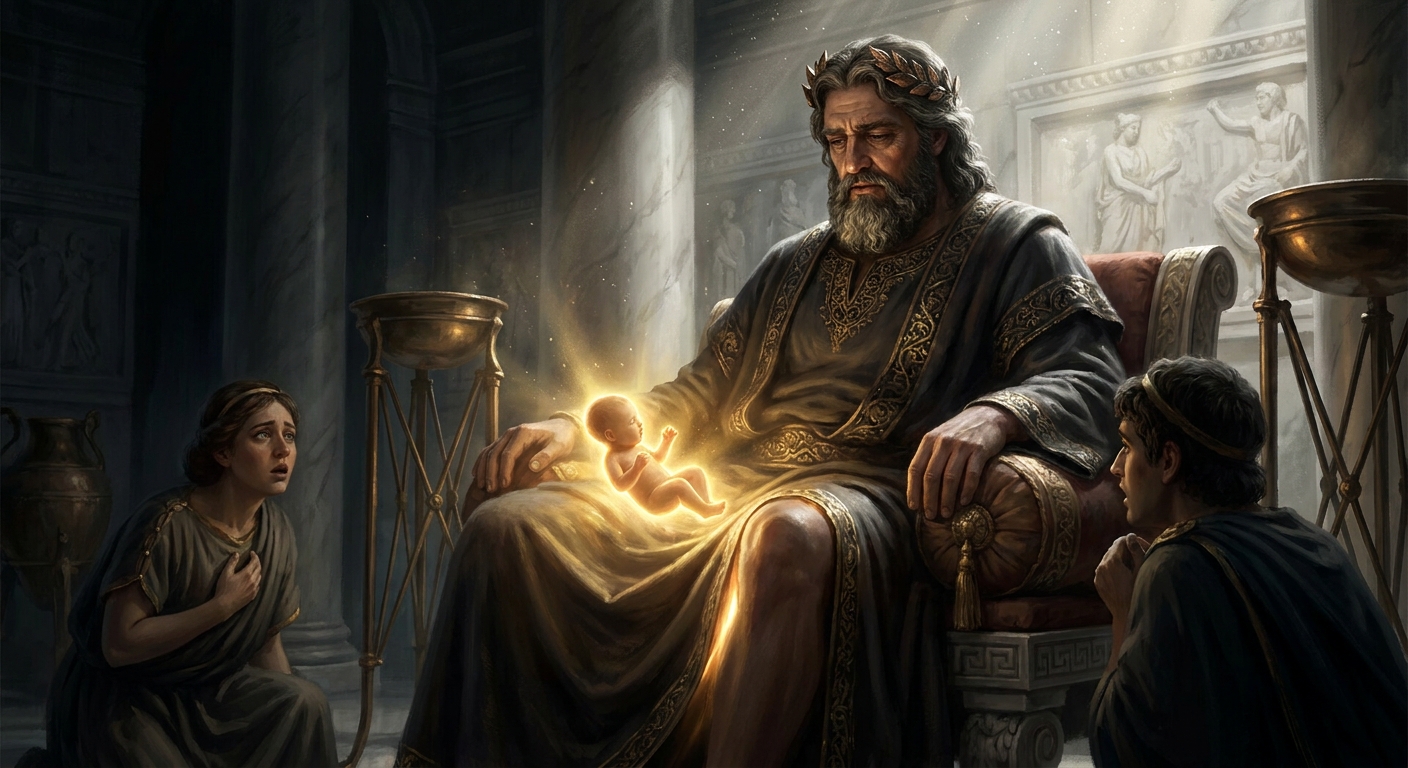
Semele dies, but the pregnancy does not simply vanish into smoke. Zeus, in a rare moment that reads as both tenderness and panic, rescues the unborn child from the burning body.
He does not hand the infant to a goddess or hide him in a temple. He does something stranger, older, and unmistakably symbolic. Zeus sews the fetus into his own thigh, carrying the child to term himself.
When the time comes, Dionysus is born again, not from a womb but from a wound, emerging from the place where Zeus turned flesh into cradle and scar into nursery. This is why the god is called twice-born. Dionysus is not merely delivered. He is reconstructed.
Nysa and the hidden boy
Even a second birth does not make the child safe. Hera’s anger does not end with Semele’s ashes. If anything, it sharpens. A new god has entered the world through Zeus’s infidelity, and Hera is not known for letting such things become permanent.
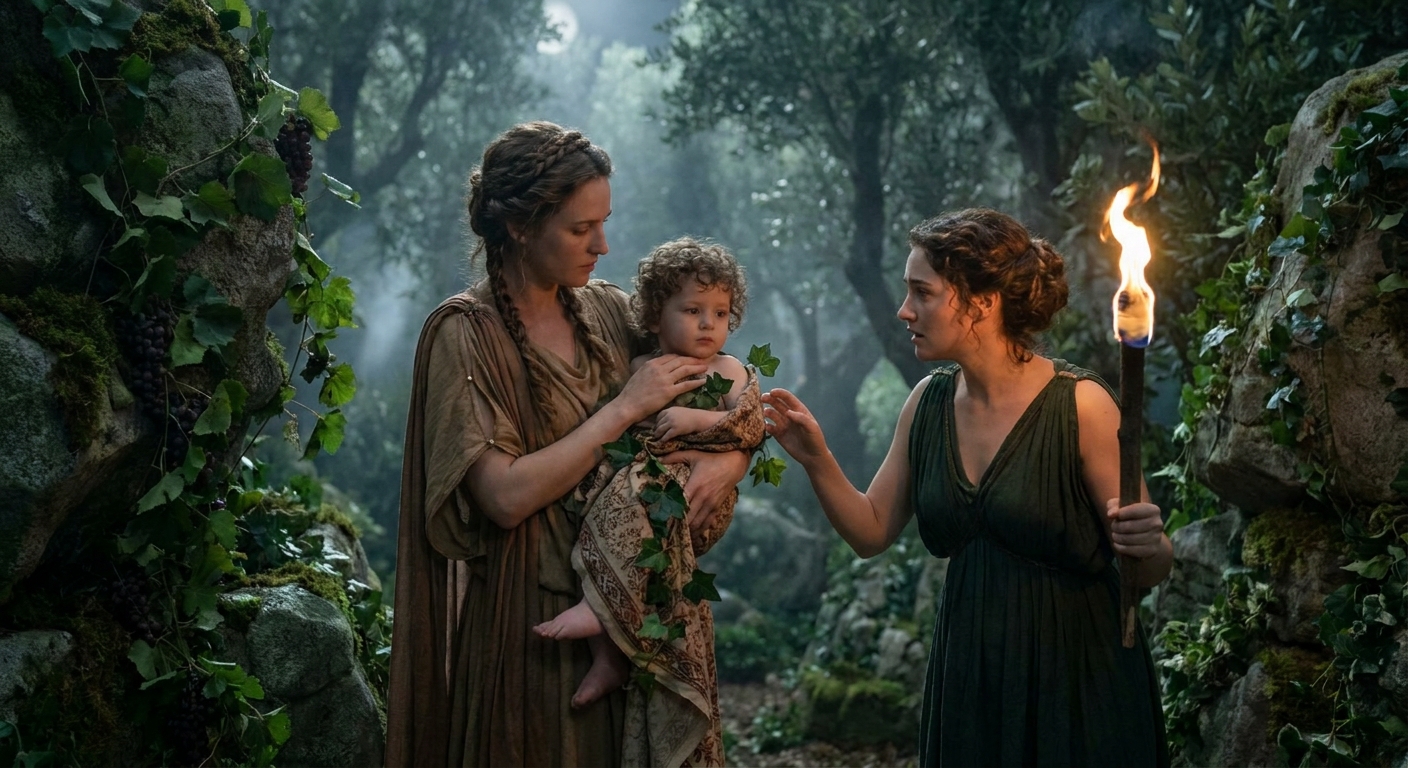
So Dionysus is hidden. Ancient sources place him on Nysa, a mythic mountain or remote land that floats through geography like a rumor. The important detail is not the map. It is the mood: green secrecy, dripping springs, and a sense that the air itself is sworn to silence.
There, nymphs raise him, sometimes guided or protected by figures like Hermes in broader Dionysian tradition. The nymphs are not warrior goddesses. They are caretakers of wild places, and Greek myth loves to test the gentle ones first.
To raise Dionysus was to invite Hera to your doorstep and hope the forest could lock its doors.
In some tellings, Dionysus is disguised as a girl to evade Hera’s gaze. In others, the protection is more magical, more frantic. Either way, the point remains: his childhood is not a childhood. It is an escape.
Hera’s pursuit
Hera’s role in this myth is not a quick flare of jealousy. It is a long campaign. Greek mythology often frames her rage as marital vengeance, but the emotional texture is broader: the defense of status, the punishment of rival lines, the grim insistence that Zeus’s appetites should leave scars.
And Dionysus, unfortunately, is a scar that walks.
Later Dionysian myths are crowded with the aftershocks of this beginning: persecution, exile, and a god who repeatedly arrives in new places only to be rejected, doubted, or attacked. His worship spreads like vine growth through stone, and resistance follows like frost.
This is part of Dionysus’s peculiar charisma. He is an Olympian, yet his origin is soaked in human fragility. He knows what it is to be unwanted by power. He knows what it is to survive anyway.
Death, return, and the second birth
The strangest claim in the Dionysus origin story is also the most revealing, at least in the way the story feels when told aloud beside temple smoke and torchlight. His beginning is shaped like a death-and-return before he is fully born.
Here is the logic, mythic rather than medical. Dionysus’s first gestation ends in catastrophe. When Semele is destroyed, the unborn god is caught in the same lethal event. What should have been a single clean origin becomes a split narrative: death, then recovery, then second birth.
Zeus’s stitched thigh functions, metaphorically, like a temporary afterlife and a second womb at once. In mythic terms, it is a threshold: the place where a being that should have ended is carried back into continuation. Dionysus does not climb out of Hades in this scene, but he crosses a boundary that mirrors the Underworld’s logic.
Other traditions tell different beginnings, and some are darker. In Orphic stories, Dionysus appears in an earlier form and is torn apart, only to be restored. Even when the genealogy shifts, the pattern remains: a god who will not stay ended.
That is why his later myths so often orbit death and return. Dionysus becomes the god of theater where people die and resurrect nightly on stage, and in later traditions a figure who can move between worlds with unnerving ease. His beginning teaches his nature: he is the god of after.
Born once is biology. Born twice is destiny. Dionysus begins as a rescue and ends as a promise.
Why he is called Twice-Born
When ancient worshippers called him Dimetor, “of two mothers,” they were not tidying up a genealogy. They were admitting that Dionysus refuses simple categories.
- Semele gives him the mortal beginning, the vulnerability, the human stake in suffering.
- Zeus gives him the divine legitimacy, the immortal body, the Olympian seat he will eventually claim.
- Hera gives him the persecution that shapes him into a god of outsiders, wanderers, and those who survive what should have ended them.
And somewhere on Nysa, among vines and hidden springs, the nymphs give him one final gift: the knowledge that joy is not innocence. It is hard-won. It is protected. It is sometimes feral.
Dionysus does not arrive in myth as a neat newborn wrapped in clean linen. He arrives as a god stitched together by catastrophe, raised in secrecy, and pursued by a queen of heaven who never forgets a betrayal.
Which is exactly why, when he finally steps into the world crowned in ivy, he feels less like a party and more like a reckoning.