
Hermes Myths: Trickster, Messenger, and Guide of Souls
Greek Mythology
Hermes never enters a story the way other gods do. Zeus arrives like a verdict. Poseidon arrives like weather. Aphrodite arrives like a problem. Hermes arrives like a door left ajar.
He is the Olympian of thresholds, the patron of movement, the slippery negotiator between realms. In myth he is at once trickster, messenger, and guide of souls. Which is to say, he is the god who knows how to get in, get out, and leave you wondering whether you were outplayed or rescued.

Who Hermes is, in myth
Hermes is the son of Zeus and the nymph Maia, born in a cave on Mount Cyllene in Arcadia. From the beginning, his mythology treats him like an adult mind in an infant body. He is not raised into power. He improvises it.
His domains sprawl across anything that moves, trades, or crosses a line: roads and travelers, merchants and thieves, language and persuasion, athletic contests, herds and luck. He is also one of the few gods whose job description includes death, not as a ruler like Hades, but as an escort. He does not judge. He guides.
The newborn thief: Hermes steals Apollo’s cattle
Hermes’ first headline is basically impossible: on the day he is born, he slips away from Maia, wanders into the world, and steals a herd of cattle belonging to Apollo. Not because he is hungry. Because he wants status. Because he wants a story that forces the gods to notice him.
He is careful in a way that feels modern and unnerving. He drives the cattle backward to confuse tracks. He invents clever sandals to mask his footprints. Then, in a second act of audacity, he returns to his cradle and pretends to be an innocent baby. It is divine theater.
Apollo, radiant and furious, drags Hermes before Zeus. And Hermes does not crumble. He performs innocence with such charm that even the king of gods has to work not to laugh.
Hermes does not win by strength. He wins by making the courtroom feel like his stage.
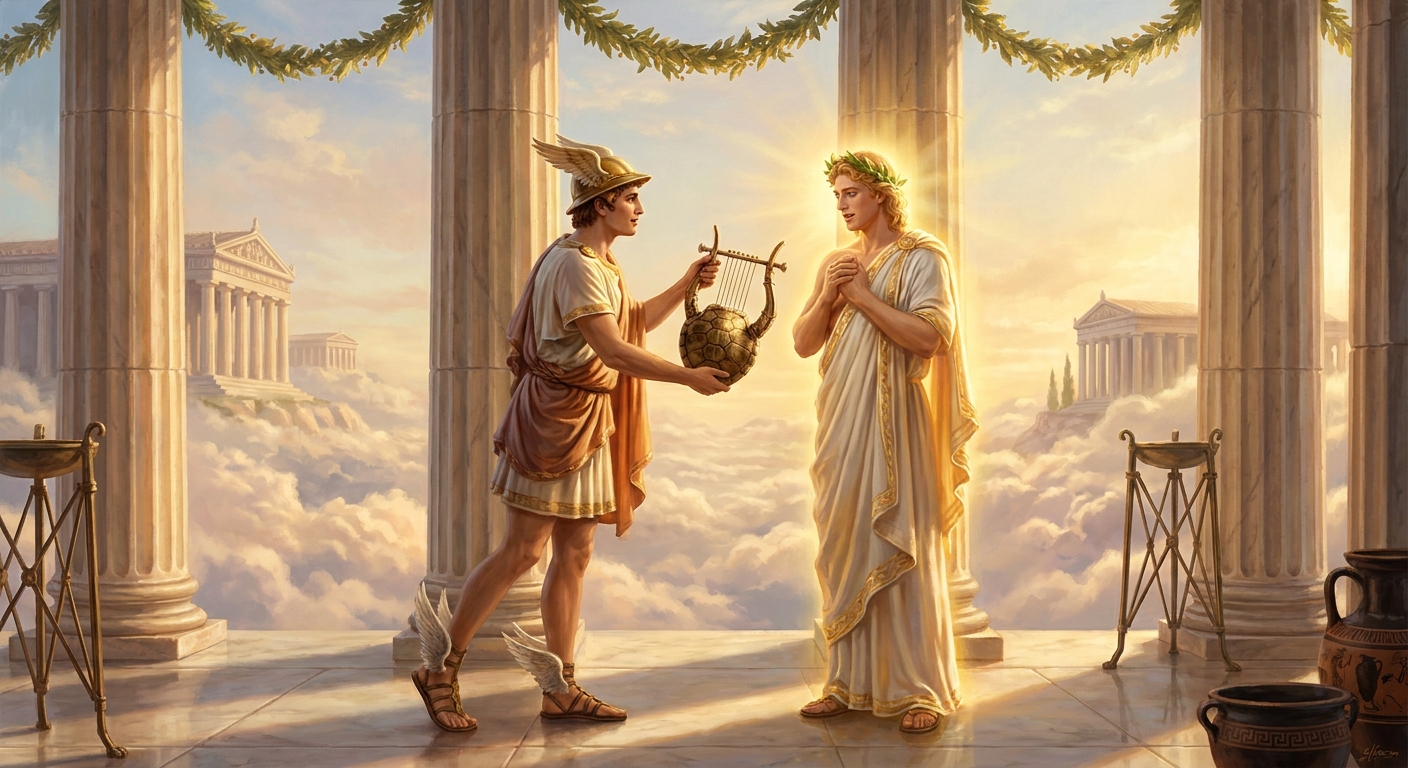
The resolution is not punishment but a bargain. Hermes returns the cattle, and in exchange he offers Apollo something astonishing: the lyre, an instrument Hermes fashioned from a tortoise shell. Apollo, god of music, falls in love with it instantly. The theft becomes a transaction, and the transaction becomes a bond.
Messenger of Zeus: the god who delivers the unbearable
Hermes is Zeus’ preferred messenger for a reason. He can move between divine and mortal spaces without making the air crackle with threat. He can carry commands that would destroy a human throat if spoken by Zeus directly.
His messenger role is not only about speed. It is about diplomacy. Hermes knows how to speak in a way that keeps a fragile situation from snapping.
Hermes and the politics of Olympus
- He negotiates, often smoothing conflicts between stronger gods who are used to getting their way by force.
- He translates, not merely language but intent, turning divine command into something mortals can actually act on.
- He deceives when necessary, because Olympus is not built on transparency. It is built on outcomes.
Hermes the rescuer: freeing Ares from the jar
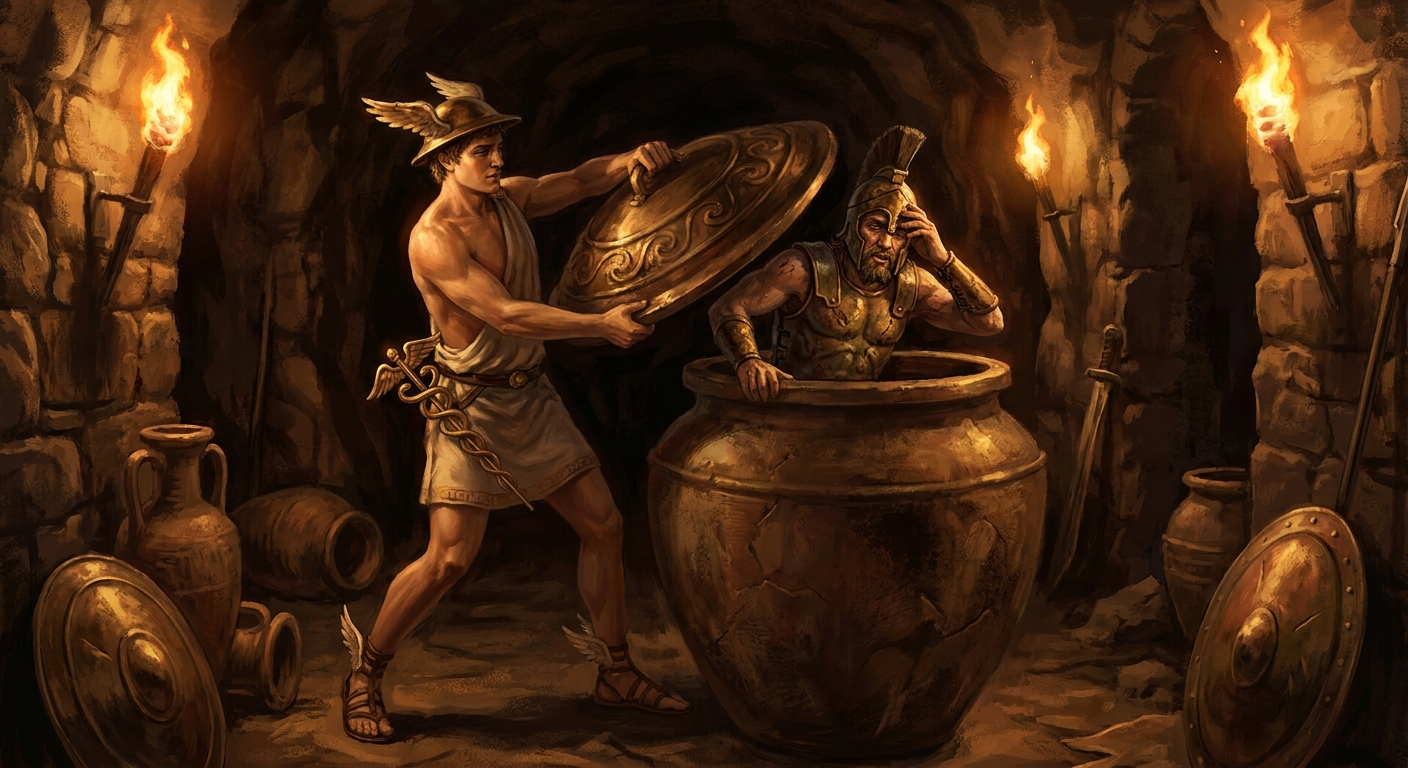
One of Hermes’ most satisfying myths is also one of Olympus’ most humiliating episodes. The giant brothers Otus and Ephialtes, the Aloadae, capture Ares and imprison him in a bronze jar. The war god, all noise and swagger, is reduced to a rattling secret hidden in the dark.
It is Hermes who untangles the mess. Not by storming a fortress, but by slipping into the situation the way smoke slips under a door. He frees Ares, because that is what Hermes does best: he moves through locks, oaths, and traps like they are ideas, not walls.
Argus and the terrible lullaby: Hermes kills the many-eyed watcher
When Zeus’ affair with Io erupts into the usual marital catastrophe, Hera assigns the giant Argus Panoptes, the many-eyed guardian, to watch Io, who has been transformed into a heifer. Argus is vigilance made flesh. He does not need to sleep the way other beings do.
So Zeus sends Hermes. Not as a soldier, but as a storyteller. Hermes approaches Argus with music and conversation, weaving words until even a creature of constant seeing begins to blur at the edges of wakefulness. When the last eyes finally close, Hermes kills him and frees Io.
Ancient sources tell the episode with different emphases. Sometimes Hermes is a soothing shepherd figure. Sometimes the act is brisk, almost clinical. Either way, the myth reveals his signature talent: Hermes defeats force with softness, and softness is not the same as mercy.
In Hermes’ hands, a song can be a key, a weapon, and an alibi.

Guide of souls: Hermes Psychopompos
If you want to understand Hermes at his most haunting, look past the clever thefts and sparkling errands. Look at his epithet Psychopompos, the Guide of Souls.
In Greek myth, the journey to the Underworld is not only geographic. It is emotional. A severing. Hermes is the god who makes that severing possible. He leads the newly dead from the bright world into the shadows, not as a captor but as an escort. A professional. A figure of ritual necessity.
Hermes in the Underworld stories
- He escorts souls to the borders of Hades, delivering them to the next stage of the dead’s journey.
- He moves between worlds with an ease that most gods do not have, making him a bridge between Olympus, earth, and the realm below.
- He appears at endings, which is why he feels so strangely present in myths that are otherwise about heroes.

Hermes in the Odyssey: the antidote to enchantment
Hermes is not always the center of a myth. Sometimes he is the decisive interruption.
In Homer’s Odyssey, when Circe turns Odysseus’ men into swine, it is Hermes who meets Odysseus on the road and provides the herb moly, a divine protection against her spell. The moment is brief, almost casual, and that is exactly the point. Hermes does not linger for applause. He delivers the difference between doom and survival and then steps back into the margins.
He also gives Odysseus instructions. Not a prophecy, not a moral lesson, but tactics. Hermes is the god of practical magic, the kind that works because it understands how traps are built.

Why Hermes feels so modern
Hermes is ancient, but he does not feel dusty. He feels like an enduring human appetite wearing divine skin.
- He is mobility: the road, the errand, the escape route, the shortcut that is also a moral question.
- He is language: persuasion, rhetoric, the ability to make a room tilt your way.
- He is ambiguity: protector of travelers and patron of thieves, helper of heroes and instrument of Zeus’ messiest orders.
Hermes myths rarely ask you to choose whether he is good or bad. They ask whether you understand what he is for. He is the god you pray to when you need passage, access, safe return, and sometimes a little plausible deniability.
Quick myth map: Hermes’ most famous stories
Hermes myths at a glance
If you only remember a handful, remember these. They show all his faces without turning him into a simple mascot.
- The cattle theft and the lyre: Hermes invents mischief, then invents art, then invents a treaty with Apollo.
- Argus Panoptes: Hermes frees Io by weaponizing gentleness, music, and sleep.
- Ares in the jar: Hermes rescues a stronger god through stealth and timing.
- Odysseus and moly: Hermes provides a divine counterspell and tactical advice against Circe.
- Hermes Psychopompos: Hermes escorts souls, proving that crossings are his true kingdom.
Hermes is the god of the in-between, and Greek myth is obsessed with in-between spaces: shorelines, crossroads, doorways, the moment before a choice becomes irreversible. No wonder he keeps showing up. He is what happens when a world built on fate still leaves room for improvisation.