Rhea Myths: Mother of Gods and the Stone That Fooled Cronus
Greek Mythology
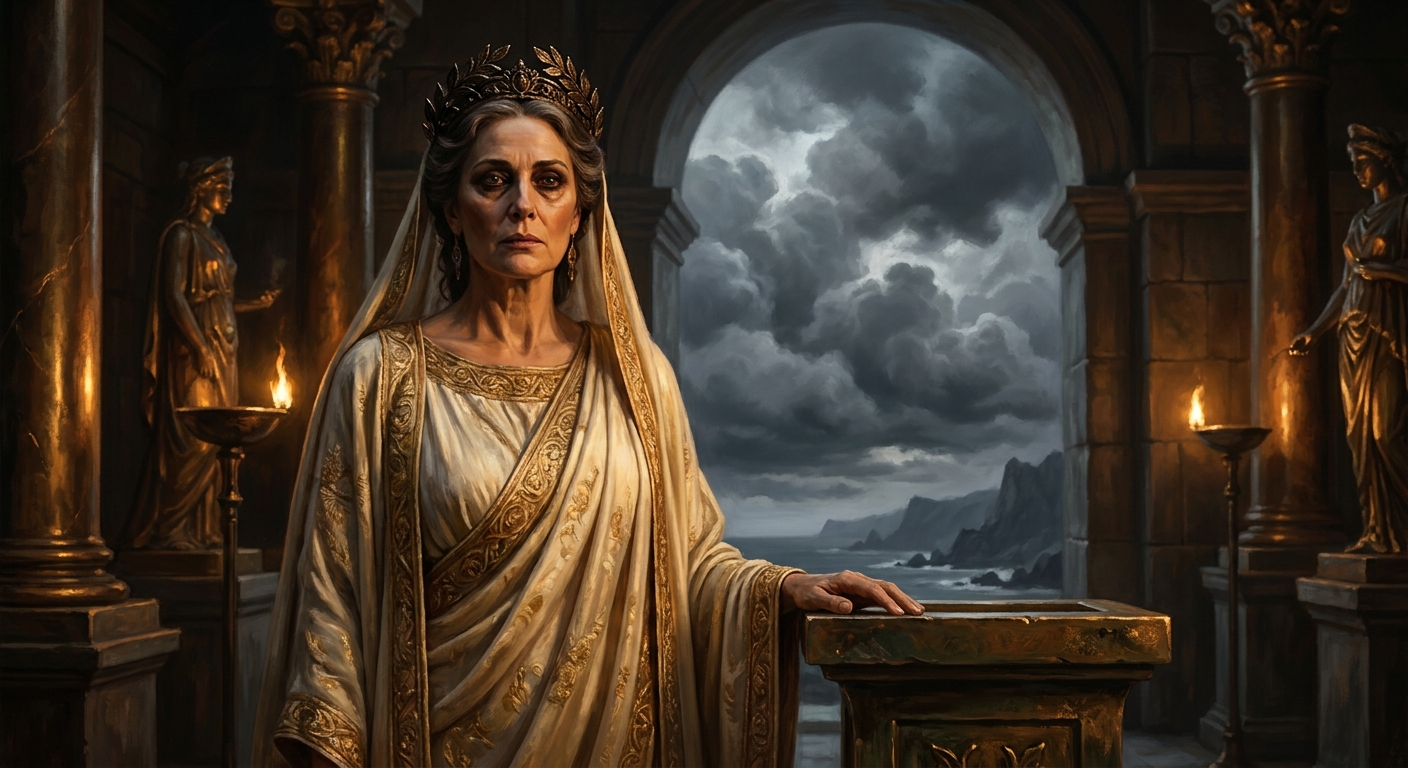
Rhea should have been a quiet goddess. A matron. A serene figure carved in marble, forever seated, forever blessing, forever asked to smile while the thunder-bearers take credit for the universe.
Instead, Greek myth gives her something sharper.
Rhea is a Titaness of origins, a queen in the age before Olympus, and the mother of the gods who had to become a liar, a planner, and a conspirator to keep her children alive. If Zeus is the great victor of the cosmos, then Rhea is the reason the victory exists at all.

The Great Mother
Rhea belongs to the first, heavy layer of Greek myth, where creation is not gentle. She is one of the Titans, child of Gaia (Earth) and Ouranos (Sky), sister to figures like Oceanus, Mnemosyne, and, most fatefully, Cronus.
And this is the tone of the myth from the beginning: family is not a refuge, it is a battlefield with genealogy.
In Hesiod’s Theogony, Cronus rises by overthrowing his father Ouranos. It is a revolution, yes, but also an omen. In Greek mythology, a son rarely topples a father without the story demanding an echo later.
In the first dynasty of the gods, power changes hands the way a blade changes hands: through fear, blood, and prophecy.
Rhea and Cronus
Rhea becomes Cronus’s partner and queen during the Titan age, a time later Greeks imagined as vast and ancient, a golden haze with iron underneath. Their union produces the earliest Olympians: Hestia, Demeter, Hera, Hades, Poseidon, and Zeus.
But Cronus does not receive fatherhood as blessing. He receives it as a threat.
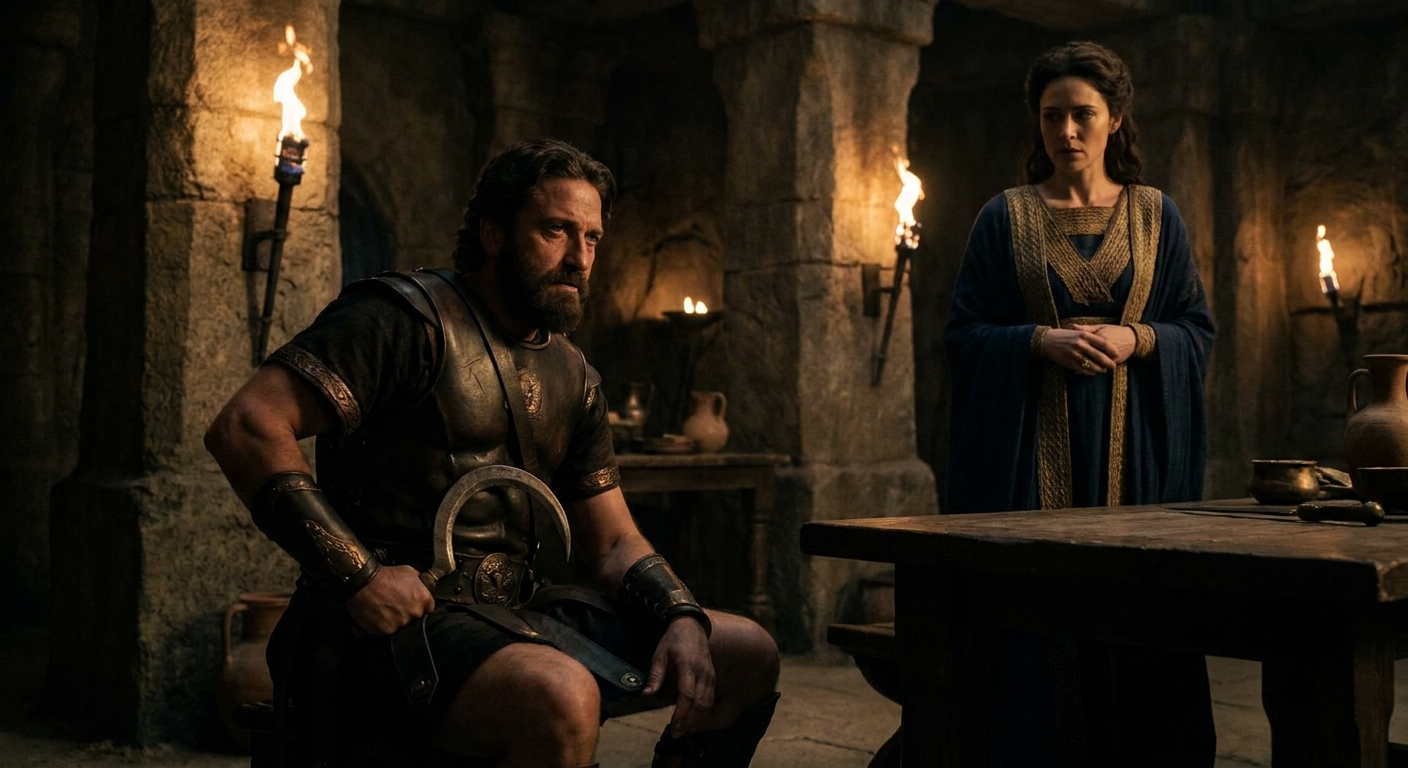
A prophecy hangs over him: he, too, will be overthrown by his own child. And because Cronus is a Titan king shaped by violence and paranoia, he does what Greek myth often lets tyrants do. He tries to outwit time itself.
The swallowed children
One by one, as Rhea gives birth, Cronus takes the infants and swallows them.
It is one of the most unforgettable images in Greek myth: not a war, not a storm, not a monster, but a father devouring the future. The gods are not killed, exactly. They are imprisoned in the living dark of his body, suspended inside the king who fears them.
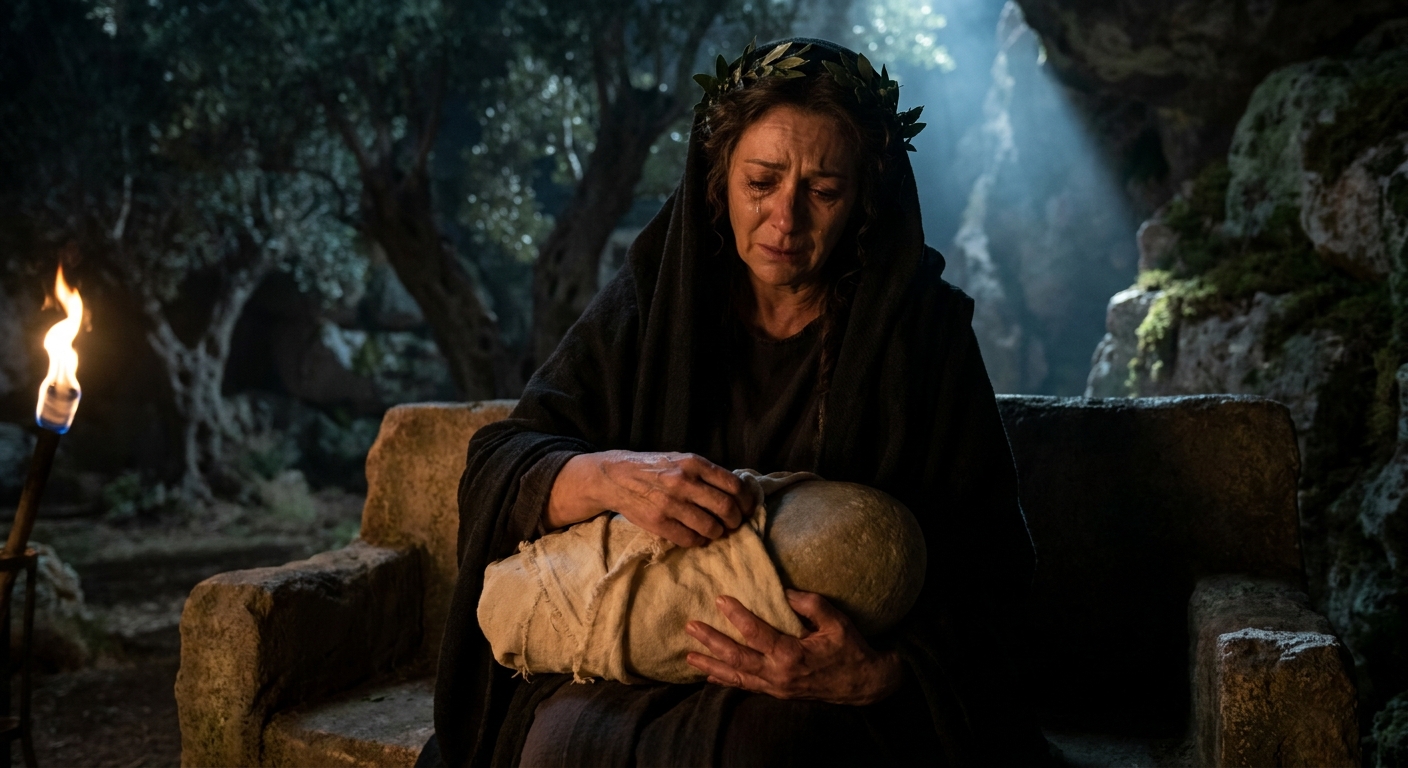
Rhea’s grief is not described with modern softness in the ancient sources, but it does not need to be. The action alone is a scream. To bear children destined for divinity, only to watch them disappear into the mouth of their own father, is a cruelty that makes even Olympus feel cold.
The stone trick
By the time Rhea is pregnant with Zeus, the pattern is established. Cronus will do it again. The myth could have ended there, sealed shut in a Titan stomach.
Instead, Rhea decides to deceive a god.
In Hesiod and later retellings, she turns for counsel to her parents, Gaia and Ouranos, who help devise the plan. When Zeus is born, Rhea hides the child away and presents Cronus with a substitution: a stone wrapped in swaddling cloth. Cronus, eager and blind with dread, swallows the bundle whole.
A king who fears his heir will eat anything that resembles the future.
That stone is not a throwaway prop. It becomes a sacred object with a long afterlife. Later Greeks pointed to a stone shown at Delphi, identified with the omphalos, as a kind of cosmic receipt: proof that tyranny can be tricked, and that the universe has a sense of bitter humor.
Zeus on Crete
Where does a goddess hide a child from a Titan king who can shake the world?
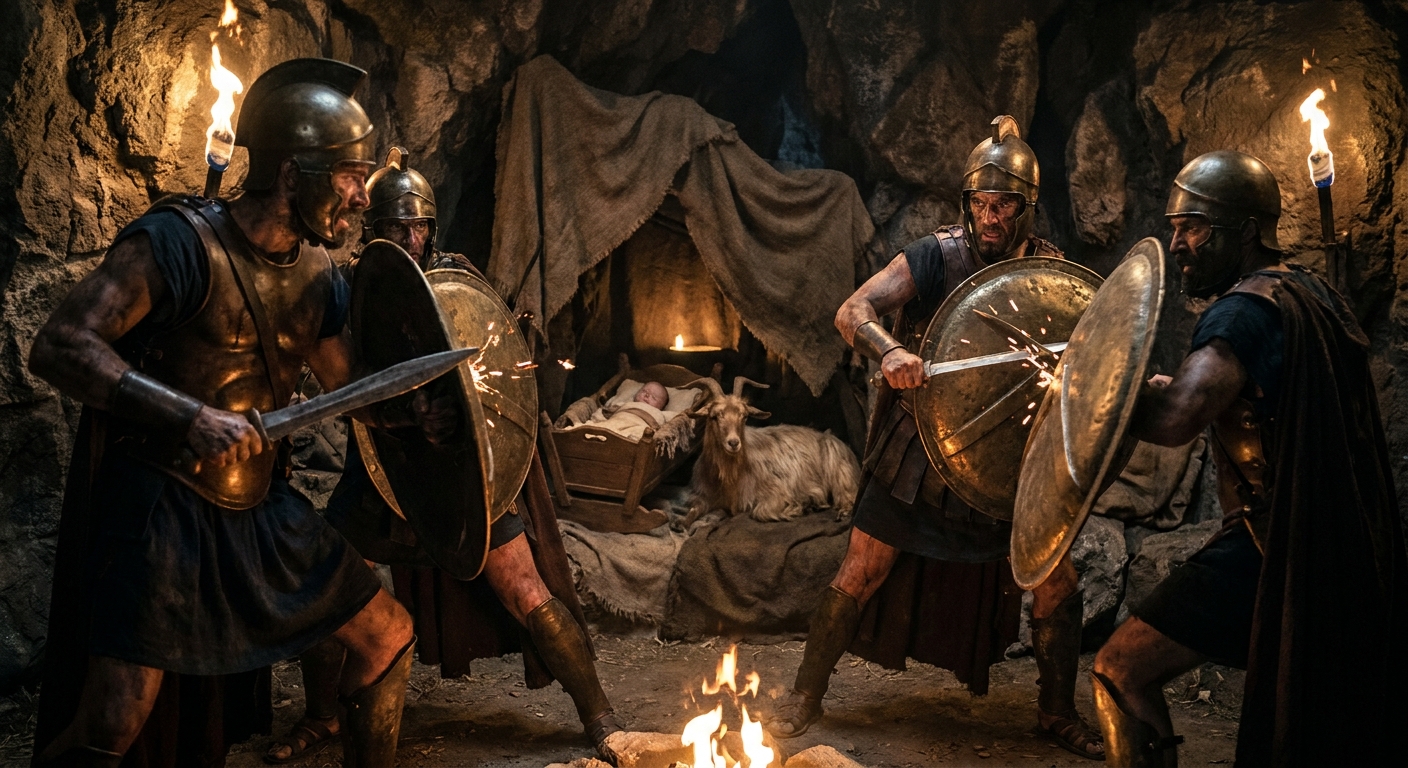
In the Cretan version of the myth, Rhea brings Zeus to Crete and tucks him into the island’s secret geography: caves, cliffs, and sacred hollows that smell of wet stone and ancient earth. Different traditions name different caves, but the emotional truth remains the same. Zeus survives because the world itself becomes his cradle.
He is raised in concealment, nourished in ways that feel half pastoral and half divine. Some say he was nursed by the goat (or goat-nymph) Amalthea. Others place him with nymphs like Adrasteia and Ida.
And then there are the Curetes, the armed dancers who clash weapons and stamp their feet to drown out the baby’s cries, turning a potential giveaway into ritual thunder. Some later sources use the name Corybantes for a similar armed-dance motif, more at home in the ecstatic rites linked with Rhea and Cybele, but the pulse of the scene is the same: bronze noise as protection.
It is one of the strangest and most cinematic inversions in the mythology: noise as a lullaby, a war-dance performed to protect a child from being found.
The return
Zeus does not remain hidden forever. Greek myth loves the moment when the child becomes a force and returns to the house that tried to erase him.
In the best known tradition, Zeus eventually compels Cronus to vomit up the children he swallowed, reversing the horror. The mechanism varies across tellings. In some accounts, Metis provides an emetic, a clever medicine that turns Cronus against his own secrecy. However it happens, the image is clear: the future forces itself out of the past.
Then comes the Titanomachy, the war between the Titans and the rising Olympians. The details vary across poets and later mythographers, but the direction of the story does not: Zeus gathers allies, the old order fractures, and the cosmos changes rulers.
After the war
Rhea’s postwar presence is less standardized than Zeus’s thunder or Poseidon’s sea. She is not the kind of goddess with a single, clean portfolio. She drifts through Greek religion and later Greco-Roman imagination as an ancient maternal force.
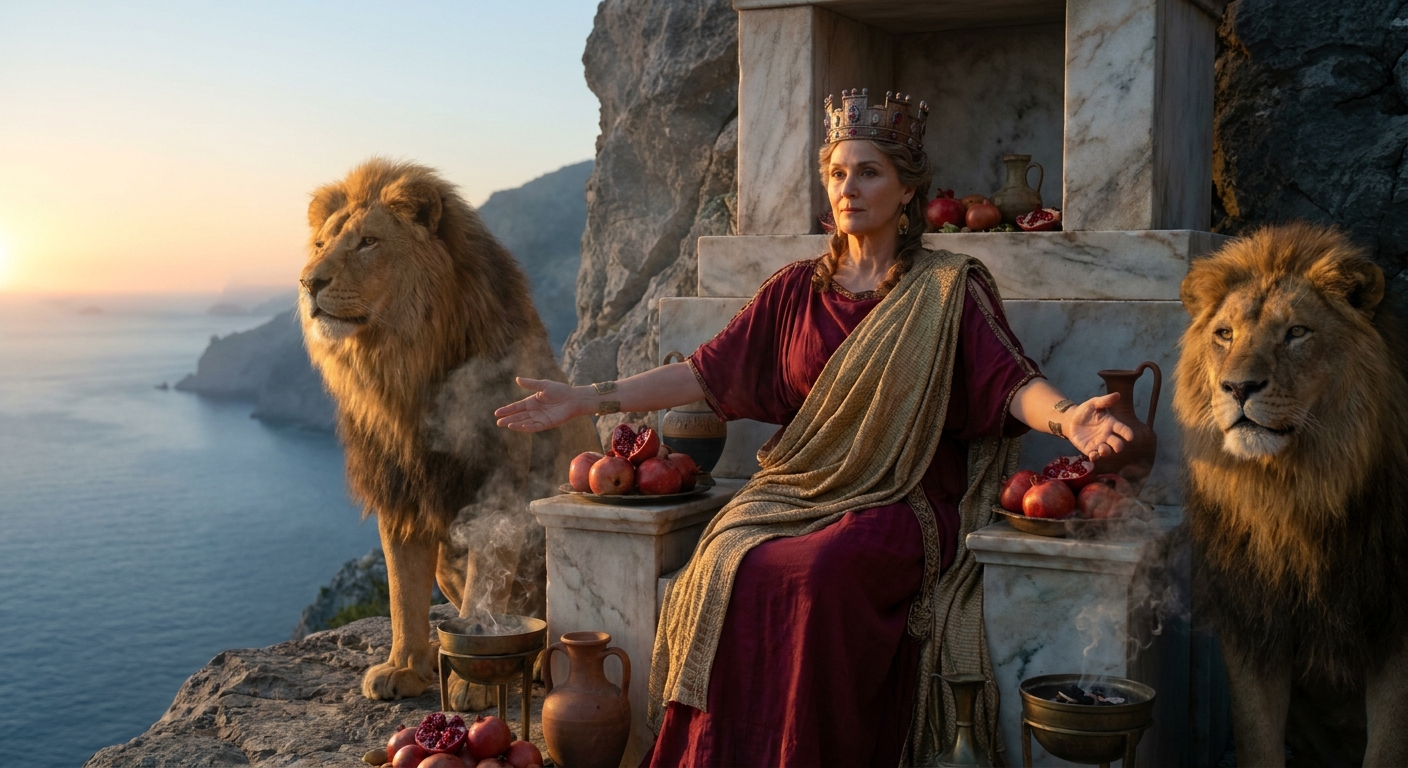
In some traditions, Cronus is cast down and confined, while Rhea remains honored. In others, she is drawn into the larger figure of the Great Mother, increasingly linked with ecstatic mountain rites and lion imagery that later audiences associate more strongly with Cybele. Greek religion is capable of reverence without simplicity, and mother goddesses in particular tend to absorb one another’s titles like temple smoke clinging to cloth.
What matters mythically is that Rhea’s deception reads as necessity, not scandal. The stories do not linger on her punishment. They move forward as if the cosmos itself has accepted the bargain she made.
Why Rhea matters
It is tempting to file Rhea under a familiar label and move on: Mother of the gods. Fertility. The gentle background figure behind Zeus’s starring role.
But the myth refuses to let her be only gentle.
Rhea is written as the Great Mother in a world where motherhood is not safe. Her children are not threatened by monsters in the woods. They are threatened by their father on a throne. So she becomes what the moment demands: not merely the womb of Olympus, but the architect of its survival.
That is the deeper Greek intuition behind her story. The maternal is not only soft. It is also ferocious, capable of lies, capable of bargaining with Gaia, capable of smuggling a god through the seams of the world.
- Cronus represents the panic of power that knows it is temporary.
- The swallowed children represent a future forced into silence.
- The stone represents deception used as protection.
- Crete represents nature turned into a hiding place, a sacred geography of survival.
- Rhea represents the uncomfortable truth that the universe is sometimes saved by someone willing to break a vow.
Rhea is not the thunder. She is the hand that kept the thunder alive long enough to strike.
And if you ever wondered why Greek myth still feels so alive, it is because it does not sanitize the gods into role models. It lets them be terrifying, beautiful, and contradictory. It lets a mother be a sanctuary and a plotter in the same breath, because in the old stories, that is sometimes what survival looks like.
Quick cast
If you want a clean map before you disappear back into the cave on Crete, here are the essentials:
- Rhea: Titaness, queen of the Titans, mother of the Olympians.
- Cronus: Titan king who swallows his children to avoid being overthrown.
- Gaia and Ouranos: Rhea’s parents, counselors in the deception plan.
- Zeus: hidden child who returns to overthrow Cronus.
- Hestia, Demeter, Hera, Hades, Poseidon: the swallowed siblings, later released.
- Amalthea (often): the goat or goat-nymph linked with Zeus’s nursing.
- Curetes (often): armed dancers who conceal Zeus’s cries with clashing bronze.