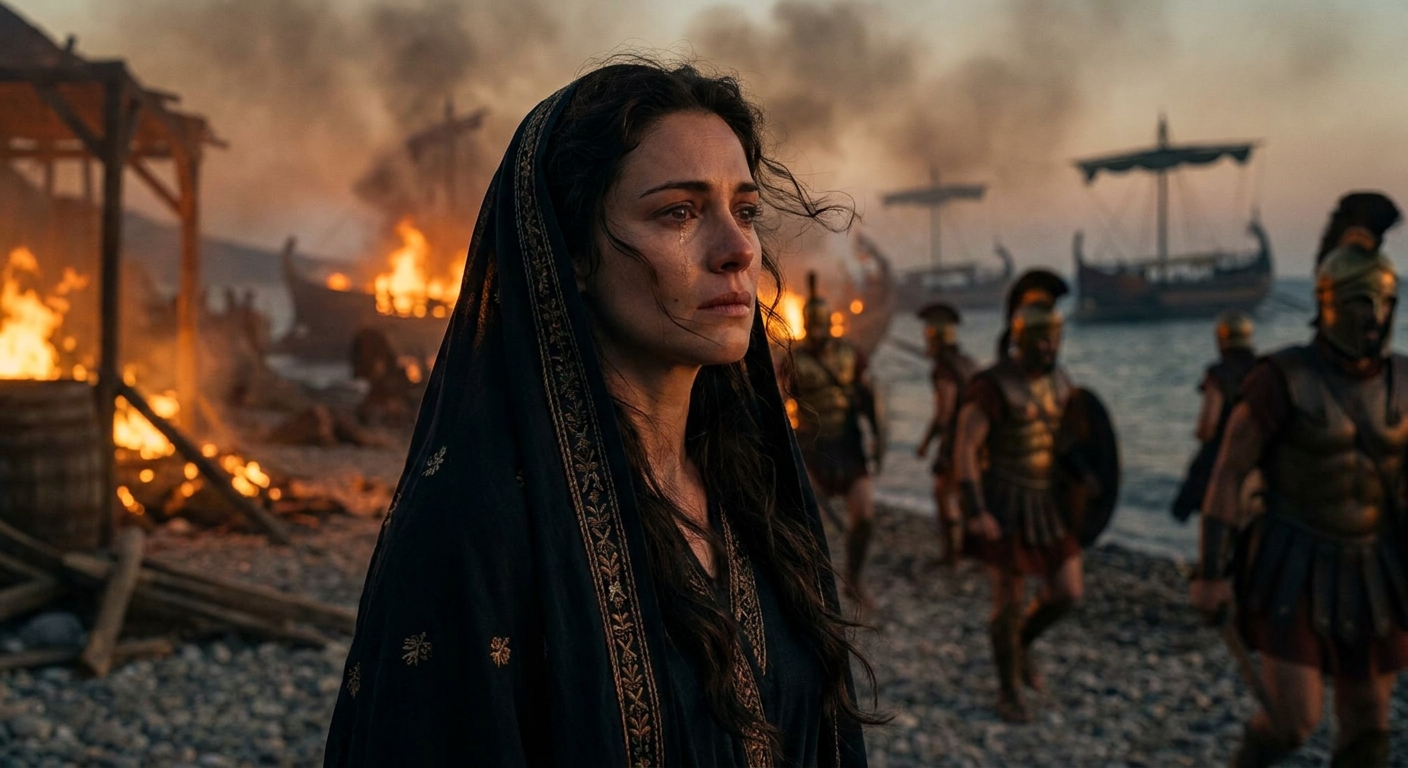
Andromache: The Good Wife in a Golden Cage
Greek Mythology
There are women in Greek myth who arrive like wildfire: a goddess with a bow, a witch with a cup, a queen with a curse tucked under her tongue. And then there is Andromache, the kind of woman the ancient world swore it adored.
The loyal wife. The steady hand at the hearth while men go chasing immortal glory across the plain.
In other words, the “good” woman.
And Greek mythology, being Greek mythology, rewards her with the most exquisite cruelty it can afford: a life where every virtue becomes a handle someone else can grab.

Thebe
Before she becomes a name spoken in mourning, Andromache begins as a princess. She is the daughter of King Eetion of Cilician Thebe, a city steeped in Trojan heritage.
Her early life, at least in the way myth preserves it, is mostly silence. No famous contest. No divine seduction glittering up the family tree. Just the sense of a noble household that deserved peaceful pursuits.
It does not get them.
When war rolls in like weather, it does not politely stop at Troy’s walls. It reaches outward, swallowing neighboring cities, turning homes into footnotes in someone else’s epic.
Andromache’s family is cut down with horrifying thoroughness. Her father Eetion dies, and so do her seven brothers, all killed by Achilles.
Hector
If Greek myth is a palace built on blood and prophecy, then love is usually the decorative fresco: beautiful, doomed, and there to remind you that the gods have never been impressed by human plans.
And yet Andromache’s marriage to Hector, prince of Troy, is one of the rare unions that feels like an actual refuge. Not a seduction disguised as a conquest. Not a bargain dripping with betrayal. A bond with warmth in it.
Within Troy’s stone embrace, she finds something like steadiness. Hector is the city’s shield, but he is also a man who hears his wife. Her fear is not decoration. It is a warning spoken into the bronze of fate.
She begs him, in essence, to choose home over the code of heroic honor. To value the living bodies waiting for him behind the walls over the shining idea of what a man should do under siege.
It is one of the most painfully human moments in the Trojan saga: love arguing with destiny, and destiny already holding the final draft.
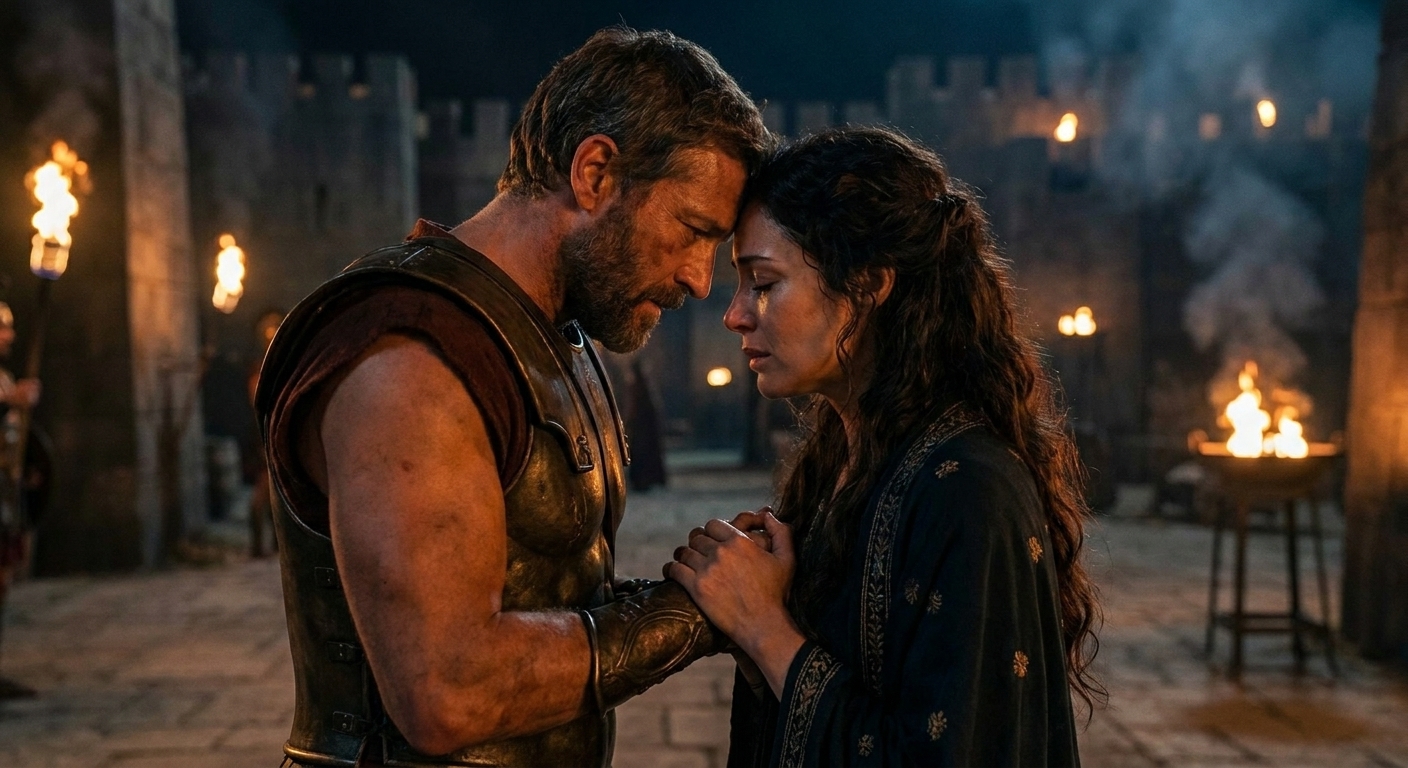
In Troy, even tenderness has the sound of distant spears.
Widow
When Hector dies, the loss is not only personal. It is structural. Troy does not simply lose a prince. It loses the figure who makes survival feel plausible.
For Andromache, widowhood is not a quiet cloak. It is a public unraveling. Her lament becomes part of Troy’s atmosphere, as if the city itself inhales ash and exhales mourning.
And then comes the cruelest truth about victory in Greek myth: it does not end when the battlefield goes silent. It keeps speaking, and it speaks through the bodies of the defeated.
Neoptolemus
After Troy’s ruin, Andromache is taken by Neoptolemus, Achilles’ son, a bitter symmetry the myth does not try to soften. The bloodline that helped destroy her life now claims what remains of it.
Her life becomes portable. She is handed across the wine-dark sea into an alien land where her former title means nothing. She is no longer the wife of Troy’s defender. She is a spoil of victory, a living tally-mark cut into the conqueror’s memory.
Captivity refashions her identity, not into something glamorous and not into a revenge engine, but into a kind of endurance that feels like metal hammered thin.
This is where the “good wife” archetype turns poisonous. She has been praised for loyalty, for composure, for bearing grief without making it spectacle. In captivity, those traits can be mistaken for compliance.
And yet the story keeps insisting on her inner resistance. She does not vanish. She does not dissolve into the role assigned to her. She adapts, and adaptation becomes its own defiant craft.
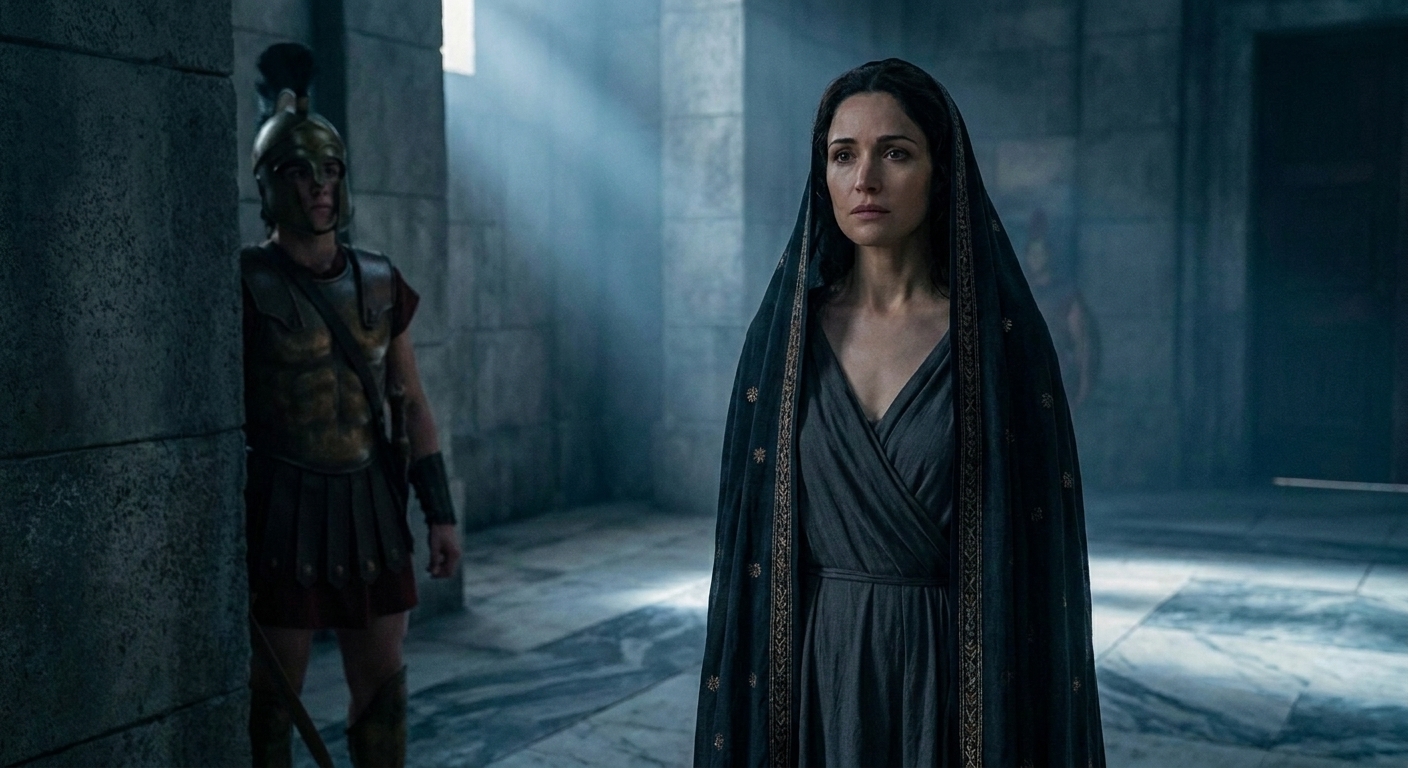
Epirus
Myth does not give Andromache a clean ending, because Greek tragedy is allergic to clean endings. What it offers is a reshuffling of the board.
In Epirus, her story turns again. She becomes connected to Helenus, a Trojan of royal lineage. The union reads less like romance and more like a strange restoration of dignity: a fragment of Trojan continuity surviving in enemy-shaped geography.
She is queen again, in a sense. And she is a mother again, in the broad, unsentimental way myth allows: not a tidy reward, but proof that history did not manage to make her story end at Troy’s ash line.
The myth gestures toward descendants and new royal threads, as if life stubbornly insists on continuing after the epic thinks it should be over.
Legacy
Andromache lasts across centuries because her tragedy is painfully legible. She is not punished for arrogance like Niobe, or for desire like so many mythic women are. She is punished for being good in a world that treats goodness as a resource to be extracted.
Her myth keeps resurfacing in art and drama precisely because it asks a question the epics love to dodge: what happens to the people a hero steps over on the way to fame?
Playwrights return to her onstage, especially Euripides in The Trojan Women and Andromache, because she embodies the aftermath, the human inventory taken when the gods and warriors are finished making their point.
And later literature cannot resist her either. From Homer to Jean Racine, Andromache becomes a template for widowhood, fidelity, and survival that does not look like triumph but still refuses to be erased.
Her echo wanders further still, into Shakespeare’s faint allusions and into operas and ballets that turn her grief into music and motion, stretching the old wound across new stages.
The epics call it glory. Andromache calls it what it costs.
Reframed
If you grew up hearing Andromache described as the ideal wife, consider what that praise really means. It means she is safe to admire. She does not threaten the order of things. She suffers beautifully.
But I cannot read her that way without wanting to throw a bronze helmet into the sea.
Andromache is not compelling because she is compliant. She is compelling because she remains herself through an unthinkable series of losses: father, brothers, city, husband, status, autonomy.
She becomes, again and again, the person forced to live in the ruins of someone else’s legend.
In a mythology addicted to spectacle, she is a quieter kind of haunting.
Not a woman who wins.
A woman who survives.