Selene Myths: Moon, Endymion, and Eternal Longing
Greek Mythology
Some gods arrive like thunder. Selene arrives like a blade of light laid gently across dark water.
She is the Moon herself in Greek myth, not a metaphor and not a mood, but a luminous, pre-Olympian presence who moves through the night with the steady confidence of something ancient enough to ignore Olympus’ gossip.
And yet for all her cosmic grandeur, Selene’s most famous story is painfully intimate: a goddess who keeps returning to one sleeping mortal, again and again, as if devotion could rewrite time.

Who Selene Is
Selene belongs to a family of celestial inevitabilities. In most traditions, she is daughter of the Titans Hyperion and Theia, and sister to Helios (Sun) and Eos (Dawn). Together they form a kind of sky-bound trilogy: sunrise’s blush, noon’s blaze, midnight’s silver hush.
She is older than Zeus’ order, older than the neat lines of temples and laws. In art and hymn, she is a bright-faced goddess, crowned or veiled, moving with the measured pace of the lunar month.
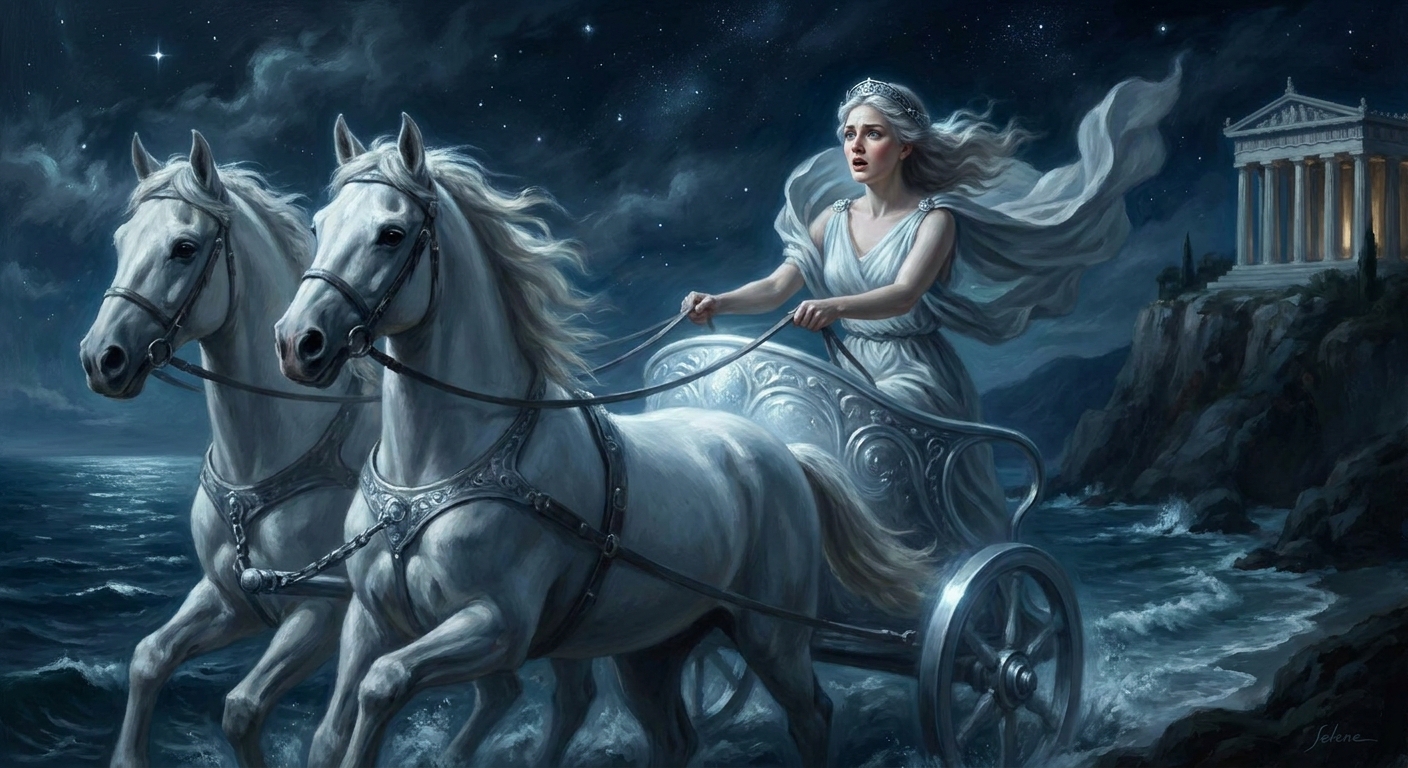
Ancient poets loved to imagine her as a traveler. Night is not empty in Greek myth. It is a road, and Selene is its reigning sovereign.
The Moon’s Chariot
Sources vary on her team, because myth is a living thing that changes its jewelry from city to city. Selene is sometimes drawn by horses, sometimes by oxen, and occasionally by more fantastic beasts in later imagination. What stays constant is the image: the Moon as a radiant woman riding above the sleeping earth.
In an Orphic hymn and in other ancient hymnic praise, she is described with an almost ceremonial brightness, her light pouring from her head and shoulders, turning the sea’s surface to hammered silver. If you have ever watched moonlight tremble across the Aegean and felt like the water was keeping a secret, you already understand the mood these songs are chasing.
Selene’s myth is full of that careful paradox. She is distant and touchable at once, a goddess you can see from anywhere, but never reach without paying in longing.
Endymion
Then comes Endymion, the beautiful mortal attached to Selene like a soft wound. Even his role shifts with the retelling. In some accounts he is a shepherd, in others a hunter, and in several he is a king of Elis. What matters is the stillness of him, the way his story is built to be visited rather than completed.
Selene sees him asleep and desire becomes devotion. Not the kind of want that draws Zeus’ thunder and Hera’s wrath, but a slower fixation, the kind that convinces a goddess to reorganize eternity around a single face.
A love affair with the Moon was never going to be daylight-safe.
The myth’s core is simple and cruel: Endymion is granted eternal sleep so that he will never age, never wither, never become a memory Selene has to outlive in the ordinary way.
The Bargain
Who grants the sleep and why depends on which ancient thread you pull.
In one tradition, Endymion is favored by Zeus, who grants him a wish that results in unending sleep and agelessness.
In others, Selene herself presses for the bargain, as if the Moon can negotiate with fate when she wants something badly enough.
In a later, more punitive strand, Endymion’s sleep reads like a sentence, tangled in divine jealousy and the dangerous attention of the Olympians.
These versions do not cancel each other. Greek myth is less like a single canon and more like a sacred coastline, reshaped by every storm. What remains consistent is the cost: Endymion is perfect because he is unreachable.
Ancient writers place him in a cave on Mount Latmus in Caria, where Selene descends by night. The setting is doing emotional labor here. A cave is a threshold space, half world and half underworld, a place where time behaves strangely. Exactly the sort of place a moon-goddess would choose for a love that cannot be fully alive.

Why It Hurts
Selene is not a goddess of marriage contracts or household peace. Her domain is the night, and night is where desires get honest.
That is why the Endymion myth lingers. It turns romance into a lunar cycle: approach, touch, retreat. Always repeating. Always beautiful. Always slightly unbearable.
For a goddess, loving a mortal is not brave. It is mathematically doomed. Mortals change. The divine does not. So the myth finds a solution worthy of Greek imagination: remove change itself. Preserve the beloved in sleep the way amber preserves a fallen leaf.
To keep him forever, she lets him never truly meet her gaze.
Pandia
Selene’s stories are not only private. They brush against civic calendars too. In Athens, a figure named Pandia appears in some sources as Selene’s daughter, sometimes with Zeus named as father.
The name means “all-bright,” a word that naturally clings to the full Moon, when Selene’s face is unhidden and the world looks temporarily enchanted.
Athenians also celebrated a festival called the Pandia, primarily a festival of Zeus, timed around the full moon after the City Dionysia. Because Greek ritual loves layered meanings, the lunar timing has been linked by some scholars to the festival’s name and atmosphere, even when the official divine address belongs to Zeus.
Selene, Artemis, Hecate
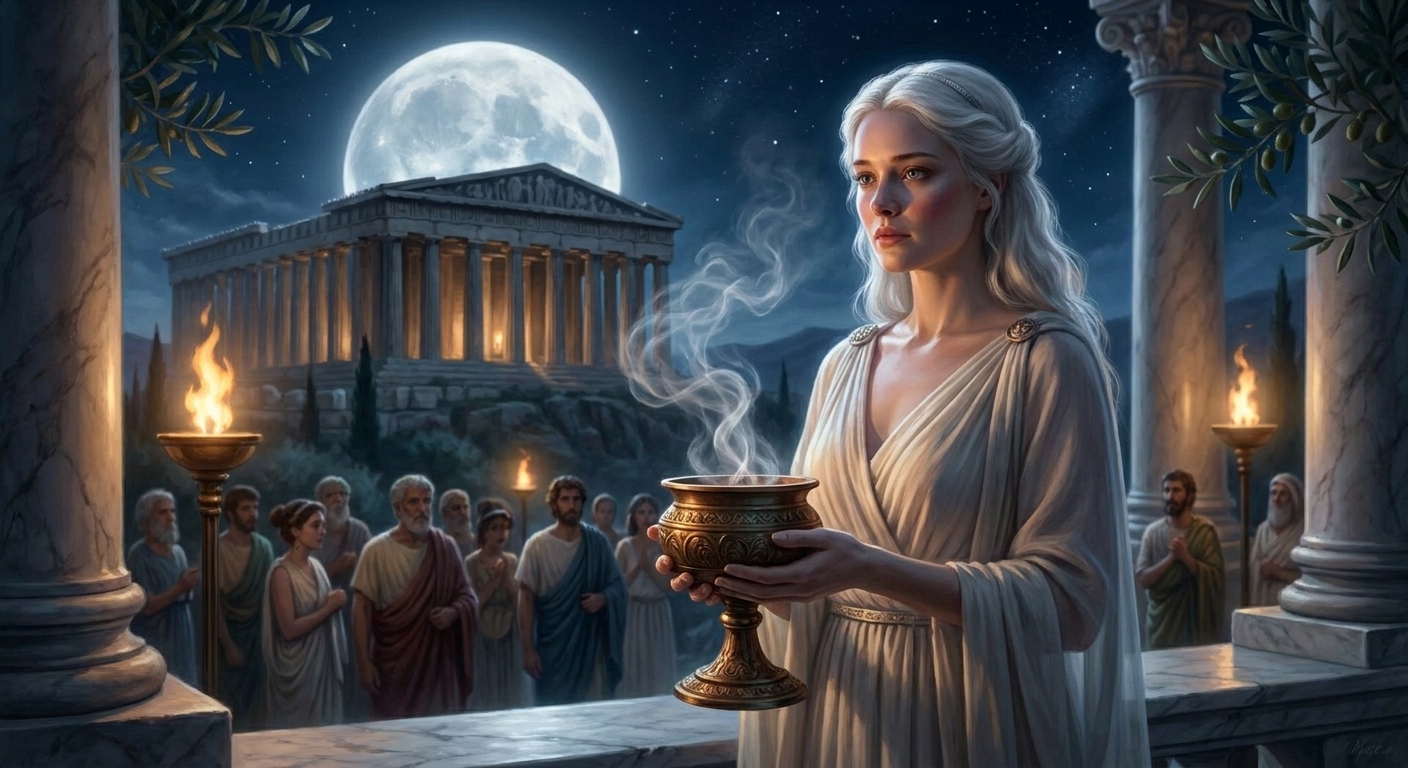
Modern readers often meet Selene after they already know Artemis and Hecate. The confusion is understandable. Later Greek religion and poetry enjoyed merging deities into lunar composites, sometimes treating them as faces of the same power.
But in their older, clearer contours, they are strikingly different.
Selene: the Moon as body
Selene is the shining disc itself, the Titan-descended radiance that travels. When you picture the Moon crossing a dark sea, you are already picturing Selene’s work.
Artemis: wilderness and boundaries
Artemis becomes associated with the Moon over time, but her core identity is the hunt, the wild, and the fierce protection of autonomy. If Selene is a nightly procession, Artemis is a sudden arrow in moonlit brush.
Hecate: thresholds and the unseen
Hecate’s night is not about brightness. It is about what brightness reveals and what it cannot. She rules crossroads, ghosts, witchcraft, and the dangerous edges of experience. If Selene is the Moon’s face, Hecate is the shadow the Moon makes when it falls across a door you should not open.
Roman Luna
When Rome takes Greek myths into its own orbit, Selene’s closest counterpart is Luna. The match is fairly direct: a moon-goddess who traverses the sky in a chariot and whose light becomes a civic, calendrical force as much as a poetic one.
Roman writers preserve the broader idea of a luminous goddess whose motion structures time. In art, Luna’s crescent imagery and heavenly vehicle reinforce what Selene already is in Greek tradition: the night made legible.
What Rome does especially well is make the Moon feel official. Greek Selene can be heartbreakingly personal, descending to a cave for a sleeping lover. Roman Luna is often the public face of that power, a goddess whose passage over the city is almost governmental in its reliability.
What Remains
Greek mythology is crowded with romances, but few are as quietly haunting as Selene and Endymion, because the drama is not in the chase. It is in the aftermath. It is in what love becomes when it cannot progress.
Selene’s gift is not a happy ending. It is a loop. A goddess moving across the world, night after night, returning to the same sleeping beauty like a prayer she cannot stop reciting.
Every month the Moon wanes. Every month it returns. Some myths are simply honest about that.
And perhaps that is why Selene still feels strangely modern. We recognize the ache of it. The desire to preserve what we love. The temptation to freeze time. The realization, arriving too late, that the price of preservation is often the loss of waking life itself.