Artemis Myths: Wilderness, Protection, and Sacred Boundaries
Greek Mythology
There are gods you can bargain with. There are gods you can flatter. And then there is Artemis, who does not negotiate with anyone who arrives entitled.
She is the goddess of the hunt, wild animals, and mountains, the patron of liminal places where human ownership starts to sound like a joke. She is also a protector of young women and, in her aspect as Artemis Lochia, a fierce presence at childbirth, though the Greeks more often called on Eileithyia as the specialist. Greek protection, as usual, comes with conditions.
Her association with the moon is powerful in later tradition and popular imagination, sometimes braided together with Selene and Hecate. Even when the myths do not name her “moon goddess” outright, her stories still happen in the kind of light that makes boundaries feel sharper.
If you have ever read her myths and thought, “That escalated quickly,” congratulations. You are having the correct ancient Greek experience.

Who She Is
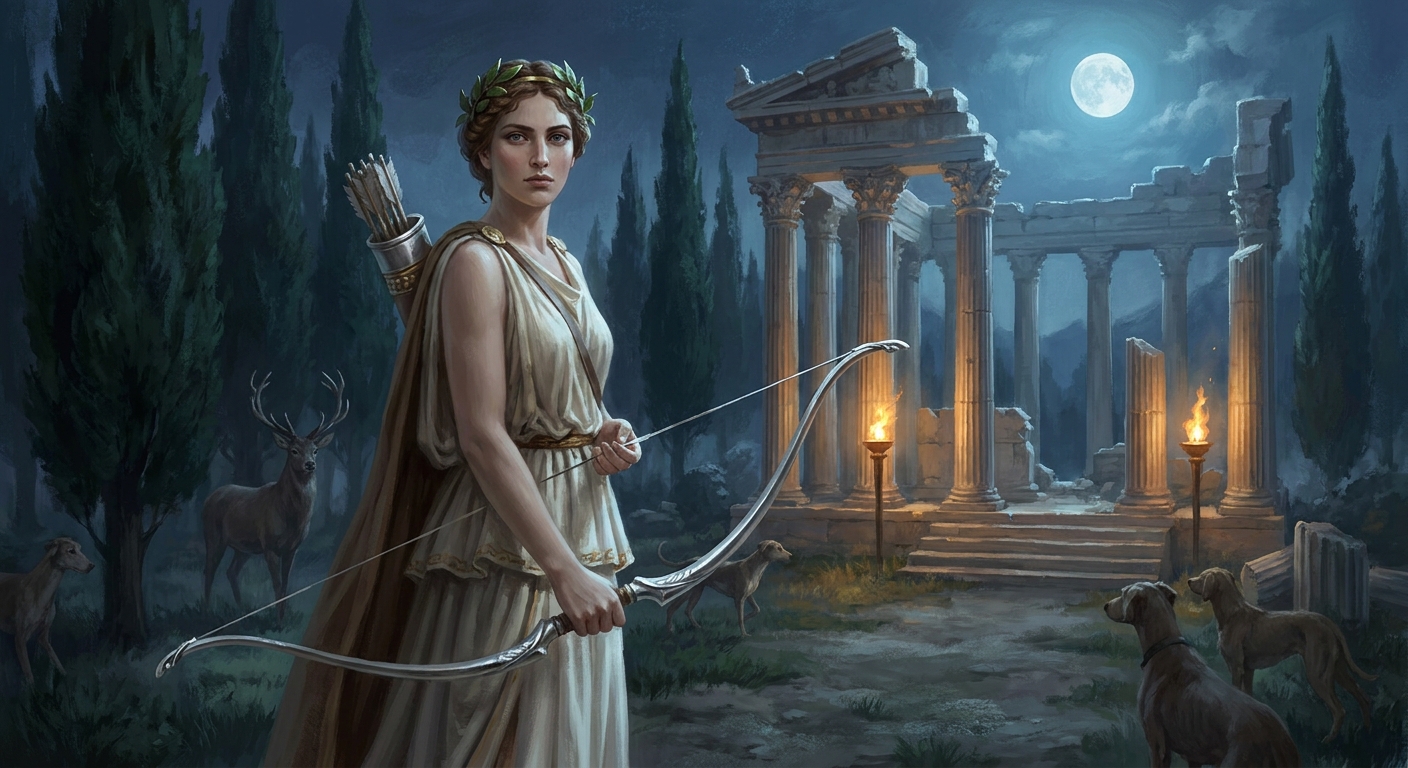
Artemis is usually introduced with the obvious symbols: bow, quiver, deer, hounds, the cold shine of the moon. But her true domain is less a place than a principle. Artemis rules sacred boundaries.
- Wilderness as a realm outside civic control, where the rules are older than law.
- Virginity not as prudishness, but as autonomy and inviolability.
- Rites of passage for girls and young women, especially at the threshold between childhood and marriage.
- Protection that is fierce, conditional, and sometimes terrifying.
In the ancient imagination, the wild was not a scenic backdrop. It was a living edge. Artemis is that edge given divine form.
Actaeon
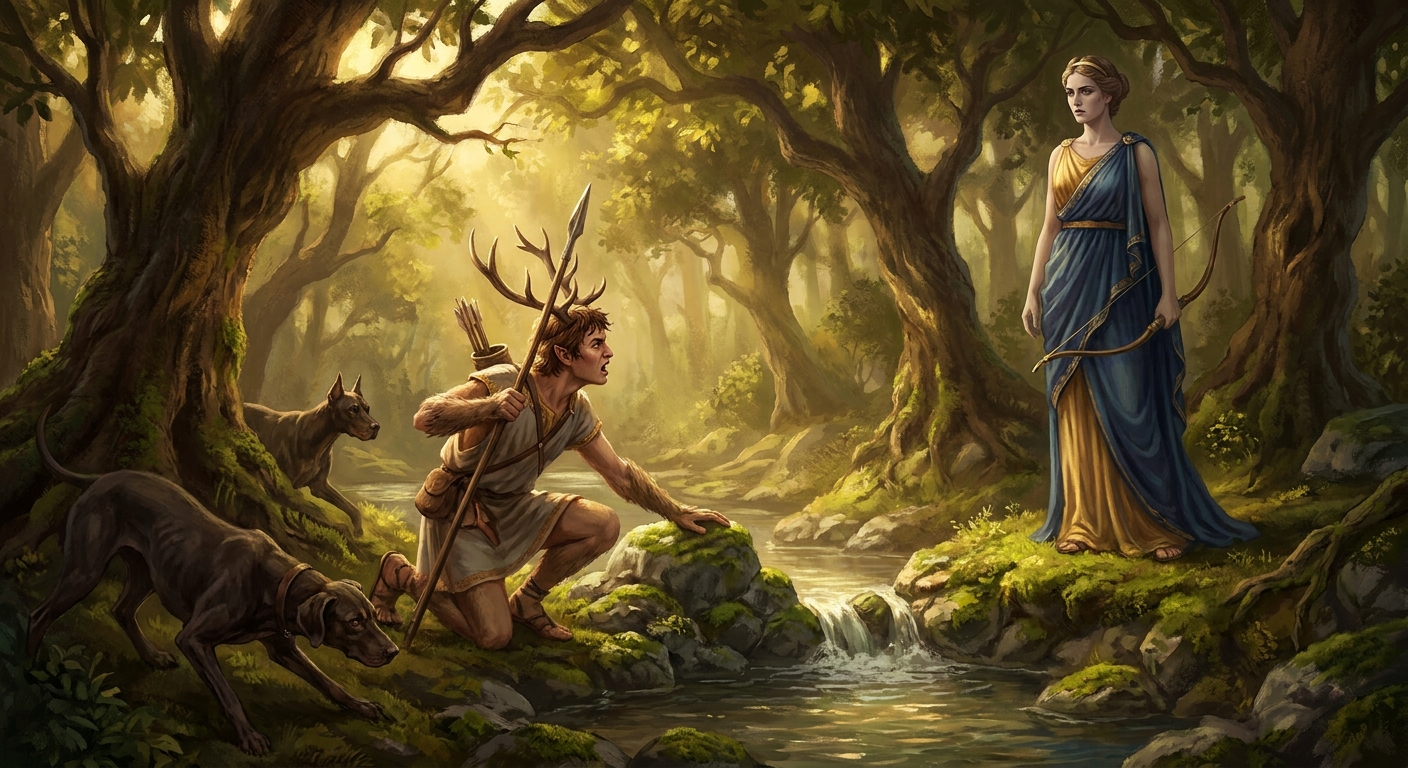
Few Artemis stories land as sharply as the fate of Actaeon. A skilled hunter wanders into the wrong clearing at the wrong time and sees Artemis bathing. In some tellings it is accidental. In others, the myth leans toward arrogance or a prior offense. Either way, the point is not erotic. It is sacred.
Artemis responds by transforming Actaeon into a stag. Then his own hounds, loyal and unrecognizing, tear him apart.
In Artemis’ world, the punishment is not only death. It is reversal: the hunter becomes the hunted.
This myth is often reduced to “do not peep,” which misses the deeper Greek fear. To see what is not yours to see is to step into a space where you do not belong. Artemis enforces that line with the clean logic of the wilderness itself.
Callisto
The myth of Callisto is one of the most emotionally brutal stories attached to Artemis, because it is a tragedy built out of competing loyalties.
Callisto is a nymph, often described as a companion of Artemis. She has sworn the goddess’ vow. Then Zeus intervenes, as he does, with the certainty that consent is something mortals pay for. Different sources vary on disguise and coercion, but the outcome is consistent. Callisto becomes pregnant, and the secret cannot remain hidden in a world that turns purity into performance.
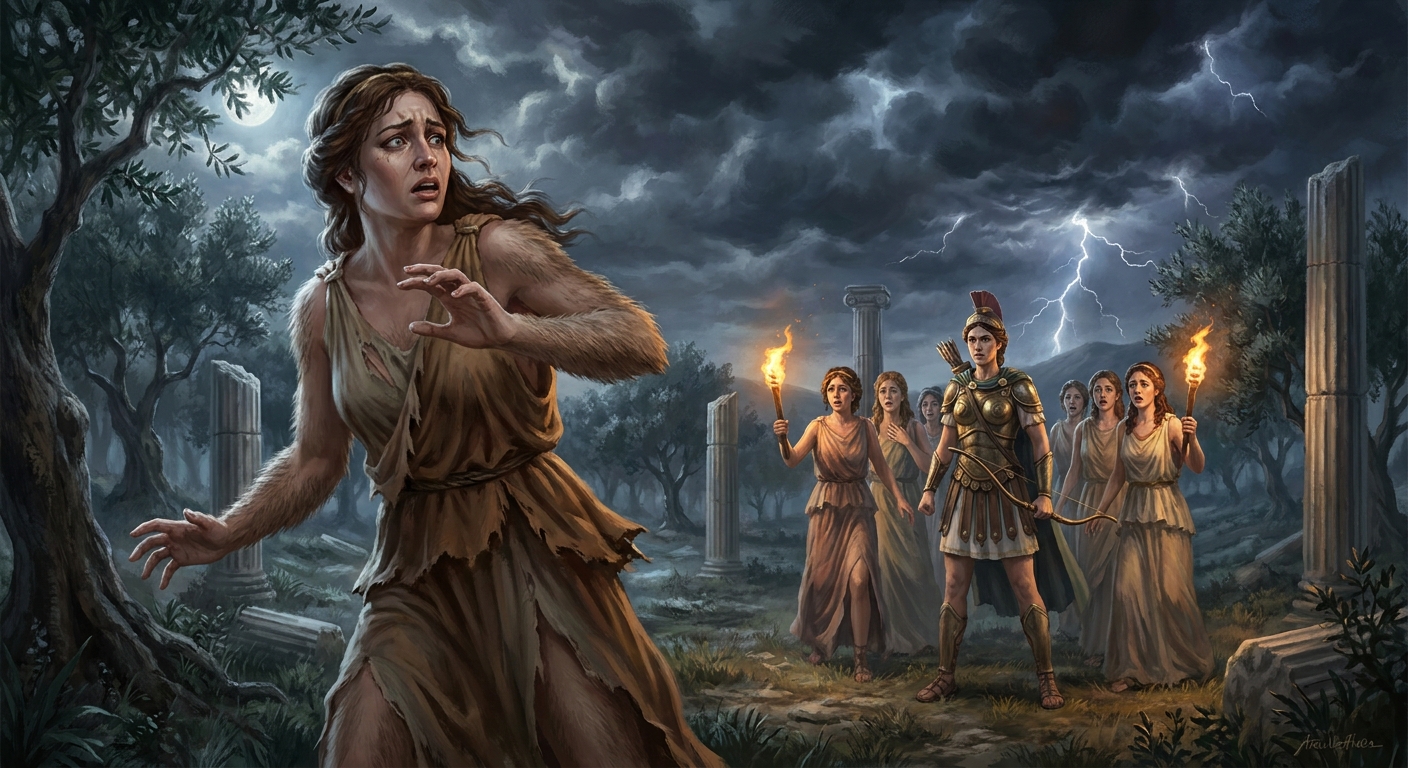
When Artemis discovers the pregnancy, Callisto is cast out, punished, or abandoned depending on the version. Hera’s jealousy often arrives next, transforming Callisto into a bear. Eventually Callisto is placed among the stars as Ursa Major. Her son Arcas is also tied to the sky in different traditions, sometimes as Ursa Minor, sometimes as Boötes, the bear-keeper who circles what he cannot quite reach.
It is tempting to read Artemis as heartless here. Yet the myth is also a portrait of an ancient system where women are punished for what powerful men do, and where “purity” becomes a social weapon. Artemis does not invent that world. She is one of its most uncompromising enforcers.
Niobe
Some myths are warnings dressed as spectacle. Niobe, queen of Thebes, boasts that she is superior to Leto because she has many children, while Leto has only two. In Greek mythology, this is not confidence. This is a public insult to a goddess.
Leto’s children answer with arrows.
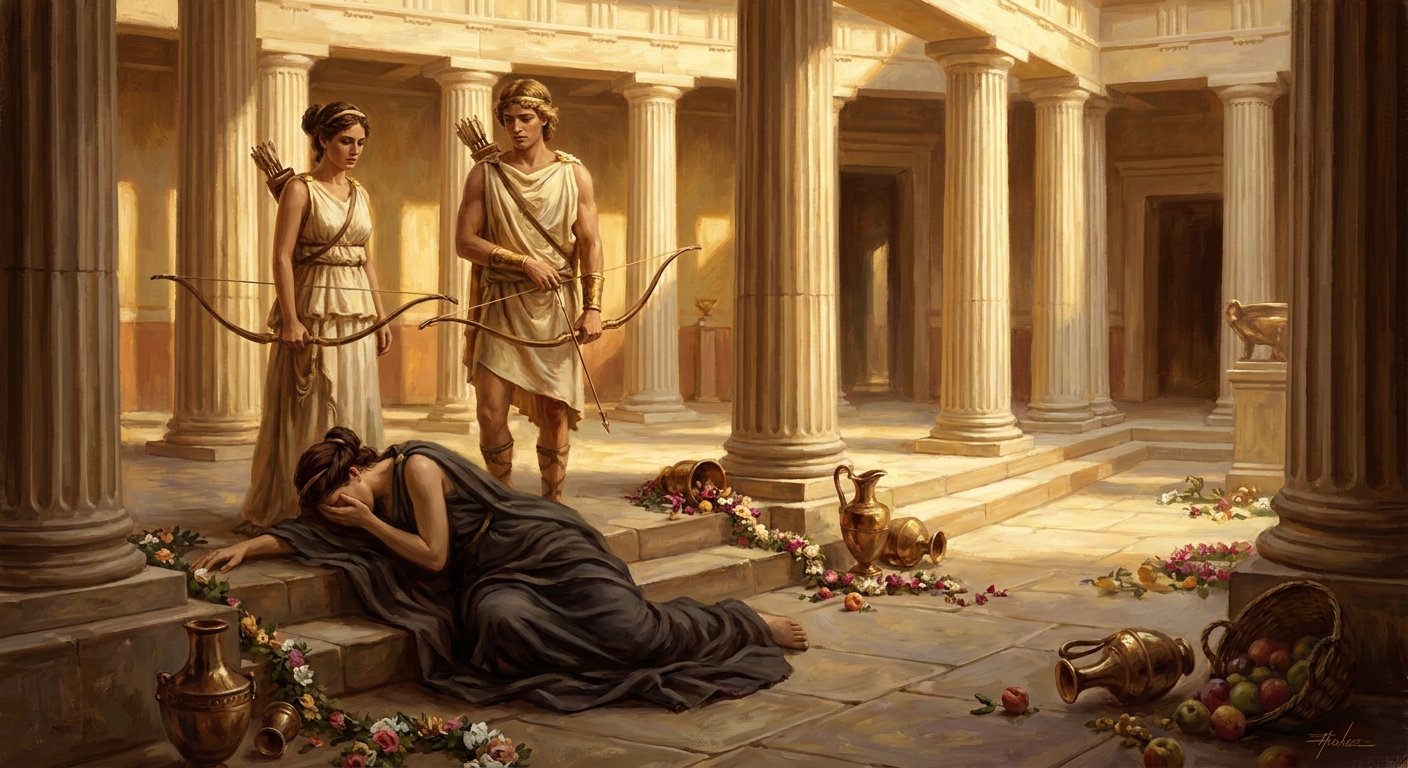
Apollo and Artemis kill Niobe’s children. Ancient sources differ on the number, often fourteen, sometimes less. The emotional point does not. Niobe’s pride is answered with annihilation, and her grief becomes so complete that she is transformed into stone, still weeping.
Greek myths love a beautiful catastrophe: a single sentence of pride, and then the sky fills with arrows.
Artemis here is not the forest guardian. She is the daughter defending her mother’s honor, embodying a divine social rule: do not make your fertility into a throne and your neighbors into footstools.
Orion
Artemis is famously resistant to romance, but myth is a messy archive. In several traditions, Orion, the giant hunter, becomes close to her. Sometimes he is a companion. Sometimes a beloved. Sometimes simply a man who can keep up.
And that is where danger enters, because closeness to Artemis tends to provoke jealous gods and an anxious brother.
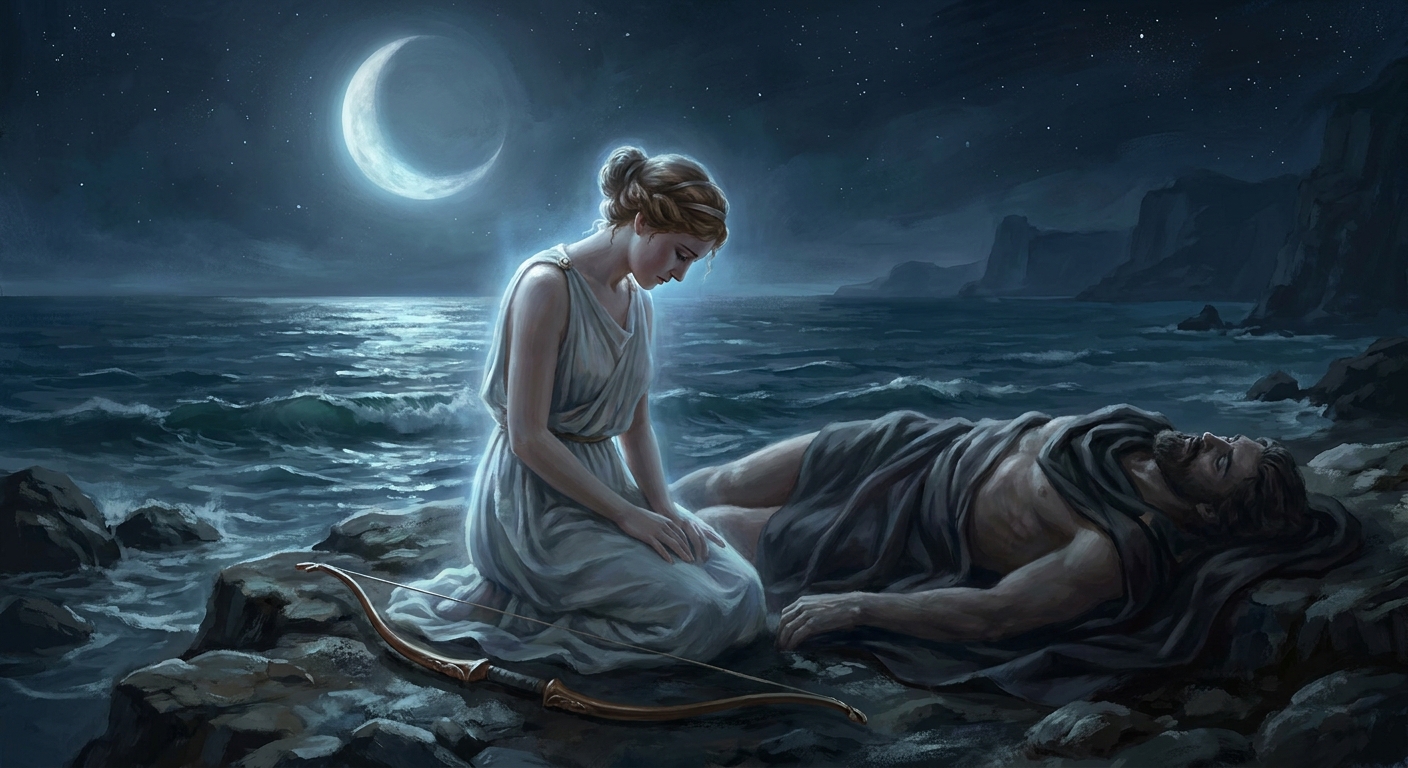
One version has Apollo trick Artemis into killing Orion, challenging her to hit a distant target in the sea. She shoots true, and only afterward learns what she has done. Another has a scorpion sent against Orion, leading to his death and catasterism into the stars.
Orion’s placement among the constellations reads like a consolation prize given by a universe that does not do apologies. Artemis remains what she has always been: capable of tenderness, yes, but never safe.
Iphigenia
Not all Artemis stories happen deep in the woods. Some happen on the edge of war, where power demands sacrifices and calls them necessary.
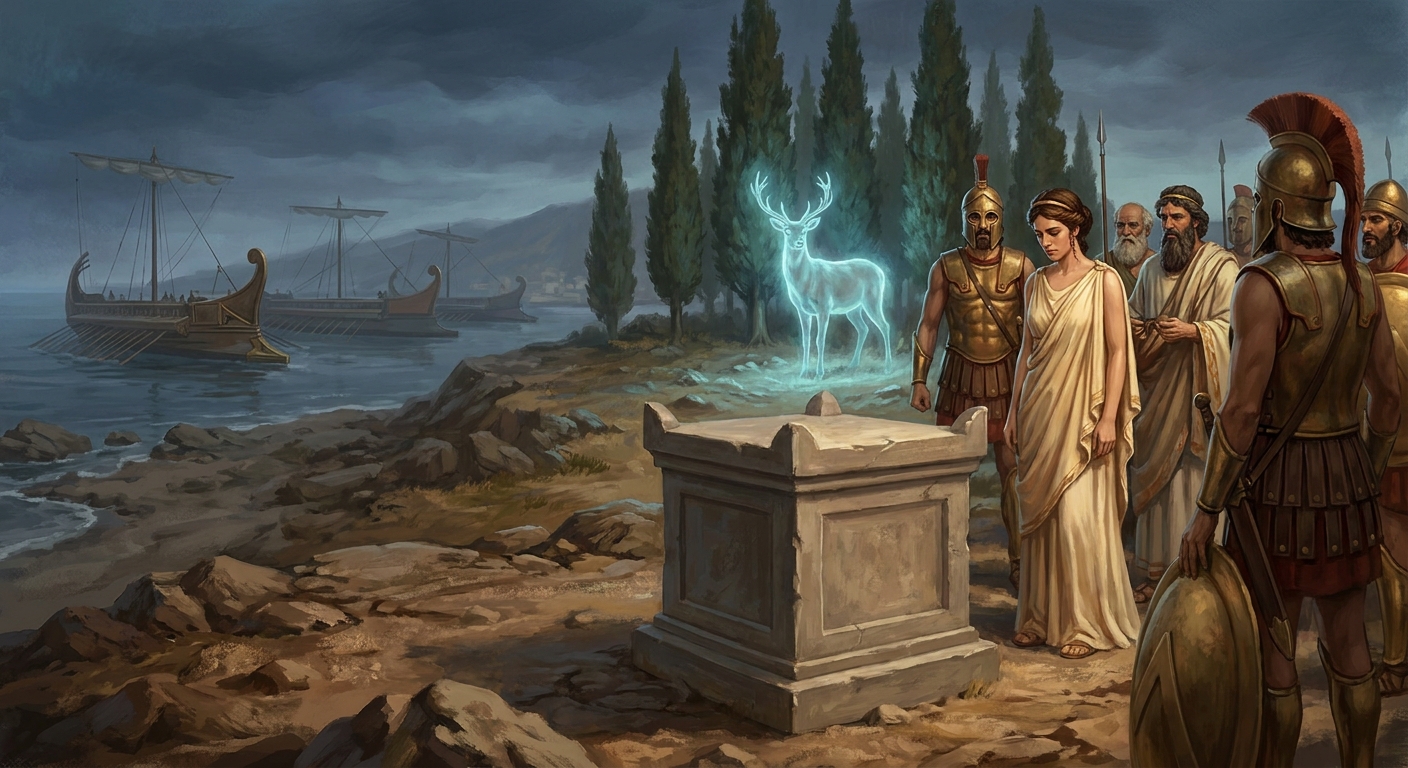
Before the Greek fleet sails to Troy, the winds die at Aulis. The seer Calchas declares Artemis is angry, often because Agamemnon has offended her, sometimes by killing a sacred deer, sometimes by boasting in a way that tastes like theft. The remedy is monstrous: the sacrifice of Iphigenia, Agamemnon’s daughter.
In some versions, Iphigenia is killed. In others, Artemis replaces her with a deer at the last moment and carries the girl away to serve as her priestess in Tauris. The tradition refuses to settle on a single ending, which feels appropriate. Stories like this are not about plot. They are about the cost of leadership and the terrifying intimacy between religion and war.
Artemis here is not merely cruel. She is the goddess demanding that a king learn what it means to owe the divine world something real.
Cults and Rites
Artemis was not only a story told by firelight. She had sanctuaries where the boundary became physical.
At Brauron in Attica, girls took part in rites that linked Artemis to growing up, to the wildness of the body, and to the social choreography of becoming “marriageable.” The ritual language is full of bears, not because it is cute, but because it is honest about what it means to be half-tamed.
And at Ephesus, Artemis appears in a strikingly different local form, less huntress than cosmic mother of abundance. It is a reminder that “Artemis” can name a single goddess and also a whole family of regional truths.
What She Guards
If you step back from the individual tragedies, Artemis’ myths begin to read like a single philosophy written in blood, moonlight, and rules no one asked for but everyone must obey.
She protects
- Wild places, where human law should not presume ownership.
- Animals, especially those marked as sacred, and the balance of predation and restraint.
- Young women at vulnerable thresholds, and the sanctity of their autonomy.
- Oaths, particularly vows made in her name.
She punishes
- Violation of sacred space, like Actaeon’s gaze.
- Hubris, like Niobe’s boast and Agamemnon’s offense.
- Boundary crossing, especially when it is casual, entitled, or performative.
This is not punishment for punishment’s sake. Myth encodes taboos, social fears, and religious limits in a form that people remember. Artemis is one of the sharpest languages that system ever invented.
Artemis does not represent “nature” in a gentle, modern sense. She represents the world that does not care about your excuses.
Why She Endures
I live in Seattle, where wilderness is never purely theoretical. We hike near cliffs and cold water. We learn quickly that beauty does not equal permission. Artemis would approve of that lesson, even if she would deliver it with less patience and more arrows.
Her myths endure because they speak to a tension we still live with: the desire to enter the wild, to touch what is holy, to look at what is radiant. And the uncomfortable truth that some things should not be taken, consumed, or claimed.
Artemis makes that truth cinematic. Moonlit forests. Sacred springs. The snap of a bowstring. The moment you realize the boundary was there all along, and you crossed it anyway.
And the wilderness, like Artemis, always remembers.