
Amphitrite Myths
Greek Mythology
There are sea goddesses who arrive like storms, loud enough to make even Olympus glance up from its wine.
And then there is Amphitrite, who moves like the deep itself. Not absent, not powerless, just ancient in the way salt is ancient. If Poseidon is the ocean’s temper, Amphitrite is its title, its legitimacy, its quiet claim to the throne.
Her myths are not a single famous tragedy the way Thetis is given one, or a single infamous transformation the way Scylla endures. Amphitrite is something subtler and, honestly, more dynastic: a Nereid pulled into queenship, a reluctant bride who becomes the court.

Nereid Origins
Amphitrite begins among the Nereids, the sea-nymph daughters of Nereus and Doris. In the older poetic imagination, Nereids are not “mermaids” in the modern sense. They are the sea’s aristocracy: lovely, terrifying if crossed, and woven into the safety or ruin of sailors.
Amphitrite’s very name is often read as oceanic in scope, something like “she who encompasses.” In some traditions she is not merely one Nereid among many, but a figure who already hints at queenship, as if the sea itself is practicing the title on her tongue.
The Nereids move through myth like a chorus of surf, but Amphitrite stands out because she does what so few divine women are permitted to do in these stories.
She refuses a god and runs.
That refusal is the first act of her mythology, and it sets the tone: Amphitrite is not introduced as Poseidon’s accessory. She is introduced as a decision.
The Marriage Pursuit
The best-known story of Amphitrite is not a battlefield, not a prophecy, not a wedding feast. It is a flight.
Poseidon desires her, and Amphitrite, in some accounts, withdraws to the farthest sea, sometimes glossed in later retellings as the world’s edge, near the old boundaries of Atlas. Sources vary on the details, but the emotional shape remains. She does not stride into marriage as a glittering prize. She retreats, and the sea itself becomes her hiding place.
Then comes the intermediary: Delphin, a dolphin, sometimes treated as an agent of Poseidon and sometimes as a creature with its own clever diplomacy. Delphin finds Amphitrite and persuades her to accept the match, a bargain delivered by a creature who knows currents and tempers better than most gods do.
Poseidon, in gratitude, places Delphin among the stars as the constellation Delphinus in some later sources. Which is very on-brand for the Olympians: a cosmic reward for services rendered in romance and politics.
Amphitrite becomes Poseidon’s wife and thus queen of the sea. But the myth never quite forgets her first movement was away.

Sea Court
Myth rarely gives Amphitrite a long monologue. It gives her something more interesting: a position.
Poseidon rules like an earthquake. He takes offense, he floods, he shatters walls, he makes monsters and calls it a mood. Amphitrite, by contrast, reads as the sea’s formal order. She is the one associated with the courtly imagery: the palace, the retinue, the legitimacy of kingship beneath the water.
Later art and poetry imagine their home as a submerged palace of coral and shining stone, a place where Triton is often named as their son and herald, where sea deities gather like nobles, and where the ocean’s chaos is forced, at least for an hour, into ceremony.
This is where Amphitrite matters most. She is not the wave. She is the crown.
Theseus and the Ring
Amphitrite steps into one of the most deliciously political scenes in hero myth: the question of who gets to claim a god as a father.
In some traditions, Theseus is a son of Poseidon. That parentage is not just genealogy. It is a credential, a claim to a certain kind of authority. And claims, in Greek myth, are often tested in public, the way bronze is tested in the fire.
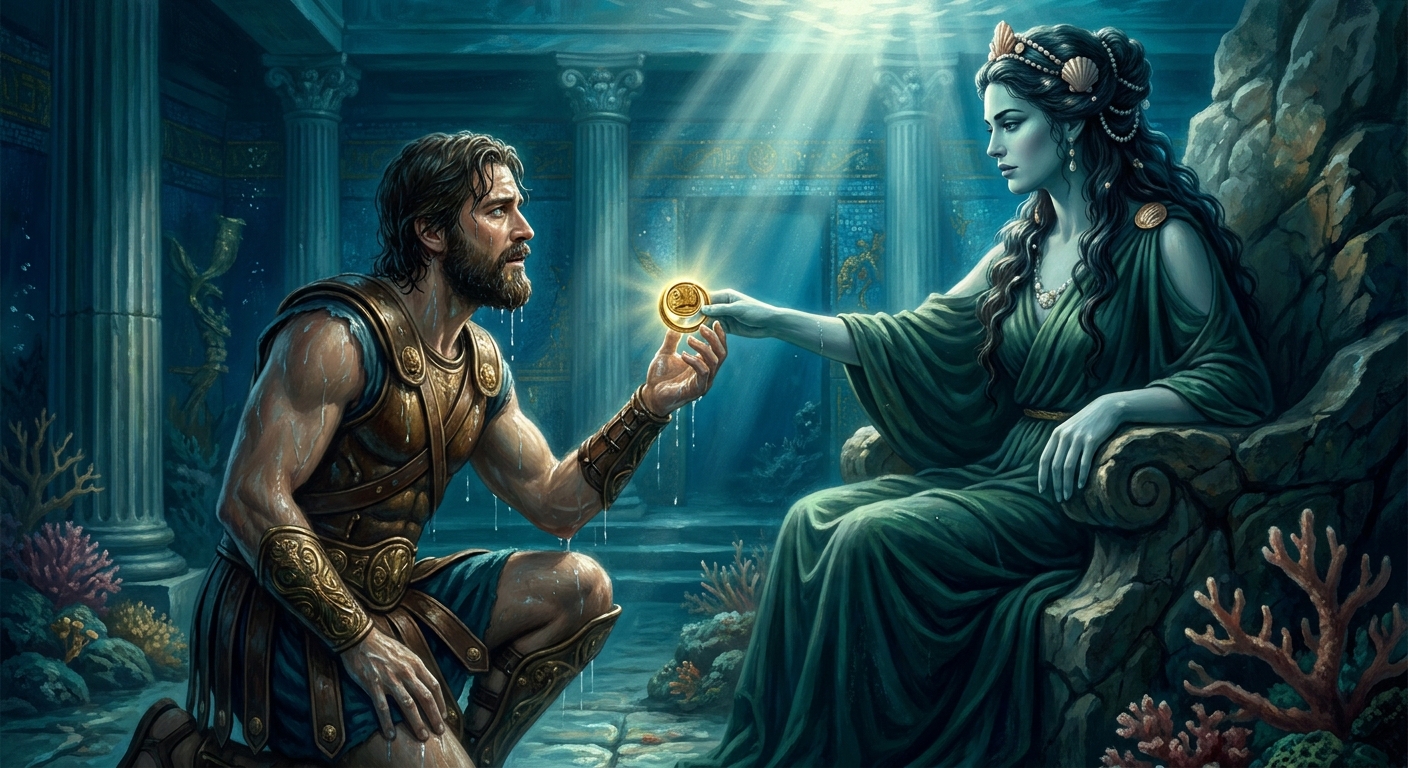
One famous pattern in the Theseus cycle features a challenge at sea: Theseus proves his connection to Poseidon by retrieving a token from the depths, often a ring thrown into the water. In versions of this story, Amphitrite appears below, receiving the hero with the cold grace of royalty.
And here the direction matters. In some versions, it is Amphitrite who presents Theseus with sea-royal proof: a wreath, a crown, or the famous purple cloak, marine wealth turned into a sign of legitimacy.
The sea does not keep what it takes. It displays it, glittering, as evidence.
Amphitrite’s role here is subtle but sharp: she is the queen who can make a double-claimed tale sound like law.
Cult and Queenship
Amphitrite is not only a narrative figure. She also belongs to the lived religious imagination of the Greek world, where the sea was less metaphor and more mortgage. You prayed because the ocean had teeth.
As Poseidon’s consort, Amphitrite appears in cult and local tradition as a sea-queen, honored alongside him in coastal contexts where sailors, fishermen, and port cities understood that the water’s favor was not guaranteed.
Her evidence is thinner than Poseidon’s, but not absent. She surfaces in poetic invocations and sporadic dedications, and in the iconography of the marine court. The point is not that Amphitrite had the biggest temples. The point is that she had the title that matters in a world of divine households.
In Greek religion, a consort is not always a footnote. Sometimes she is the stabilizing name attached to a volatile god, the one who turns raw force into something a city can bargain with.
Amphitrite and Thetis
If Amphitrite is the Nereid who becomes a throne, Thetis is the Nereid who becomes a prophecy.
Thetis is pursued by gods and then redirected into mortal marriage because of a divine warning: her son would be greater than his father. That story is about preventing a succession crisis. It ends with Achilles, and all the grief that follows him like smoke.
Amphitrite’s refusal, by contrast, is not framed as a cosmic threat to Zeus. It is personal, and then civic. She flees, she is found, she is persuaded, and she enters a marriage that turns her into a figure of institutional power.
- Thetis: sea power as fate and maternal catastrophe, shaped by prophecy and the limits placed on a goddess.
- Amphitrite: sea power as queenship and court, shaped by negotiation and the public meaning of marriage.
Both stories are about agency under pressure. The difference is what the myth wants to do with that agency once it catches it.
Amphitrite and Scylla
Now for the contrast that exposes the sea’s cruelty.
Scylla is not a queen. She is a shoreline nightmare, a name sailors curse when rocks appear too late and the water sounds hungry. Her story, in many traditions, is a transformation story, a before-and-after that turns beauty into terror, often because gods and nymphs treat jealousy like a sacrament.
And in some strands of myth, Amphitrite is not only the sea’s crown. She is also the throne’s defense. A rival appears near Poseidon’s desire, and the queen answers with poison: Scylla’s bathing pool fouled, her body rewritten into a warning that breathes.
Where Amphitrite’s myth is about entering a palace, Scylla’s is about being exiled into the cliffside, made into a monster-margin the court can point to and call justice.
This is the sea’s range in Greek imagination:
- Amphitrite represents the ocean as realm, a place with rank, law, and ceremony.
- Scylla represents the ocean as ambush, the place where desire curdles into punishment.
Same element. Different theology. Sometimes, the same household.

Sea Powers Nearby
The sea in Greek myth is crowded. It is not one god and his wife. It is a layered, competitive ecosystem of deities, nymphs, and old powers that do not always respect Olympian order.
Nereus and Doris
Amphitrite’s family ties matter because they root her in an older, more “native” sea divinity. Nereus, the Old Man of the Sea, is often associated with truth and prophecy. Amphitrite is not born from Poseidon’s conquest. She is born from an ancient marine lineage.
Oceanus and Tethys
Behind the familiar sea gods stand the Titans, Oceanus and Tethys, the boundary-defining waters of an earlier cosmic map. Amphitrite’s queenship can be read as an Olympian court built atop older seas, older names, older depths.
Proteus
Figures like Proteus embody the sea’s slipperiness, the way knowledge becomes a wrestling match. Amphitrite, by comparison, is the sea made legible, a face the ocean chooses to show when it wants to be approached as a kingdom.
What She Represents
Amphitrite is not the most quoted goddess, nor the one with the most hymn-smoke and playwright rumor clinging to her name. She does not have Athena’s sharp clarity, or Aphrodite’s temple-bright scandal, or Artemis’ clean, lonely wilderness.
She has something stranger and older: the aura of a woman who becomes a regime.
Her myths sketch a journey from Nereid to queen through flight, pursuit, persuasion, and finally authority. Along the way, she reveals a truth Greek myth loves to hide inside beauty.
In the sea, power is not always the one who strikes. Sometimes it is the one who endures, and is still there when the storm returns to the palace.
Amphitrite stands beside Poseidon not as soft decoration, but as a reminder that the ocean is more than a weapon. It is a world with a throne, and she knows exactly how to sit on it.