Poseidon Myths: Sea Storms, Horses, and Earthquakes
Greek Mythology
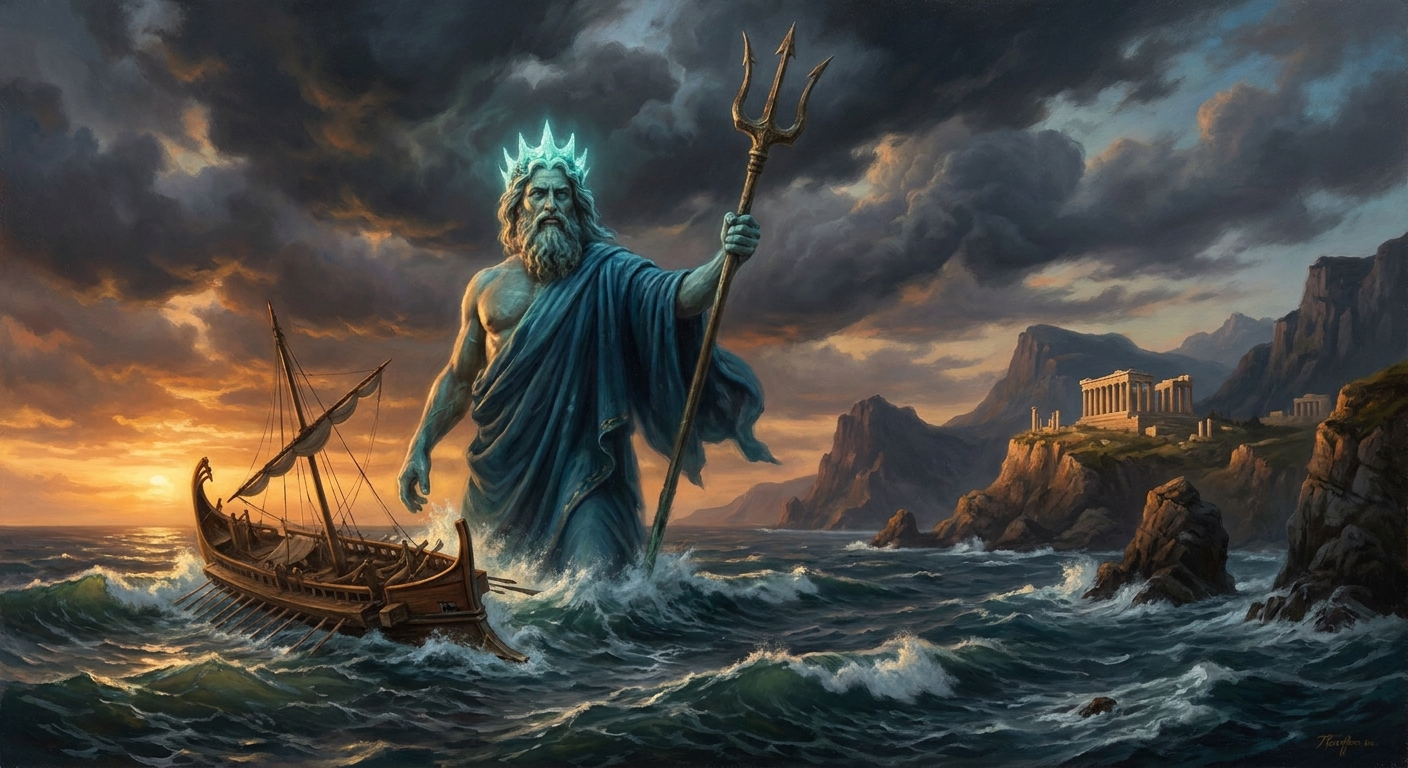
Poseidon is easy to misfile as “Zeus, but wetter.” It is a rookie mistake, the kind that gets a ship broken on a reef while the sky stays perfectly blue. In Greek myth, Poseidon is not merely the sea. He is the mood of the sea. He is the fact that water has a will, that coastlines are temporary, and that the world beneath your sandals may, on a whim, decide to move.
And because Greek mythology loves a god with range, he also arrives with horses thundering out of salt-foam and with the old, cold title that made ancient cities swallow hard: Earth-Shaker.

Who Poseidon Is
In Homer and beyond, Poseidon is called Ennosigaios, the Earth-Shaker. You will also meet Gaieochos, “Holder of the Earth,” and cousins of the same idea such as Enosichthon. These are not decorative epithets. They are a warning label, and a clue to why a sea god can still reach you inland.
Yes, he rules the sea after the Olympians divide the cosmos, but Poseidon’s power keeps slipping across borders like water under a door. He sends storms. He breaks ships. He fathers monsters. He stirs the ground. He produces horses, those beautiful panic engines the Greeks admired and feared in equal measure. His mythic portfolio tells you what coastal peoples already knew: the sea is never only the sea.
Sea Storms
Odysseus and a god’s grudge
If you want to understand Poseidon’s storms, do not picture random weather. Picture a grudge that learned to speak in wind.
In the Odyssey, Odysseus blinds the Cyclops Polyphemus, who is not just any monster, but Poseidon’s son. Polyphemus prays to his father, and Poseidon answers in the language he speaks best: he makes the sea into a long, humiliating detour. Odysseus is not struck down quickly. He is made to drift. He is made to lose time, men, and certainty.
Poseidon does not always kill you. Sometimes he simply ensures you arrive too late to recognize your own life.
The storm that finally shatters Odysseus’ raft after Calypso releases him is Poseidon as pure temperament: the horizon blackening, the waves rising like animals, the hero reduced to a body in salt and prayer. Even when other gods intervene, the message remains. The sea has a king, and that king remembers.
Laomedon and the cost of cheating
Poseidon’s storms also appear as civic punishment. In one well-known tradition, Poseidon and Apollo help build the walls of Troy for King Laomedon. The king withholds their promised payment, and Poseidon sends a sea monster against Troy’s shore, while Apollo’s anger is often felt as plague.
The myth is not subtle. Treat divine labor like disposable labor and the ocean will invoice you in teeth. Heracles later arrives to deal with the monster, but the stain remains on Laomedon’s name. With Poseidon, bargains matter. Even kings are just mortals who forgot to read the fine print written in foam.
Horses
Poseidon’s relationship with horses is one of those mythic facts that feels strange until you stare at it long enough and realize it is perfect. Horses are beautiful, volatile, expensive, and hard to restrain. In other words, they are Poseidon in muscle and breath.
He is worshipped as Poseidon Hippios, Poseidon of Horses. Some traditions credit him with creating the first horse. Others show him producing horses as gifts, bribes, or proof of divine status. The sea god, of all gods, is a patron of something that belongs to the land, which is exactly the point. Poseidon’s power does not stay in its lane.
Athens chooses the olive
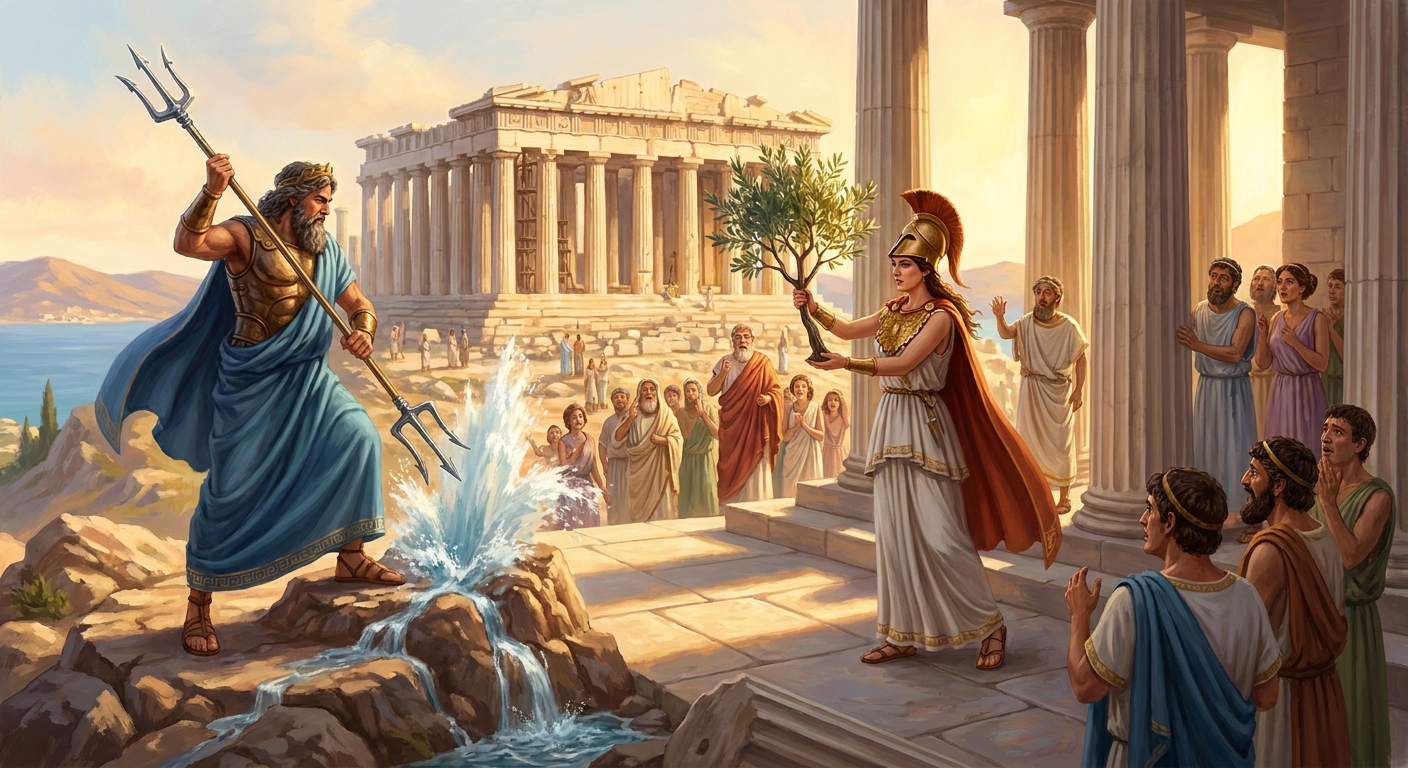
In the famous contest for the patronage of Athens, Poseidon and Athena offer gifts to the city. Poseidon strikes the ground with his trident and brings forth a saltwater spring, the “sea” remembered on the Acropolis. In some tellings, the gift is a horse instead. Athena offers the olive tree. The Athenians choose Athena.
It is a story about values, yes, but it is also a story about PR. Poseidon’s gift is dramatic, glamorous, and a little impractical, like handing a city a storm in a bottle and calling it a blessing. Athena offers something that feeds people, lights lamps, and builds wealth.
Demeter and Arion
Some Poseidon horse myths are not cute origin stories. They are darker, older, and edged with pursuit. In an Arcadian tradition, Demeter attempts to evade Poseidon by transforming into a mare, hiding among horses. Poseidon becomes a stallion and takes her by force. From this union comes Arion, a wondrous horse described as swift and, in some accounts, able to speak.
Ancient myth often treats divine desire as a force of nature rather than a moral problem, and modern readers are right to feel the discomfort. Still, the transformation is revealing: Poseidon’s horse aspect is not decorative. It is how the myths express relentless momentum, the unstoppable surge of appetite and power, the way the god’s domain spills into bodies and fields.
Earthquakes
The Greeks did not need seismographs to feel the truth of Poseidon’s title. A quake is a kind of betrayal, because the ground is supposed to be loyal. When it moves, the world becomes suddenly mythic again, the way it must have felt in the Bronze Age when every tremor could be read as a god shifting in his sleep.
Poseidon’s earthquake power appears in myth and cult alike. He was honored in places that feared shaking earth, and his sanctuaries clustered where the sea and land argue constantly over who gets to exist.
Walls that do not stay standing
Poseidon is a builder and a destroyer, sometimes in the same breath. Myths that place him as a contributor to city walls, like Troy’s, sit beside the idea that he can crack foundations open. This contradiction is not an accident. It reflects a coastal worldview: the same forces that allow trade and prosperity can also erase the map.
Theseus and shifting bloodlines
Even in stories centered on Athens, Poseidon’s presence hangs like weather. Theseus is sometimes called a son of Poseidon, sometimes of Aegeus, sometimes both. Heroes often carry complicated paternity like a second weapon, and the ambiguity fits Poseidon’s nature. He is the god of unstable borders. Even bloodlines blur around him.
Monsters and Consequences
Where Poseidon goes, monsters follow like surf. Sometimes they are his children. Sometimes they are his tools. Sometimes they are what happens when the sea is given a personality and it decides to show you its teeth.
Medusa and Pegasus
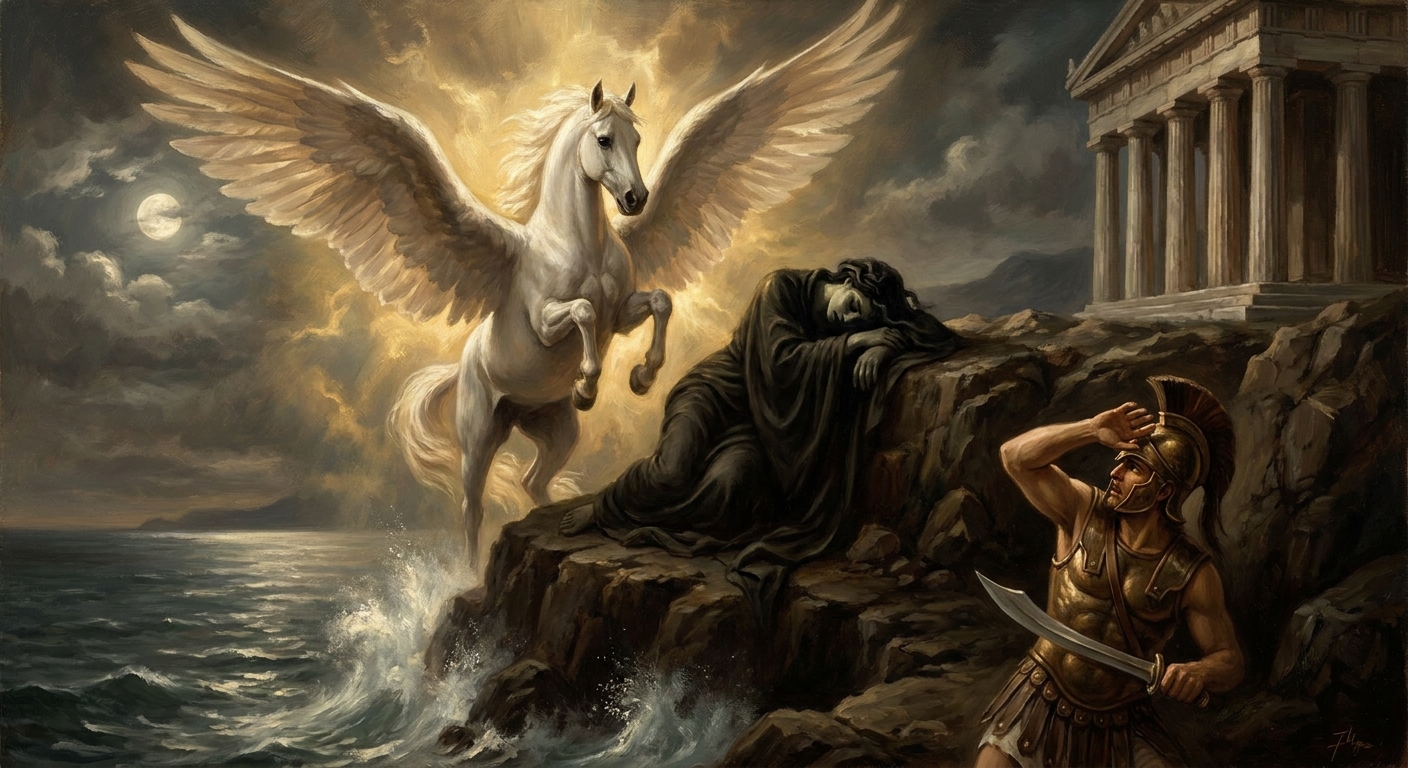
One of myth’s most iconic horses, Pegasus, is tied to Poseidon through Medusa. In many traditions, Poseidon lies with Medusa, and when Perseus later beheads her, Pegasus springs from her blood, along with the warrior Chrysaor. The myth is grotesque, gorgeous, and typical of Greece: beauty arriving through catastrophe, a winged horse born from a moment nobody would call gentle.
If Poseidon is in the background here, he is still unmistakable. His stories keep producing creatures that feel like contradictions made flesh: horse and bird, wonder and violence, gift and omen.
Minos and the bull from the sea
Poseidon’s most famous “gift with a hook in it” appears in the Cretan cycle. King Minos asks Poseidon for a sign of legitimacy. The god sends a magnificent white bull from the sea, meant to be sacrificed back to him. Minos, entranced by the bull’s beauty and value, keeps it instead.
Poseidon’s response is not a lightning bolt. It is worse: he bends desire itself. In many versions, Minos’ wife Pasiphae is made to long for the bull, and the result is the Minotaur, the half-bull monster hidden in the Labyrinth. Other tellings spread the blame across the gods, but the lesson stays sharp.
Poseidon does not only punish bodies. He punishes choices, especially the moment a mortal decides a god’s offering is theirs to edit.
This myth braids together Poseidon’s signatures: the sea’s sudden generosity, the demand for correct ritual, the humiliation of kings, and the way blessings become nightmares when you mishandle them.
How He Was Worshipped
Poseidon was not only a character in a story. He was a god with calendars, altars, and anxious attention. Sailors made offerings for safe passage, and coastal communities treated him like a neighbor with a temper, the kind you greet politely because you live too close to his fence.
At the Isthmian Games near Corinth, Poseidon receives the kind of public honor that feels like diplomacy. And in places remembered for disaster, like Helike, swallowed by earthquake and sea in the historical imagination, the Earth-Shaker’s myth is not metaphor. It is an explanation people could point to with wet hands.
What to Watch For
Once you recognize Poseidon’s patterns, his myths read like a set of ocean rules written in bronze.
- He is transactional. Vows, sacrifices, and payments matter. Forgetting that is how you meet a monster.
- He is territorial, but not contained. His power leaks inland through springs, horses, and earthquakes.
- He loves spectacle. A salt spring, a bull from the sea, a storm that turns the horizon into a verdict.
- He remembers insults. Odysseus learns that the sea can carry a grudge for years.
Why He Still Feels Near
I live in Seattle, where water is not a backdrop. It is weather, it is commerce, it is mood, it is a daily negotiation. And when I hike the Pacific Northwest and watch fog roll in like a curtain, I understand why Greeks made a god out of the sea’s volatility. You cannot reason with it. You can only respect it and hope it respects you back.
Poseidon endures because he is honest about the world’s glamour and cruelty. He offers horses that gleam like living myth. He offers storms that strip heroes down to breath and prayer. He offers earthquakes that remind cities their marble is temporary.
And if you listen closely in these stories, beneath the roar of waves and the thunder of hooves, you can hear the oldest lesson Greek myth ever taught coastal people: the sea is beautiful, but it is not kind. It has a king. His name is Poseidon.