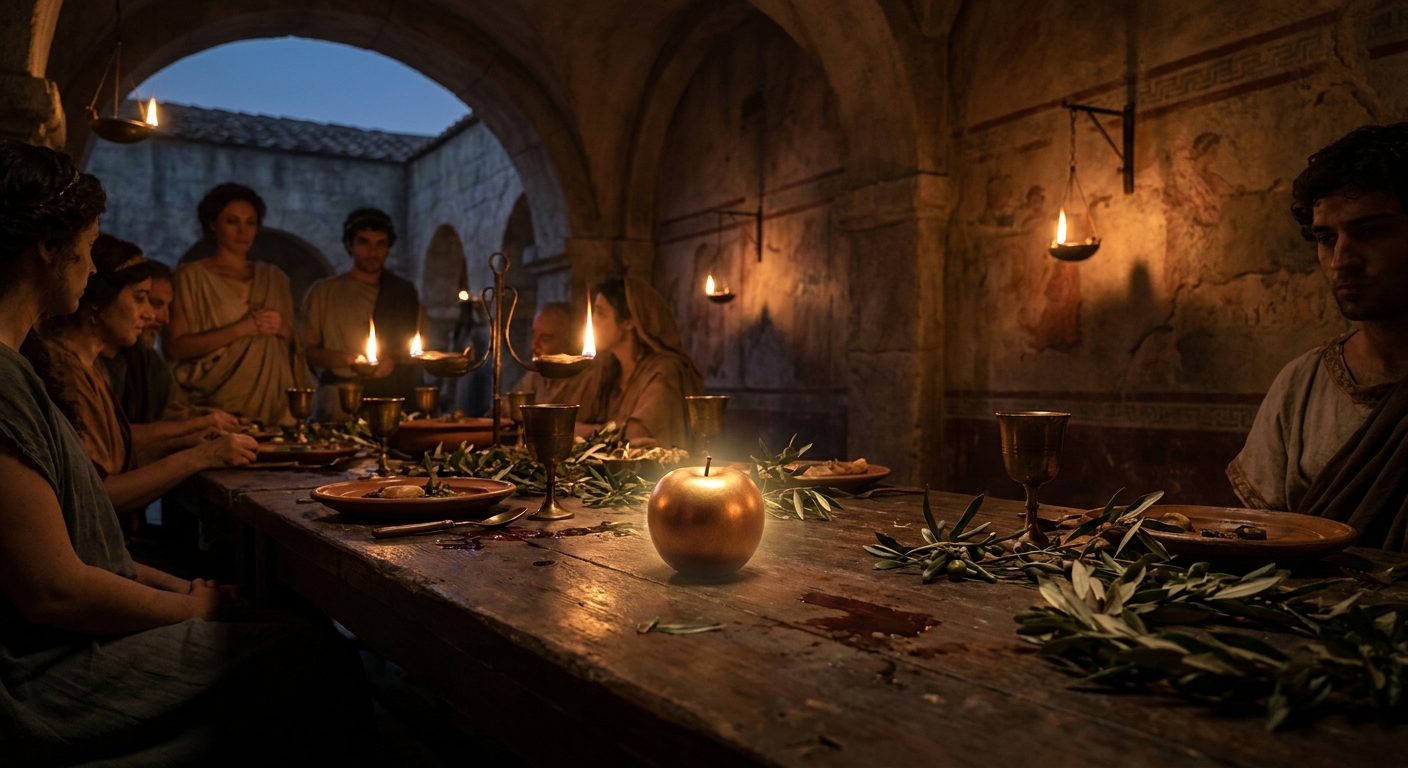
The Golden Apple
Greek Mythology
It starts the way Greek catastrophes often do: with a party on a mountain, a guest list, and one person who notices they have been left out.
There are wars that begin with borders, treaties, and strategy. Then there is the Trojan War, which begins with a wedding reception and a single object small enough to fit in a palm: the golden apple.
On Paleothea, I love the big, thunderous myths. But this one has always felt more unsettling because it is so familiar. A slight. A room full of powerful people who cannot let it go. A “just one little choice” that becomes a decade of funerals.

The wedding that should have been safe
The wedding of Peleus, a mortal hero, and Thetis, a sea nymph, is not just romance. It is politics. The marriage is arranged in part because Zeus and, in some accounts, Poseidon both desired Thetis, and a prophecy warned that her son would be greater than his father. Better, then, to marry her to a mortal and keep that future power from rising inside the divine household.
So the gods gather to celebrate, often said to be on Mount Pelion in Thessaly. In many tellings, it is a rare moment where Olympus attempts something like harmony. The wine flows. Salt air clings to the garlands. The guest list is meticulous.
And then comes the omission. In the familiar telling, Eris, goddess of strife, is not invited. The ancients loved a lesson about hospitality, but with Eris it is more than etiquette. Leaving out strife does not eliminate strife. It only guarantees it will return with better timing.
Eris arrives with a weapon disguised as a prize
Eris crashes the celebration and tosses a golden apple into the crowd, inscribed with a phrase that is less a compliment than a trap: “to the fairest” (Greek: tē(i) kallistē(i), “to the most beautiful”).
It is not the apple that matters. It is the social mechanism it unleashes. In a room of immortals, “fairest” is not a harmless label. It is prestige, power, and rank, compressed into one glittering word.
A single apple hits the floor, and suddenly everyone is auditioning for supremacy.
Three goddesses claim it at once. Hera reaches like a queen collecting what is already hers. Athena looks at it like a problem to be solved and a victory to be won. Aphrodite smiles as if the room has finally started telling the truth. The argument escalates fast, because of course it does. Nothing in Greek myth is more volatile than divine self-image.
Zeus, who can hurl lightning but cannot survive household politics, refuses to judge. Instead, he hands the decision to a mortal.

Why Paris is chosen
The judge is Paris, a Trojan prince. This detail is not random. It is destiny with paperwork.
Paris has his own mythic backstory: born to Priam and Hecuba of Troy, he is tied to ominous prophecies. In several traditions, a dream or oracle warns that the child will bring ruin to Troy, so he is exposed on a mountainside and survives anyway, raised by shepherds. The city tries to abandon its doom, and doom develops excellent stamina.
By the time the goddesses arrive, Paris is young, beautiful, and positioned exactly where myth loves to place a human: between forces too big to understand, yet flattered into thinking he has control.
The bribes
The “Judgment of Paris” is often framed like a beauty contest, but it is really a bidding war over what kind of life Paris will live, and what kind of world will follow him.
- Hera offers kingship and political power, in some versions dominion over all Asia and beyond.
- Athena offers victory and skill: unmatched wisdom, martial excellence, glory earned through discipline and strategy.
- Aphrodite offers love: the most beautiful woman in the world.
It is easy to scoff at Paris for choosing desire over dominion. But Greek myth is sharper than a morality play. Aphrodite is not offering a wholesome romance. She is offering a specific woman, one already entangled in oaths, alliances, and the fragile honor economy of Greek kings.
That woman is Helen.
The gods do not need armies to start a war. They just need the right promise in the right ear.
Helen is not a prize
Helen of Sparta is typically the daughter of Zeus (often by Leda), which makes her beauty feel less like genetics and more like divine design. She is married to Menelaus, king of Sparta, and her marriage is not only personal. It is a diplomatic knot tying Greek leaders together.
In many accounts, Helen’s former suitors once swore the Oath of Tyndareus to defend the chosen husband and punish anyone who violated the marriage by carrying Helen off. The oath is one of those mythic details that looks dull until it detonates. It means that if Helen is taken, the men who swore it are bound to answer.
Aphrodite’s “gift” is not simply “the most beautiful woman.” It is “the most politically dangerous woman to take.”
From judgment to departure
How Helen ends up in Troy varies by source and tone.
Some traditions emphasize abduction, making Paris a thief under Aphrodite’s protection. Others play up seduction or divine compulsion, suggesting Helen is swept into a goddess’s agenda. Later tellings complicate it further, letting Helen speak with more agency, more resentment, or more grief, depending on the poet.
There is even a famous alternative tradition, associated with Stesichorus and later dramatized by Euripides, where a phantom Helen goes to Troy while the real Helen remains elsewhere. Greek myth loves a war so much it will stage it twice, once with a woman, once with her likeness.
What stays consistent is the result that matters for the story’s machinery: Helen leaves Sparta with Paris, and Menelaus calls on the oath. The Greek leaders rally under Agamemnon, Menelaus’s brother, and the long logistics of war begin to turn.
At this point, the apple has done its real work. It has converted a divine rivalry into mortal necessities: ships, supply lines, and young men who will die on foreign sand.

Olympus picks sides
Once the war begins, the goddesses do not gracefully move on. This is Greek myth. Spite is a renewable resource.
Because Paris awards the apple to Aphrodite, Hera and Athena become implacably anti-Trojan in many tellings. Aphrodite, naturally, supports Troy and especially Paris, though she cannot shield him from everything. Even gods have limits, or at least boundaries imposed by the story.
The Trojan War becomes not only a clash between armies, but a stage for divine vendettas. Heroes are favored, punished, rescued, misled. The battlefield is crowded with invisible hands.
And if you have ever wondered why the gods feel so emotionally invested in mortal suffering, the apple is part of the answer. It turned the war into an extension of Olympian reputation.
For the gods, the war is personal. For the mortals, it is fatal.
Where it appears in sources
Myths rarely live in a single “official” version. The golden apple episode belongs to the broader Trojan Cycle, and it is most vividly preserved in later summaries and retellings.
- The wedding and apple story is famously associated with the lost epic Cypria, known through later references and summaries.
- Apollodorus (in the Library) provides a compact mythographer’s version, including the judgment and the bribes.
- Hyginus (in the Fabulae) also preserves key beats of the story in Latin mythographic form.
- Homer does not narrate the apple scene in the Iliad, but the consequences saturate the poem. The war is already burning when Homer opens the curtain.
This matters because it keeps us honest. The apple story feels inevitable, but it is a stitched thread in a much larger tapestry of poems, cult traditions, and later mythography. Greek myth is not a single book. It is an argument across centuries.
Why it still feels modern
If the Trojan War has a mood, it is inevitability. But what the apple reveals is that inevitability can be manufactured. Eris does not force anyone’s hand. She creates a situation where pride does the work for her.
That is the small insult at the heart of it. Not a sword. Not a siege engine. A deliberate social provocation aimed at three immortals who cannot bear to lose face.
And the humans are the ones who bleed.
In the Pacific Northwest, we have landscapes that can feel mythic: storm-dark water, cedar forests, mountains that look like sleeping gods. Hiking under low clouds, I think about how Greek myth ties fate to terrain. The world looks beautiful, and then it ruins you.
The apple belongs to that tradition. Something gleaming in the hand. Something catastrophic in the shadow it casts.
The takeaway
The golden apple drags Olympus into the Trojan War because it exposes what Olympus already is: a family of gorgeous, volatile powers obsessed with status, devotion, and vengeance.
Eris does not create that. She simply names it, gilds it, and tosses it into the center of the room.
And somewhere in the echo of that apple hitting the floor is the sound of a thousand oars entering the sea.