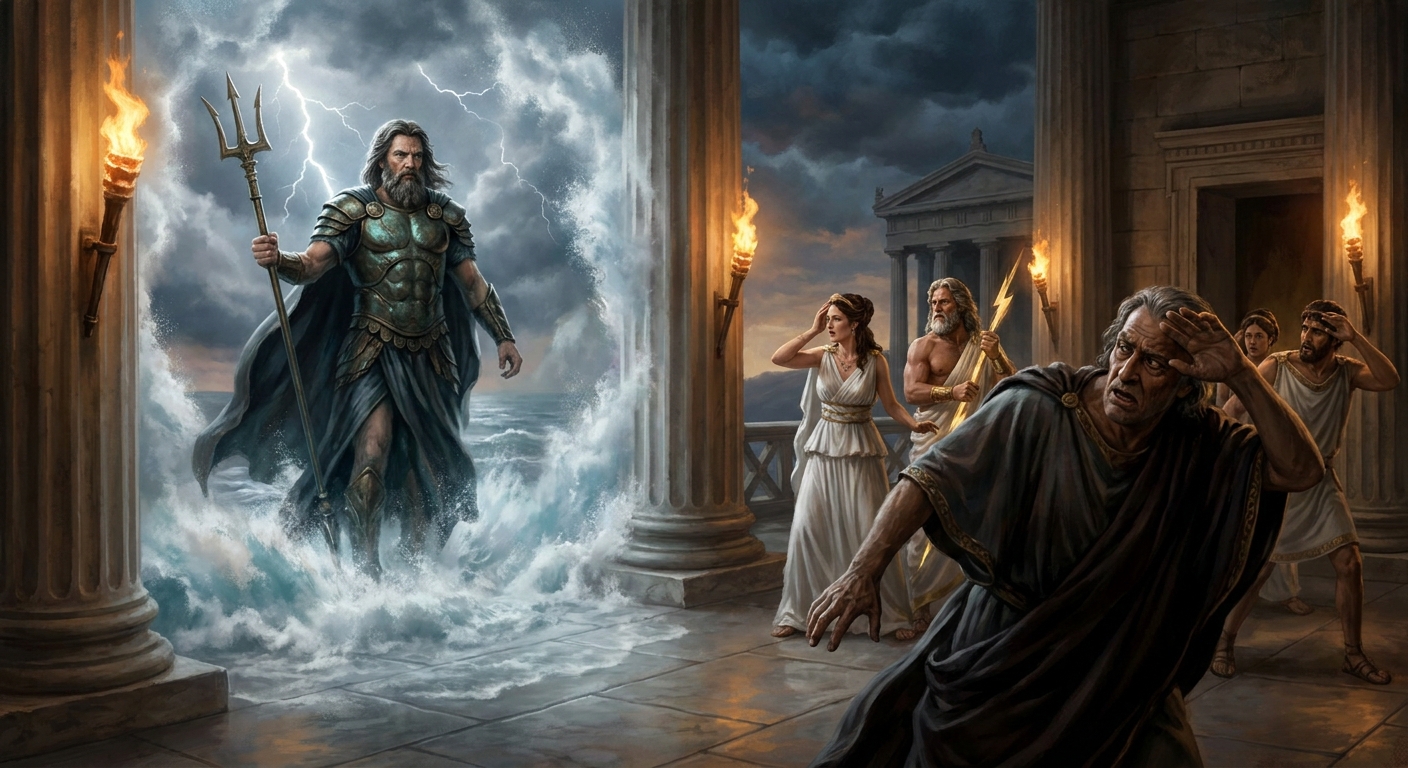
The Birth of Poseidon
Greek Mythology
Poseidon does not arrive in Greek myth like a gentle wave. He arrives like a coastline breaking.
His origin belongs to that early era when the universe still feels half-formed, still loud with Titan violence. Before the seas had a king, before the trident became a sign of settled rule, there was a child swallowed whole by a fearful father trying to choke prophecy into silence.

And somehow, that swallowed child becomes the god of the sea, the Earth Shaker, and the strange father of horses, as if the world’s wildest forces recognize him as kin.
This is the beginning of Poseidon, which is to say: the moment the world learns what it means to be shaken.
Swallowed by Cronus
Poseidon’s first cradle is a prison.
In Hesiod’s Theogony, the Titan Cronus hears the prophecy that unseats kings: one of his children will overthrow him, as he overthrew his own father Uranus. Cronus answers with appetite.
Each time Rhea gives birth, Cronus swallows the child and seals them inside his body, as if flesh can lock a future. Hestia, Demeter, Hera, Hades, and Poseidon vanish into that living darkness.
Some births are not beginnings. They are delays.
Poseidon’s “birth,” in this telling, is less about first breath than endurance. The myth makes the point with brutal simplicity: a tyrant tries to make destiny impossible by treating children like problems to be swallowed.
Regurgitation and revolt
Rhea refuses to keep birthing victims. When her youngest, Zeus, is born, she hides him and gives Cronus a stone wrapped in swaddling cloth instead. Cronus gulps it down, satisfied.
Zeus grows in secret and returns with a plan that ends an age. In Hesiod, Cronus is made to take an emetic and disgorge what he swallowed. Later retellings shift the mechanics and the helpers, but the hinge stays the same: the old king who tried to consume the future is forced to spit it back out.
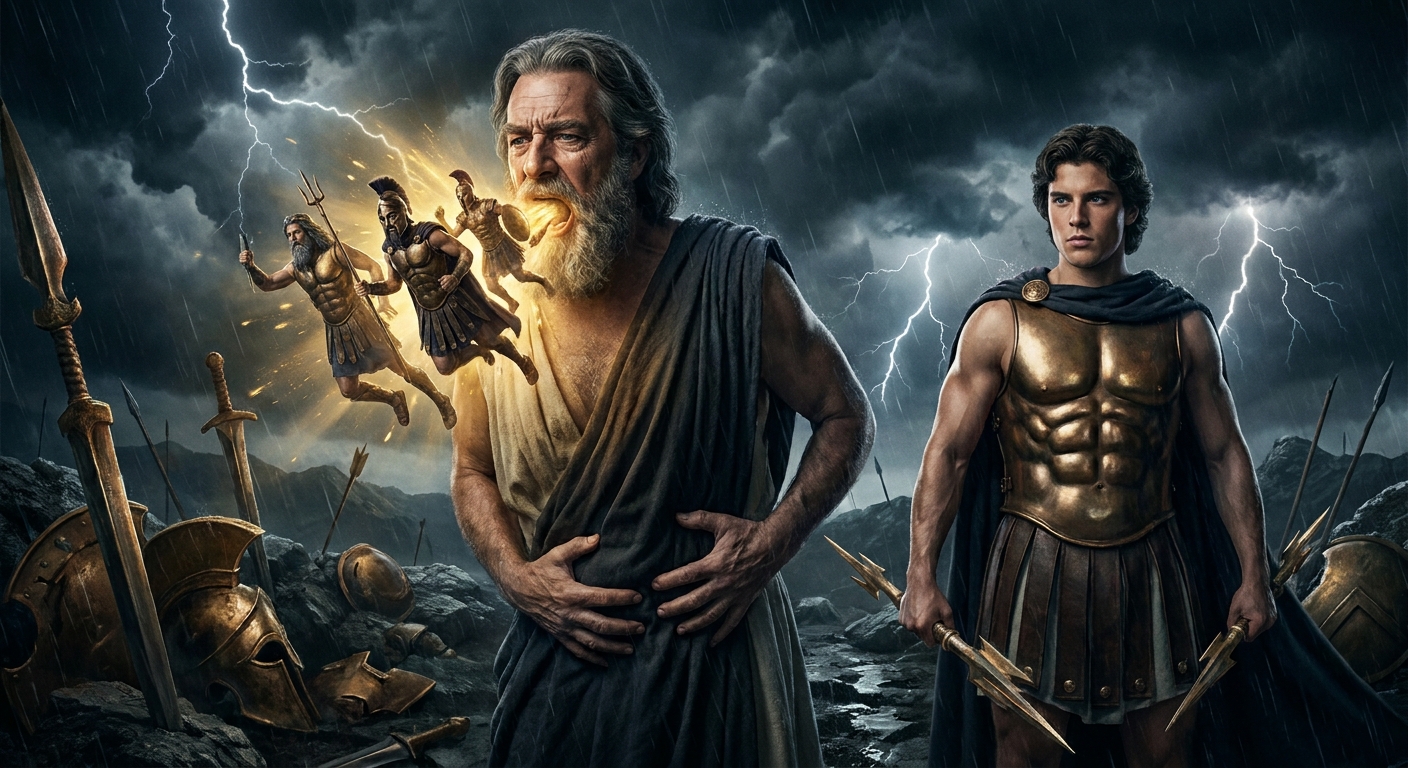
Poseidon returns to a world already cracking. The Titanomachy looms. The air tastes of thunder and scorched laurel. The younger gods are not simply born. They are retrieved, like weapons pulled from a sealed chamber.
There are also narrower, later variants that cling to Poseidon like sea-spray to stone. In an Arkadian strand of myth, Rhea saves him by tricking Cronus into swallowing a foal instead, while Poseidon is hidden away. It is not the dominant Panhellenic version, but it is unmistakably Poseidon: even his escape arrives with hoofbeats.
Childhood with the Telchines
Greek myth does not always agree on where Poseidon spends his earliest years. One later, local thread, tied especially to Rhodes in mythographic and scholium tradition, places him among the Telchines.
The Telchines are island beings described variously as daimonic craftsmen, sorcerers, or envy-soaked spirits who could blight fields and bend luck toward ruin. They belong to an older atmosphere where the line between artisan, monster, and god is thin as sea mist.
In these accounts, Poseidon’s childhood is not soft. It is salt and metal. It is the sound of hammers striking bronze like thunder along the shore. The god later honored in marble is first imagined in a place closer to a forge than a nursery.
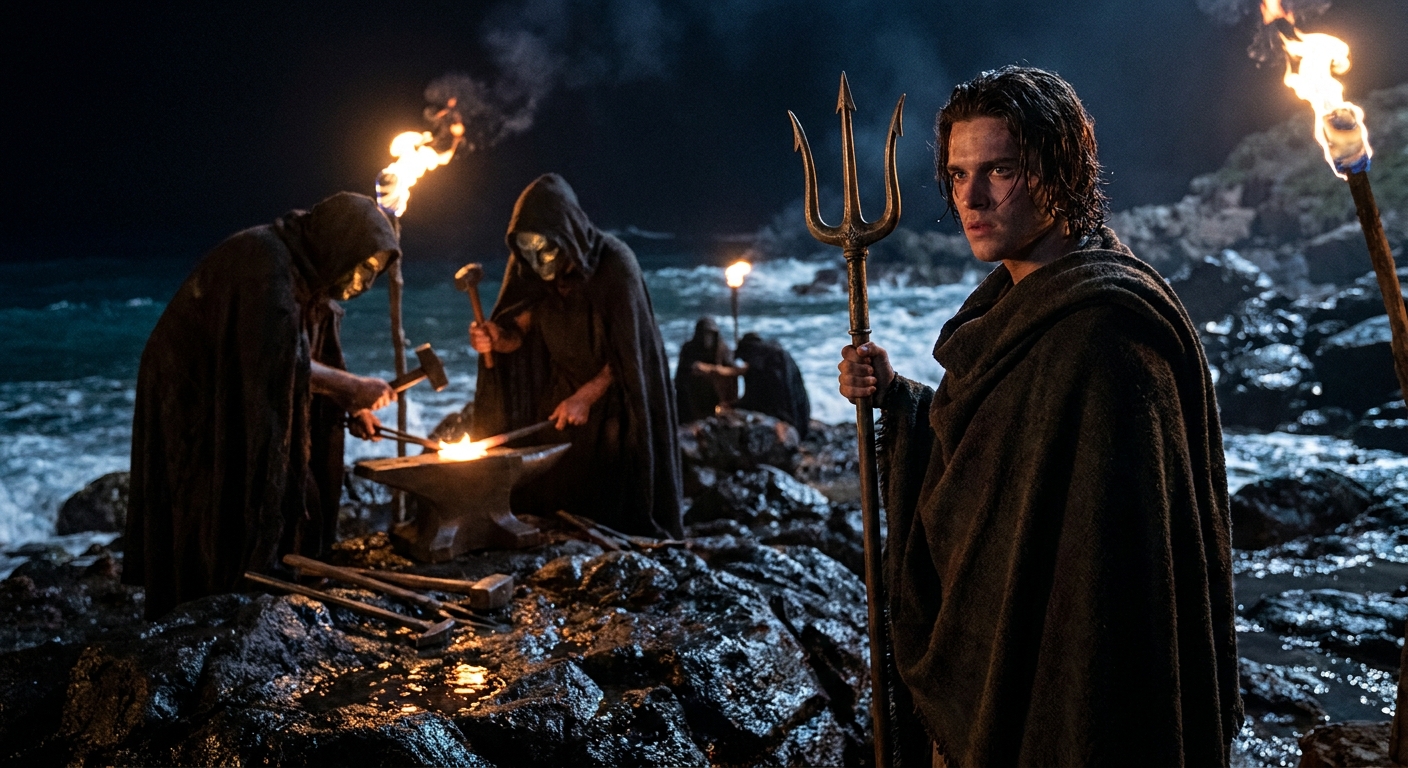
It matters because Poseidon’s power is never only about the glittering surface. The sea is his throne, but his temperament is tectonic. He is as much about what lies beneath as what storms overhead.
Division of the cosmos
After the Titans are defeated, the new order takes shape. The brothers cast lots to divide the universe.
- Zeus takes the sky and the thunder, and with it the burden of kingship.
- Hades takes the underworld, the quiet wealth of the dead, and a solitude that feels like iron.
- Poseidon takes the sea, which sounds like romance until you remember the sea is also hunger, shipwreck, and weather without mercy.
Earth itself is shared, at least in principle. In practice, the gods share like storms share a horizon.
Poseidon’s authority becomes vast: coastline, harbor, and the deep places where light fails. He is called Earth Shaker because earthquakes were felt as his movement. When the ground trembled, it was not an accident of nature. It was a god turning.
Why Poseidon rules horses
It is one of mythology’s best mismatches: why does the sea god keep arriving with horses?
The Greeks linked Poseidon not only with oceans, but with springs and wells, and the violence of water forcing its way through stone. Horses, in turn, embodied force barely contained, a living storm of muscle and breath. In some myths, Poseidon is credited with bringing forth the first horse, and cult gives him the epithet Hippios, the horse god.
Sometimes the horse is a gift. Sometimes it is an omen. Sometimes it is what happens when a god’s power tries to take a shape the world can recognize.
The contest for Athens
Power is rarely enough in Greek myth. A god also wants recognition: temples, altars, a city speaking your name through smoke and prayer.
Poseidon sets his gaze on Athens, bright and stubborn, still deciding what it will become. But Athena steps forward too, cool with intelligence and hard-edged precision. Poseidon arrives like weather given a pulse.
Each offers a gift to claim the city’s devotion.
- Poseidon strikes the ground with his trident, and a spring bursts forth. In many tellings, the water is salt, dramatic and symbolic, but useless for thirst.
- Athena offers the olive tree, a gift of food, oil, wood, and endurance.
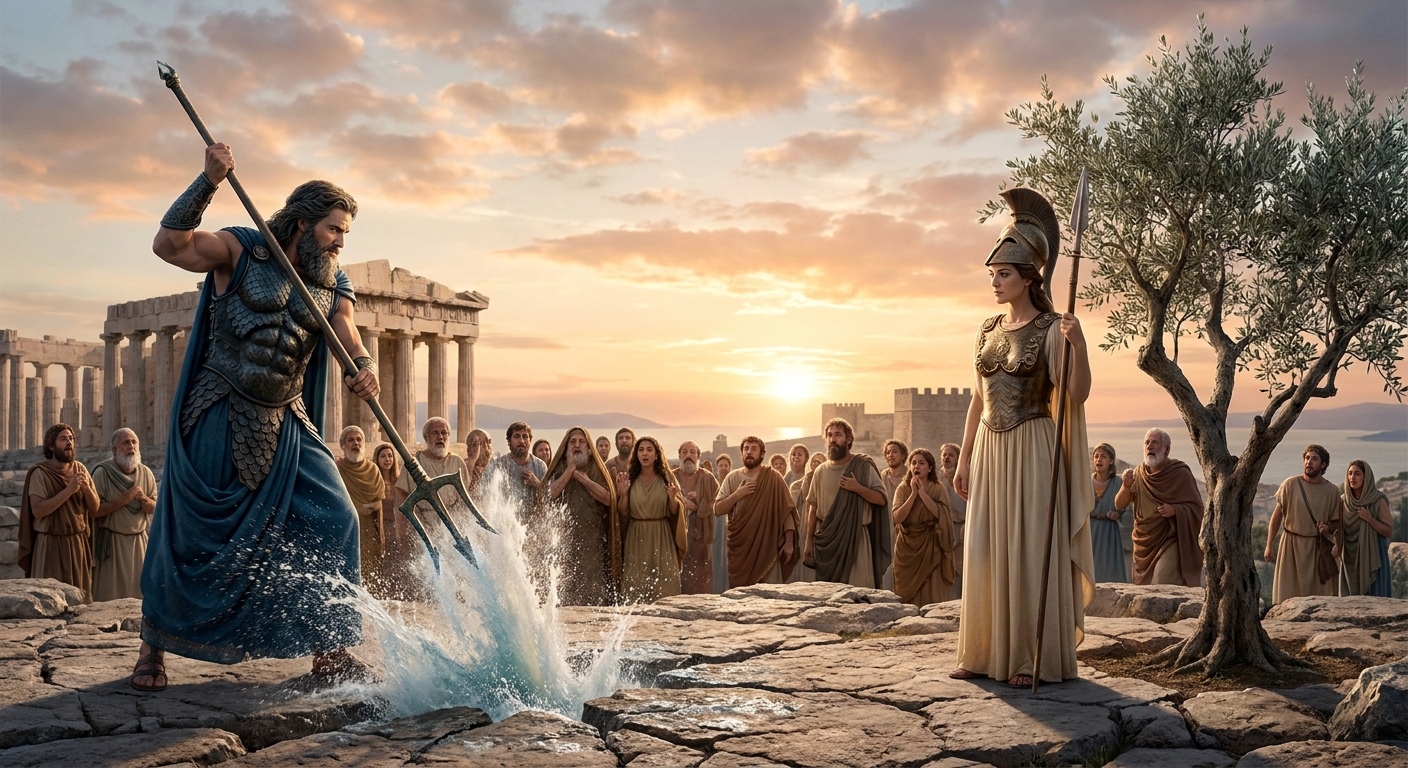
Athens chooses the olive over the salt, and a god remembers.
The city favors Athena, and the myth leaves a bruise on Poseidon’s pride. Some traditions describe retaliation as flooding the land or sending the sea against it. In a few later retellings, the punishment shifts in texture. The constant is the warning: Poseidon is not a god to dismiss.
The rivalry also carries a deeper argument about civilization. Athena offers order, craft, and law. Poseidon offers raw power, sea-roads, and the reminder that even empires stand beside water that can rise.
Signs of the Earth Shaker
By the time Poseidon is fully enthroned in the Greek imagination, he is already a study in contradictions.
Sailors worship him because he can grant passage, and fear him because he can turn a clean horizon into wreckage. He is invoked at horse races and in stables, and he is dreaded when the ground begins to mutter beneath a city’s feet. His beauty is the kind that makes mortals forget themselves for a heartbeat, then remember what gods do to arrogance.
In epic and hymn, he moves with the authority of a force older than names. His chariot is drawn by sea creatures, his palace is imagined under the waves, and his anger is never far below the surface. Sometimes he helps heroes. Sometimes he hunts them. Often the difference is not justice, but respect.
That is the earliest sign of Poseidon’s rule: not simple cruelty, not simple kindness, but demand. He is the ocean given a face and a temper. He is the earthquake with a signature.
From swallowed to sovereign
Poseidon’s myth begins inside Cronus, but it does not stay there. It moves outward like pressure seeking a fault line.
- He is born into a cycle of overthrow, where children inherit power and unfinished violence.
- He is tied, in later local strands, to older and stranger edges of the world, where the Telchines blur craft and curse.
- He claims a domain that never stays still, and that instability becomes his signature: magnificent, volatile, permanent.
- He learns the humiliation of Athens, and the lesson hardens into something like law: worship is not optional.
Poseidon is proof that Greek myth loves transformation. A swallowed child becomes an elemental king. A victim of a father’s terror becomes a god whose temper can frighten coastlines into prayer.
And when the sea darkens without warning, when the ground shivers underfoot, when horses rear as if they sense a storm before the sky admits it, the old story feels less like a relic and more like a memory the world still carries.
Sources and myth notes
Ancient myths come in versions, and Poseidon’s origins are no exception. The core sequence of swallowed children and Cronus’s disgorging is most famously preserved in Hesiod’s Theogony. Other details in this article are explicitly later or local traditions, kept here as variations rather than a single canon.
- Hesiod, Theogony (Cronus swallowing the Olympians; Zeus’s return; Cronus made to disgorge the children).
- Later mythographers and scholia preserve local strands, including Rhodes-linked traditions about the Telchines and Arkadian variants such as the foal substitution.
- Athenian local tradition for the contest between Poseidon and Athena and the symbolism of salt spring versus olive tree, with retaliation described most commonly as flooding or raising the sea.