The Birth of Hades
Greek Mythology
There are gods who arrive with thunder and gods who arrive with a hush.
Hades belongs to the second kind. His “birth” in myth is not a cradle scene in a sunlit palace. It is a story of mouths, prophecy, and a cosmos that learns, slowly and violently, how to keep its dead in the right place.
Greek myth does something coldly elegant here: it treats the beginning of Hades as the beginning of a system. Before he is the lord of the dead, he is a swallowed infant. Before the Underworld is a kingdom with borders, it is a shadowy concept. Before death is orderly, it is simply the terrifying fact that living things stop.

Prophecy and the swallowed god
Hades is born to Cronus and Rhea, Titans ruling in the uneasy calm after Cronus seizes power from his own father, Uranus. In Hesiod’s telling, it is not a tidy coronation but a violent turning of generations, an old sky cut down so a new order can breathe.
A prophecy hangs over Cronus: one of his children will dethrone him. He responds the way tyrants do in myth when handed a warning. He tries to eat the future.
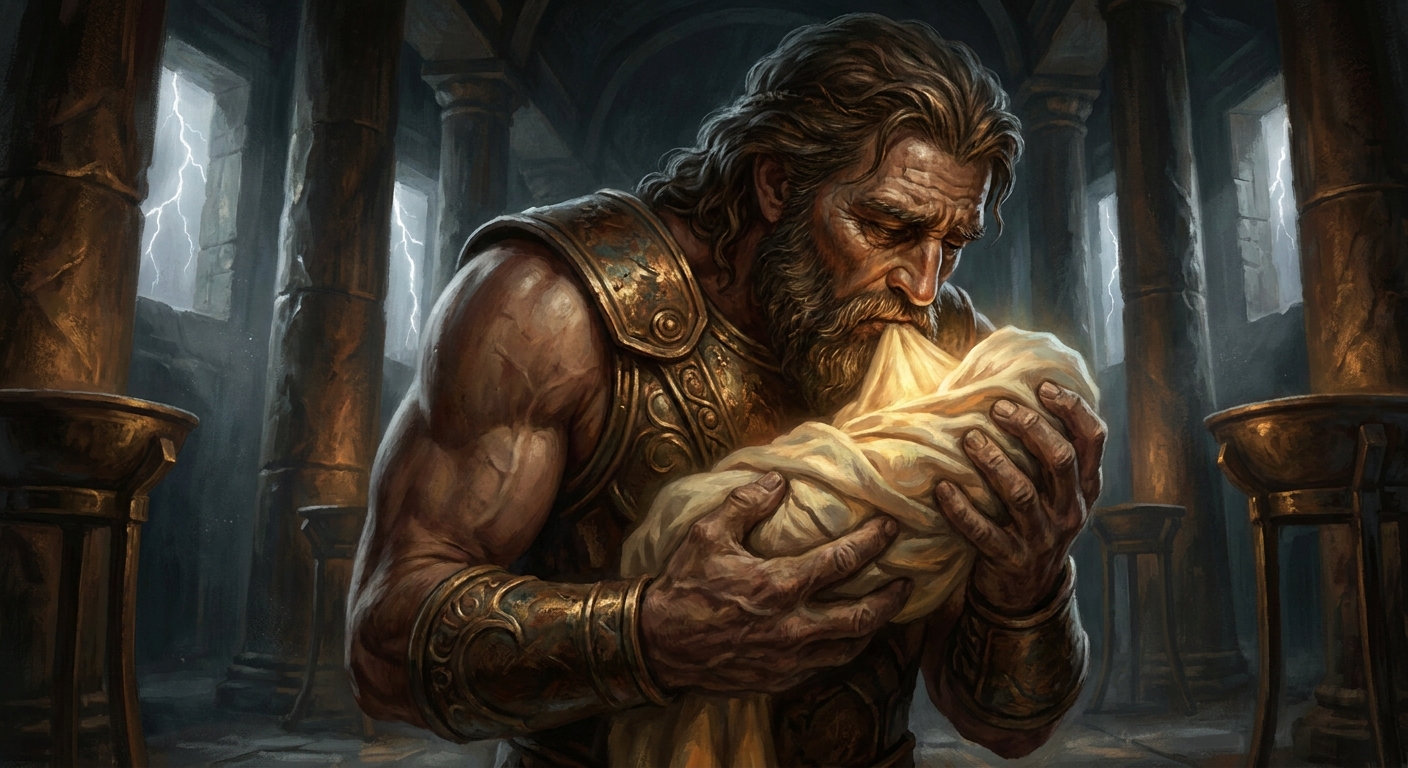
So when Rhea gives birth, Cronus swallows the children whole. In the common order given by Hesiod in the Theogony, Hestia, Demeter, Hera, Hades, and Poseidon are taken into Cronus’ body, living captives in a prison made of divine flesh.
A god is born, and the first thing he meets is not light, but a locked door made of his father.
This detail matters. Hades is not “born dark” in any moral sense. He is made familiar with enclosure, with the inward, sealed world. When his kingdom later becomes the great enclosed region beneath the earth, Greek imagination is simply continuing the first architecture he ever knew.
Rhea’s gamble
Rhea, done with birthing children into a mouth, hides her youngest, Zeus, on Crete. The Titan king is given a stone wrapped in swaddling clothes. Cronus swallows it. Myth does not insist the gods are wise. It insists they are powerful enough to survive their own foolishness.
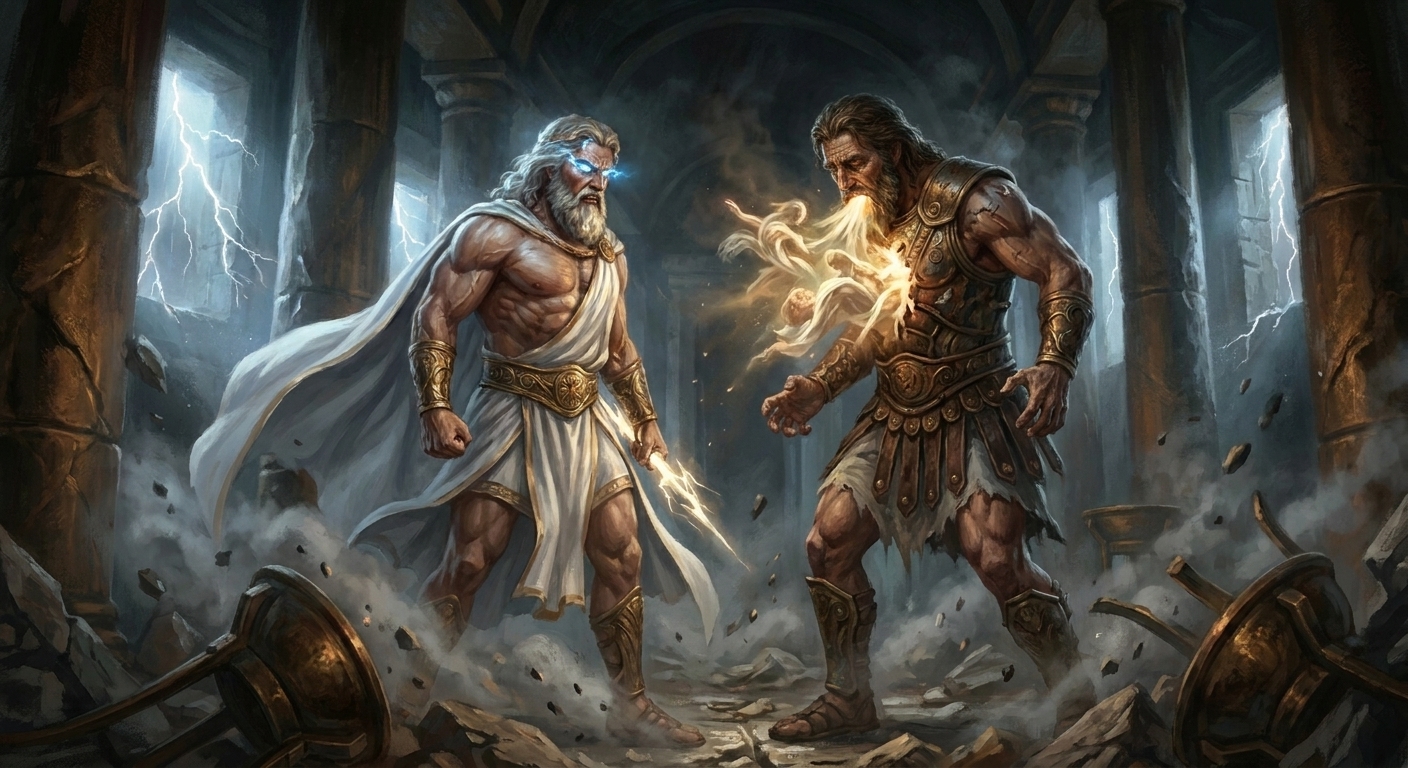
When Zeus grows, he returns with a plan that is part strategy, part poison, and entirely irreversible. Some traditions say an emetic is given to Cronus, compelled by Zeus and aided by counsel that shifts by source: sometimes Gaia, sometimes Metis in later tellings. However it arrives, the result is the same.
The siblings emerge in reverse order, like a story being unspooled back into daylight.
The war that makes room
Freedom does not mean peace. The Titanomachy follows: an Olympian generation fighting to replace the Titan regime. This war is cosmic housekeeping, the violent labor of reorganizing reality.
For Hades, the war is also identity formation. He is not the flashy hero of this conflict. He is one of the necessary ones. In later myth, he wields a crucial object: the helm of invisibility, sometimes called the Cap of Hades, often said to be forged by the Cyclopes, even if its origins are less uniformly fixed than Zeus’ thunderbolt.
Not brute force. Not persuasion. The power to pass unseen through the world’s most guarded spaces.
The lots are cast
After the Titans fall, the brothers do not simply claim everything. They do something surprisingly procedural for beings who frequently turn mortals into plants: they cast lots.
Zeus receives the sky. Poseidon receives the sea. Hades receives the Underworld.
The earth and Olympus remain, in many tellings, held in common. But the dead do not remain common property. The dead require governance. The dead require boundaries. And many Greek stories cannot imagine death as an unruled riot forever spilling back into the world.
Not a conquest, but a drawing of lots: the moment death becomes a jurisdiction.
Notice the emotional twist. Hades does not steal his realm from his brothers. He is assigned it by fate and agreement. Greek myth is ruthless about this: some thrones are prizes, and some are duties that taste like iron.
Early Underworld maps
When modern audiences picture “the Underworld,” they often picture one unified place. Early Greek thought is more layered, more geographic, and more haunted, with poets and periods arranging its regions differently.
Hades, the place and the god
In Greek sources, Hades can mean the deity and the realm. That linguistic overlap is a clue. He is not merely a resident. He is a personification of the place’s order, a consciousness applied to a vast, necessary darkness.
What exists beneath
Depending on era and author, the Underworld includes or neighbors several regions:
- Tartarus, a deep pit used as a prison for divine enemies, more a cosmic dungeon than a human afterlife.
- Asphodel, the pale meadows where ordinary dead drift in a diminished echo of life.
- Elysium or the Isles of the Blessed, a brighter fate for select heroes and favored souls in some traditions.
And then there are the borders. Greek imagination loves thresholds because thresholds create rules.
Rivers and gatekeepers
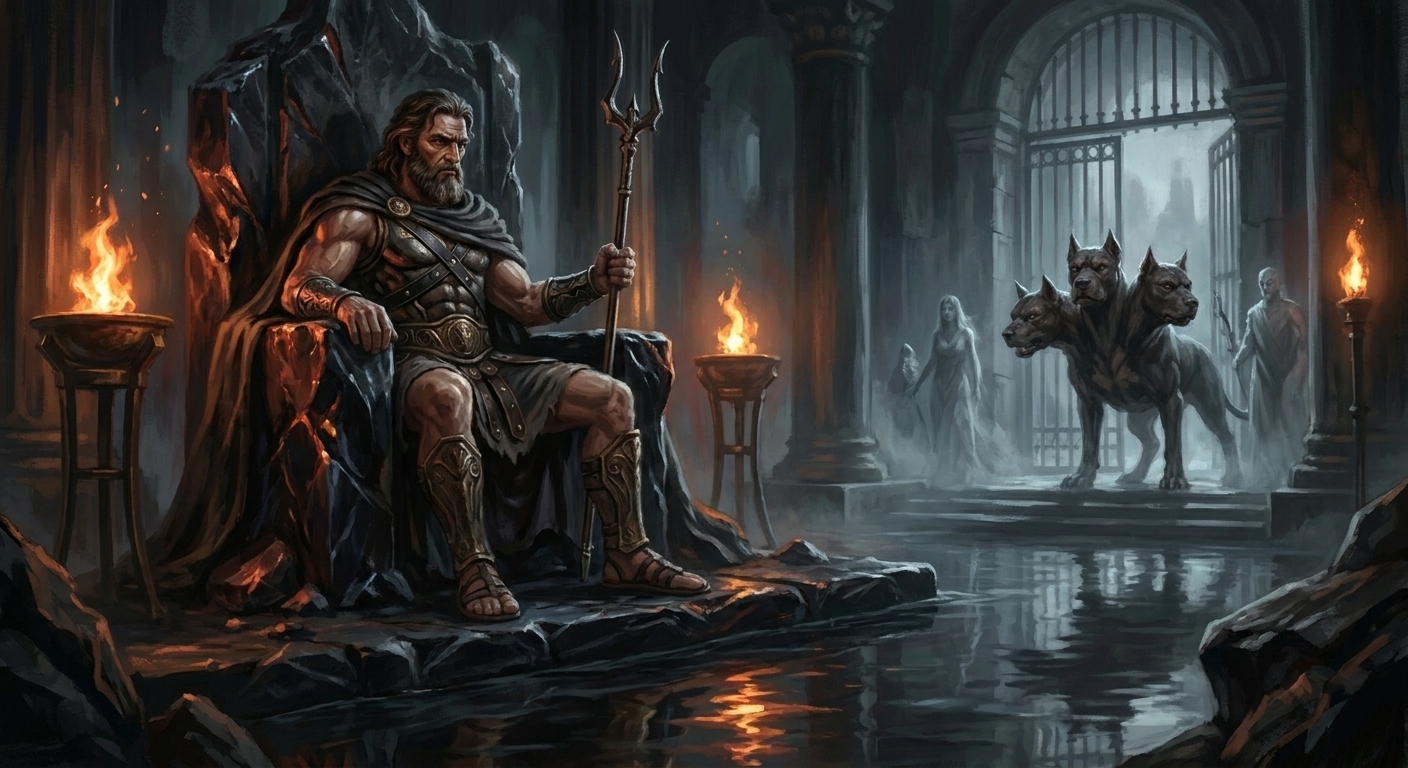
Later poets often name five rivers that stitch the Underworld together: the Styx (oath and dread), Acheron (grief), Cocytus (lament), Phlegethon (fire), and Lethe (forgetting), with details shifting between storytellers. The ferryman Charon appears as a grim logistics manager. Cerberus, the hound at the gates, is not there to attack the living for sport. He is there to keep the dead from leaving, and to keep the living from entering too easily. The boundary must hold.
Why his birth matters
To call Hades’ story “the birth of death” would be inaccurate. Mortality exists before his reign. Even the gods fear dissolution in earlier cosmic generations.
But Hades’ emergence marks something Greek myth finds almost comforting, even while shuddering: death becomes administered.
Without a ruler, the dead are chaos. With Hades, the dead become a population with an address. Myth and ritual speak to each other here. Greek funerary practice is obsessed with proper passage: burial rites, offerings, coins, libations. Not because Hades is kind, but because boundaries matter, and passage must be made correctly.
This is also why he is often approached indirectly. He is frequently called Plouton (Pluto), “the Wealthy One,” because riches rise from beneath the earth: metal veins, gemstones, fertile soil. Even language tries to soften the stare. Do not summon death by name if you can praise him as prosperity instead, or speak of the House of Hades as though it were simply an address.
Persephone changes it
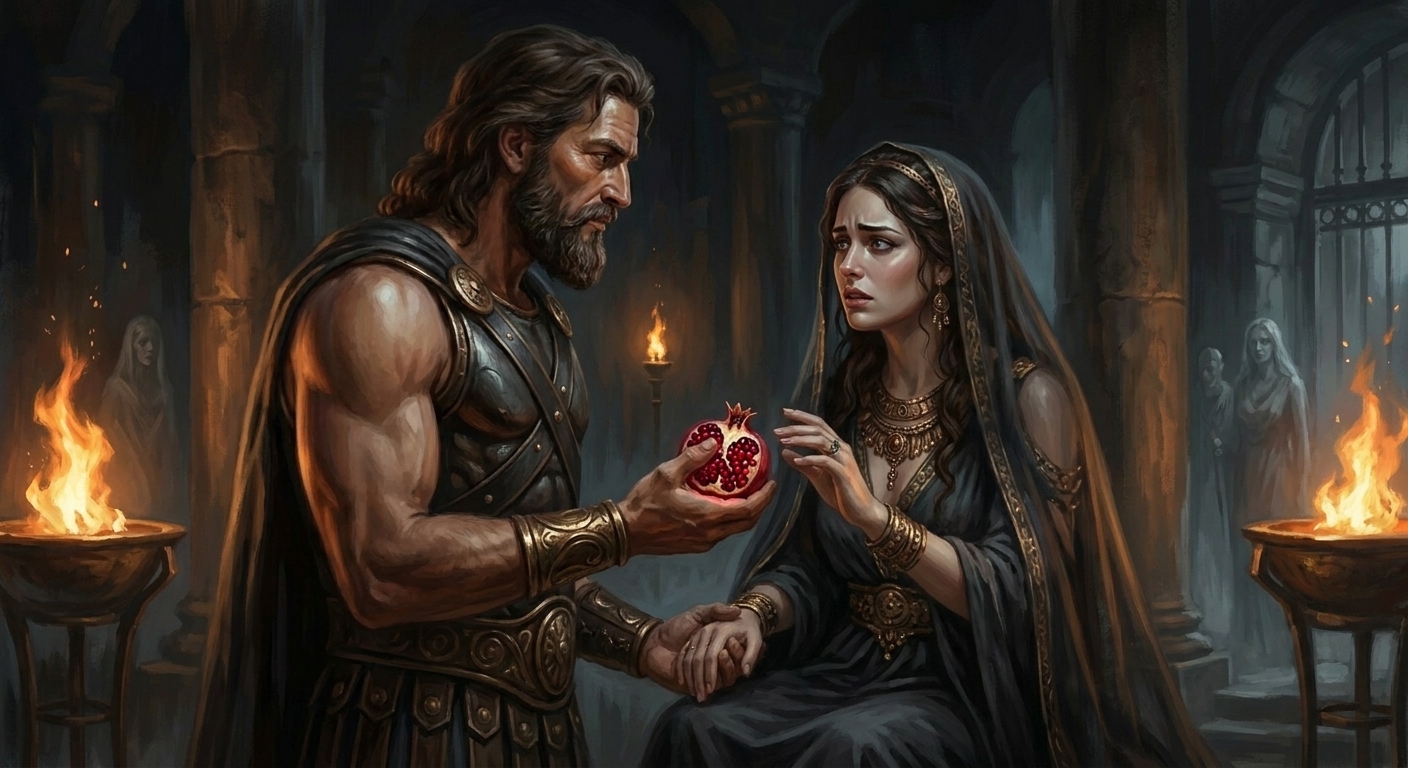
If Hades begins as solitary authority, later myth makes him a husband. The Underworld gains a queen whose presence alters the emotional weather of the realm.
Persephone, daughter of Demeter, is taken to the Underworld in the famous abduction myth, crystallized in the Homeric Hymn to Demeter. The story is political as much as romantic, a divine bargain threaded through grief and seasonal necessity.
Persephone’s role is not a decorative crown placed on Hades’ darkness. In many traditions, she becomes Underworld royalty in her own right: a figure who can receive, judge, and sometimes be appealed to. She makes the kingdom feel like a court, not only a prison. Her presence also binds the world above to the world below through the seasonal cycle: descent and return, the fields dying and rising again.
The Underworld stops being only an ending. With Persephone, it becomes a cycle with a hinge.
The god who stays
Among Olympians, Hades is a strange kind of constant. Zeus roams. Poseidon erupts. Apollo performs. Aphrodite rearranges your life for sport. Hades rules what does not move.
Greek stories rarely show him wandering the bright world because his function is not to meddle. It is to hold. Hold the dead. Hold the oaths. Hold the line that separates breath from silence.
That is why his “birth” story matters so much. It is not just a childhood anecdote. It is a mythic blueprint:
- Swallowed, he learns enclosure.
- Freed, he becomes part of a new cosmic order.
- Assigned, he turns death into a governed place rather than a screaming abyss.
And once the lots are cast, once the gates are set, once the rivers remember their names, the imagination can finally exhale. Not because death is gentle, but because it has rules. There is a king on the throne, and the kingdom, however terrifying, is no longer shapeless.
Hades does not need to be loved to be necessary. He simply needs to remain where he was placed, under the earth, beneath the olive roots and temple stones, keeping the world from filling up with what it cannot hold.
Quick myth notes
- Parents: Cronus and Rhea.
- Siblings swallowed by Cronus: Hestia, Demeter, Hera, Hades, Poseidon (with Zeus hidden).
- Release: Cronus is made to disgorge the children, often by means of an emetic; sources vary on who provides it and how directly Zeus administers it.
- Realm by lot: Underworld to Hades, sea to Poseidon, sky to Zeus.
- Common epithet: Plouton, “the Wealthy One,” reflecting earth’s hidden riches.