Hecate Myths: Crossroads, Torches, and Underworld Magic
Greek Mythology
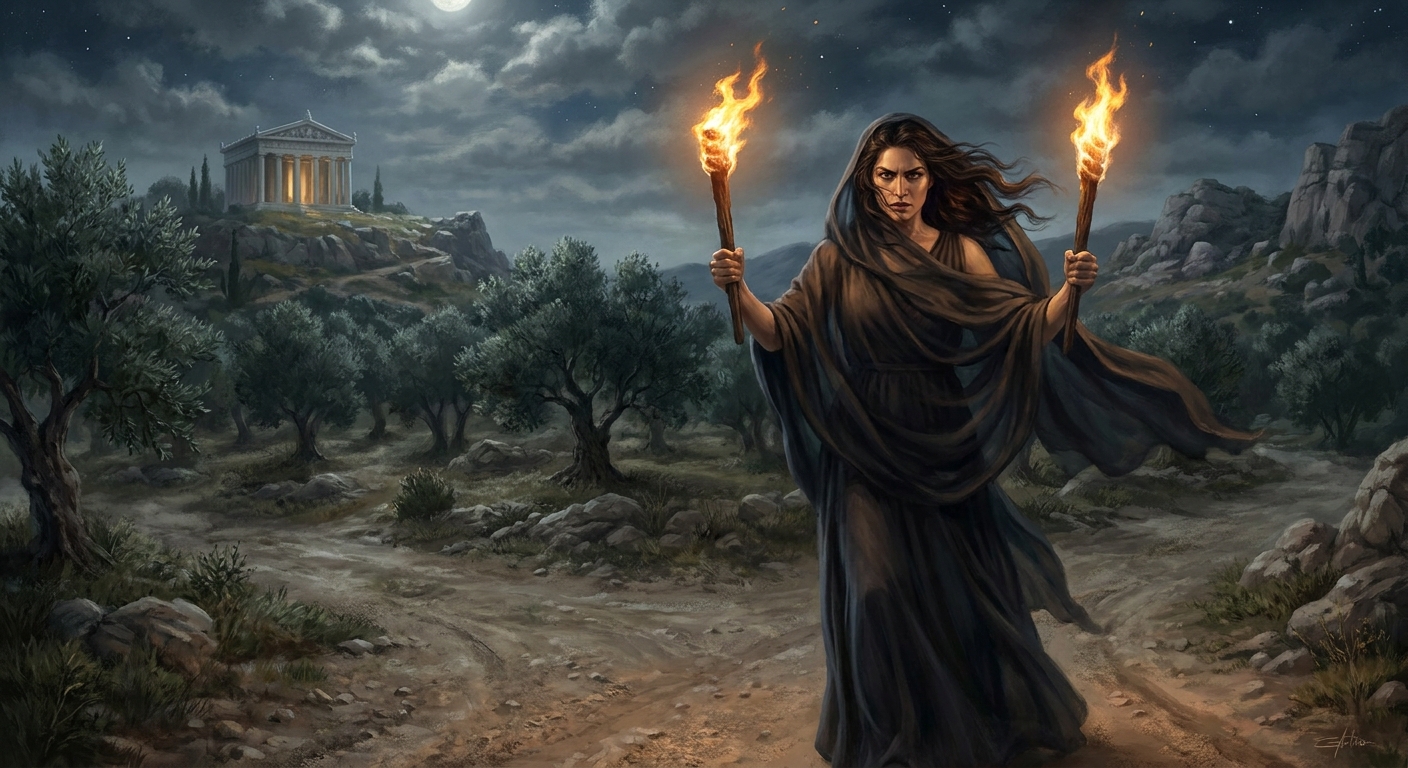
There are gods who like the spotlight, and then there is Hecate, who prefers the edge of the light, where the flame ends and the shadows start telling the truth.
She is the goddess of crossroads, thresholds, ghosts, and the uneasy brilliance of magic. Not because she is “dark” in the simplistic, modern sense, but because she rules the places we do not control: the door at midnight, the road that splits three ways, the moment you realize you have already agreed to something you cannot undo.
Hecate’s myths do not unfold like heroic epics. They happen in glances, in torchlight, in the hush between temple smoke and the Underworld’s first cold breath.

Titan-born, Olympian-honored
Hecate’s origin story already feels like a paradox, which is fitting for a goddess of the in-between. In Hesiod’s Theogony, she is born of the Titans Perses and Asteria, a lineage that, in most cases, would have made a divinity vulnerable after Zeus’ regime change.
Instead, Zeus does something shockingly un-Olympian: he confirms her honors. Hesiod’s portrait gives her honored standing “in earth, sea, and sky,” and the reach to tip outcomes across many human arenas, from contests and councils to voyages and herds. This is not the Halloween witch of late imagination. It is a primordial patron of legitimacy, luck, and granted passage.
In a cosmos built on overthrows, Hecate is the rare survivor who does not beg for a place at the new table. Zeus simply leaves her standing where she already was.
This matters because it tells you how the Greeks could think about her: not as a fringe spirit, but as a recognized power whose domain was too essential to exile. A goddess of boundaries is, by definition, present wherever borders exist.
The torchlit myth
Demeter, Persephone, and the cry in the dark
If you want the emotional center of Hecate’s mythology, you do not find it in a spellbook. You find it in the most famous abduction in Greek myth: Persephone taken by Hades, and Demeter tearing the world apart with grief.
In the Homeric Hymn to Demeter, Persephone vanishes and the earth begins to fail. Demeter searches, refuses comfort, refuses compromise. And in that first terrible gap in the story, one figure is defined not by what she sees, but by what she hears.
Hecate hears Persephone’s cry. She does not claim omniscience. She claims attention. She arrives with torches, and with them a particular kind of competence: the ability to move through darkness without pretending it is not there.
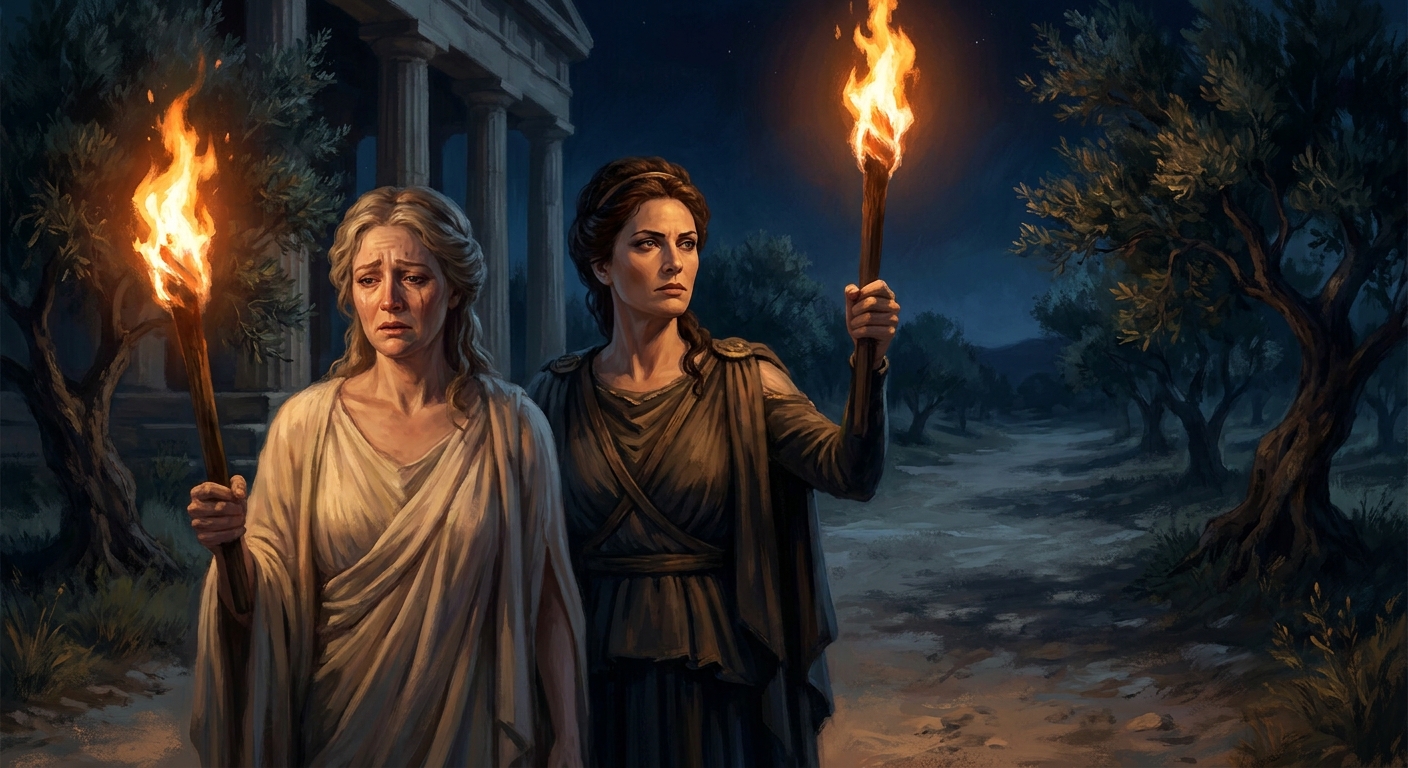
Hecate becomes Demeter’s witness and attendant. When the search reaches the point where only a god who sees everything can answer, Demeter questions Helios, and Hecate stands close, torchlight steady at her shoulder.
The machinery of myth clicks into place: the abduction was approved by Zeus, and a divine bargain begins to form around a stolen girl and a hungry Underworld.
The torches are not decoration. They are the signal that the search has crossed a line, from sorrow into revelation.
Some later traditions keep Hecate close to Persephone after the compromise of the pomegranate binds her to the dead for part of each year. In those tellings, Hecate does not soften the loss. She simply stands beside the one who must learn two worlds at once.
Crossroads and bargains
Crossroads in Greek religion are not cute metaphors. They are functional sacred spaces, where travelers pause and where the unseen feels closest. Hecate, as Enodia (of the road) and guardian of thresholds, collects meaning wherever routes split.
A three-way crossroads is a small theology lesson: multiple futures, one body, and the uncomfortable fact that choosing is a kind of sacrifice. It is no accident that Hecate becomes associated with the triple form in later art and cult practice, facing different directions at once.
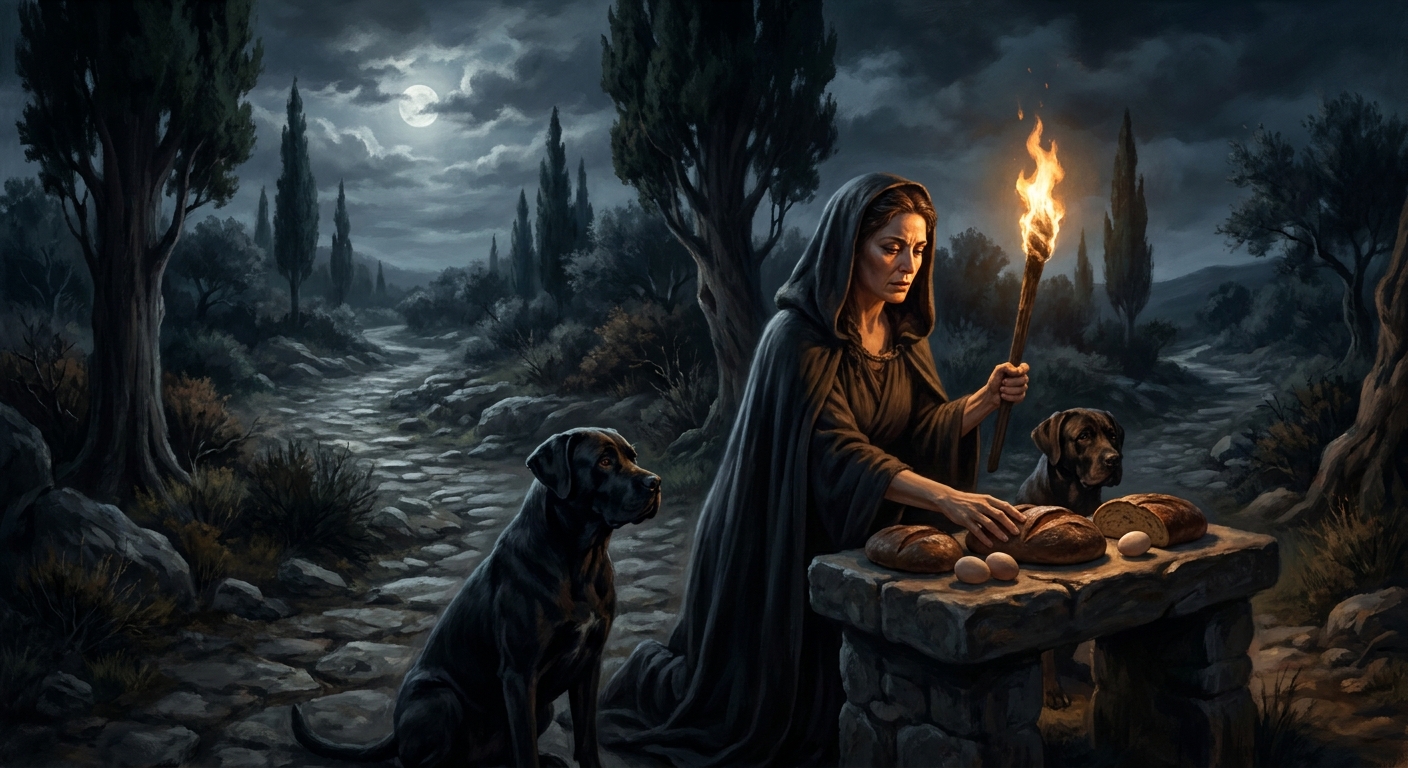
At these liminal points, offerings were left in rites often called Hecate’s suppers. In Athenian practice, the Deipnon fell at the new moon: a household clearing of spiritual residue, with food set at crossroads or doorways as apotropaic payment to what roams at the edge of the road.
Dogs and the door at night
Hecate’s mythic atmosphere comes with a soundtrack: the bark of dogs in the dark.
Dogs are her most persistent companions in cult and storytelling, and they make perfect sense. They are guardians, threshold creatures who know the difference between a friend approaching and something that should not be there. In some traditions, their howling is an omen of the goddess’ presence, as if the animal world recognizes what humans only feel as unease.
Where dogs appear, ghosts are never far behind. Hecate is connected to restless spirits and nocturnal processions, not necessarily as a villain, but as an authority. She is the one who can open a way, or close it, or simply stand there and remind the dead and the living that boundaries exist for a reason.
When Hecate arrives, the story shifts from “what happened” to “what followed you home.”
This is the logic of liminality: crossroads, doorways, grave edges, temple boundaries. Hecate’s realm is not “evil.” It is jurisdiction.
Triple-formed Hecate
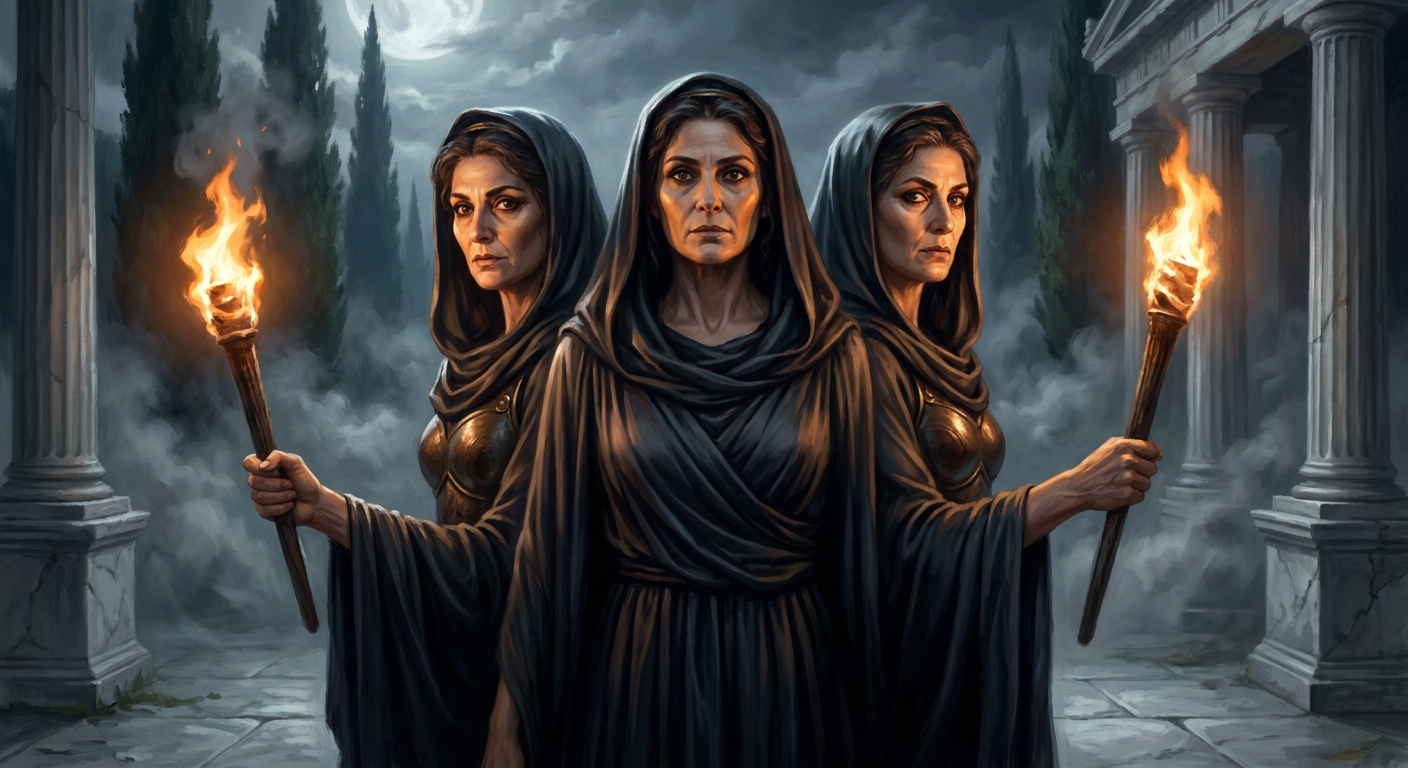
The famous image of Hecate as triple-bodied or triple-faced becomes especially prominent in later Greek practice, particularly in Classical and Hellenistic iconography. Art shows her looking in three directions at once, sometimes back-to-back, sometimes with multiple arms holding torches, blades, or ritual keys.
This is iconography doing its job. At the crossroads, you want a guardian who can watch every route. At the threshold, you want a presence that can face both worlds without flinching.
It also carries a quieter warning. We want the universe to face one way, to give one clean answer. Hecate’s form suggests the opposite: the world has angles, and the truth depends on where you stand.
From hymn to spell
In early sources like Hesiod, Hecate can look almost surprisingly civic: a goddess who grants favor, wealth, and victory, honored by Zeus. So how did she become the name that later magic practitioners whispered like a key turning in a lock?
Part of the answer is structural. A goddess of boundaries naturally becomes a goddess of passage. Magic, in Greek imagination, is often about crossing a line: calling up the dead, binding a lover, compelling a rival, opening what should stay shut. If you are going to do that, you do not petition a polite Olympian with clean hands. You seek the one who already rules the seam between worlds.
By the Hellenistic and Roman periods, her identity deepens into a powerful figure in the world of curse tablets, night rites, and late antique syncretism, including the spells preserved in the Greek Magical Papyri. Literature reinforces the association too. Figures like Medea invoke Hecate as patron of potent, dangerous knowledge, and the goddess’ name begins to feel less like a title and more like a doorway.
Moonlight, layered
Modern retellings often introduce Hecate as a straightforward moon goddess. Ancient Greek religion is messier. The moon’s most direct divine personifications tend to be Selene, and, in many contexts, Artemis.
And yet, Hecate’s world is undeniably lunar in mood. She thrives in night rituals, in torchlit processions, in the silver hour where roads feel longer and the sea sounds like prophecy. Over time, her mythology absorbs moon associations, especially in later syncretic traditions, because moonlight is what you have when sunlight is not available.
So if you meet a moonlit Hecate in later tradition, do not treat it as a mistake. Treat it as myth doing what myth always does: layering meanings until the goddess becomes too large to fit inside a single definition.
What to remember
Hecate is not a decorative goth accessory for the pantheon. She is one of Greek mythology’s most sophisticated ideas wearing a goddess’ face: that there are places where categories fail, where your tidy map ends, where the rules change under your feet.
- Titan lineage, but not Titan defeat. Zeus preserves her honors in Hesiod.
- Torches as her signature, especially in the search for Persephone.
- Crossroads as sacred negotiation points, with offerings and protections, including the new-moon Deipnon.
- Dogs and ghosts as signs of her nocturnal jurisdiction.
- Triple form as a later visual theology of watching, choosing, and belonging to more than one realm.
- Magic as the natural consequence of ruling thresholds, sharpened in Hellenistic and late antique tradition.
Some gods demand worship. Hecate does not always demand. She simply appears where the world splits into options, and the wrong option becomes a story you will be telling for the rest of your life.