Orpheus and Eurydice: The One Look Back
Greek Mythology
Some love stories arrive like spring. This one arrives like temple smoke, curling up from a wedding torch that should have burned clean.
Orpheus is not merely a musician in the myth. He is a force of nature holding a lyre like a key to the world’s locked doors. They say Apollo favored him, and it shows. When Orpheus plays, even the unromantic parts of creation behave: stones shift as if they have hearts, and wild beasts forget their hunger long enough to listen.
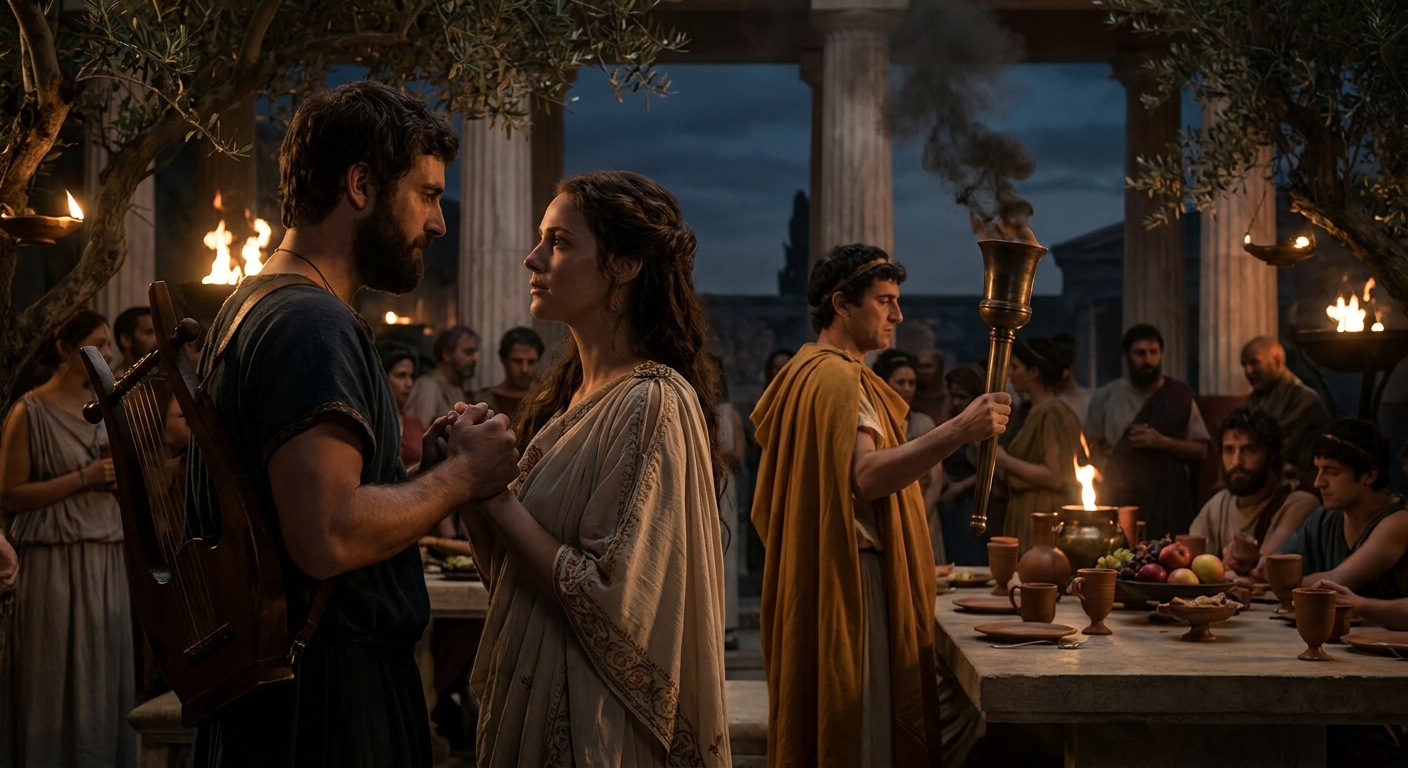
And then, in a gathering thick with admirers both human and not quite human, he meets Eurydice, a nymph with the kind of beauty that myths treat as both blessing and bait. She hears him. He sees her. The story wastes no time pretending this is sensible.

They marry in joy, the kind that makes mortals arrogant enough to believe the gods have finally looked away. Hymen, god of marriage, attends. His torch sputters, sending up smoke instead of a steady flame, an omen drifting through the celebration like a warning no one wants to translate.
A wedding torch that smokes is still a torch. Until it is the first sign that the future is already burning wrong.
The Snakebite That Ends the Music
Not long after the wedding, the promise collapses. Eurydice is bitten by a snake and dies at once, the way tragedy likes to do it: swift, unfair, and so final that language itself feels embarrassed.
This is where the myth reveals Orpheus’s true flaw. He does not accept the boundaries mortals are supposed to accept. He refuses to be reasonable. He refuses to be alive in a world where she is not.
So he does what polite people do not do. He goes down.
Orpheus at the Underworld’s Court
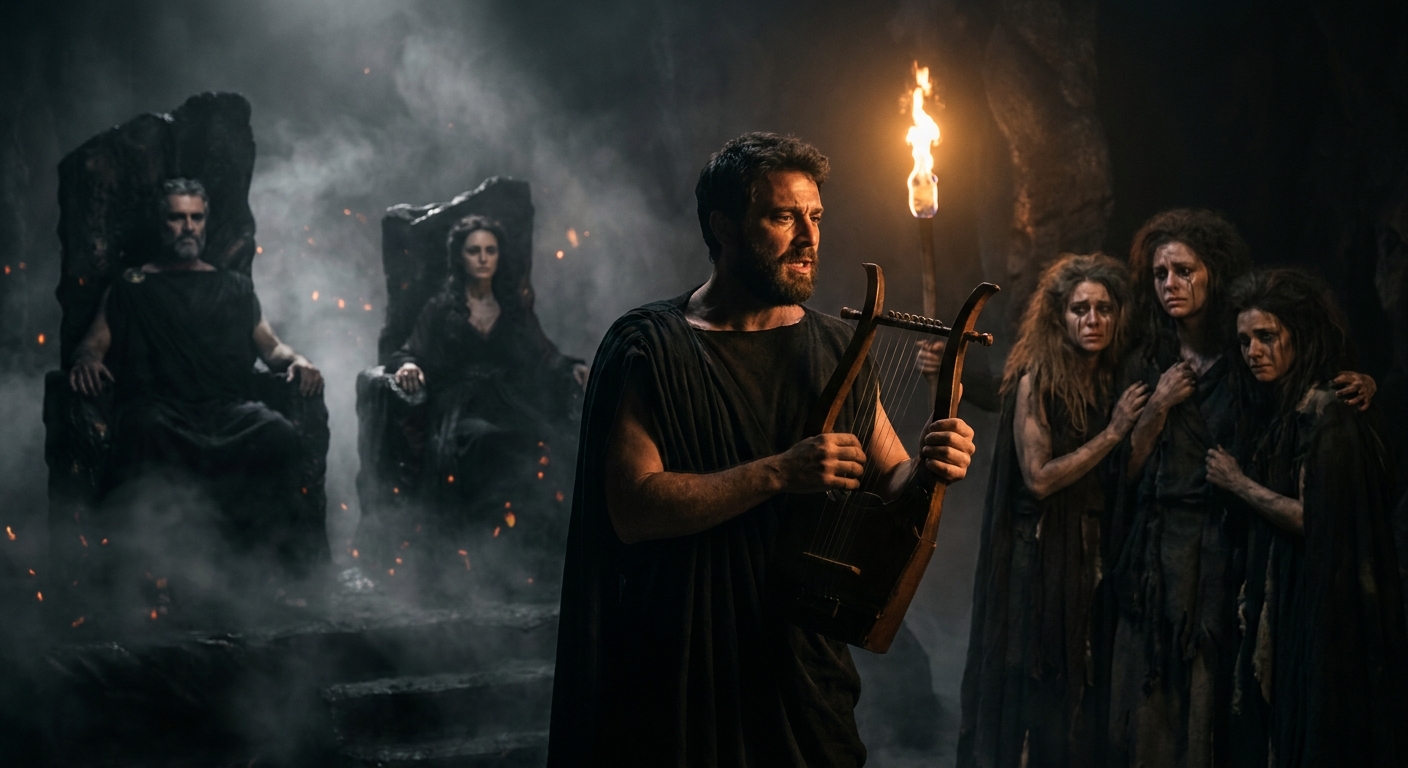
He descends with his lyre, crossing the threshold into the Underworld as if grief itself has given him a passport. The realm of Hades is not a place designed for hope. It is a kingdom built to hold what is gone.
Orpheus sings anyway.
His music reaches the rulers: Hades and Persephone. It reaches the ones who punish. It reaches the ones who have seen every human pleading trick in history and still find themselves moved. Even the Furies, not exactly famous for tenderness, are said to weep.
And then, the impossible happens. Hades agrees to let Eurydice return.
But the Underworld never gives without a hook hidden in the generosity.
The One Rule, Sharper Than Any Blade
The bargain is brutally simple: Orpheus must not look back at Eurydice until they have both reached the upper world.
No dramatic quest. No monster to stab. Just a single instruction, the kind that sounds easy until you realize it attacks the most human part of him.
Because what is a lover without proof?
Do not turn. Do not check. Do not ask the dark to reassure you.
They begin the ascent. Orpheus leads. Eurydice follows. The space behind him is all silence, and silence is where doubt breeds like ivy.
He cannot hear her footsteps. He cannot feel her breath. He cannot glance at her face to steady his own. And the thought arrives, velvet-soft and poisonous: What if Hades has tricked me?
The Split-Second That Ruins Everything
Near the threshold, with daylight close enough to imagine, Orpheus breaks.
He turns.
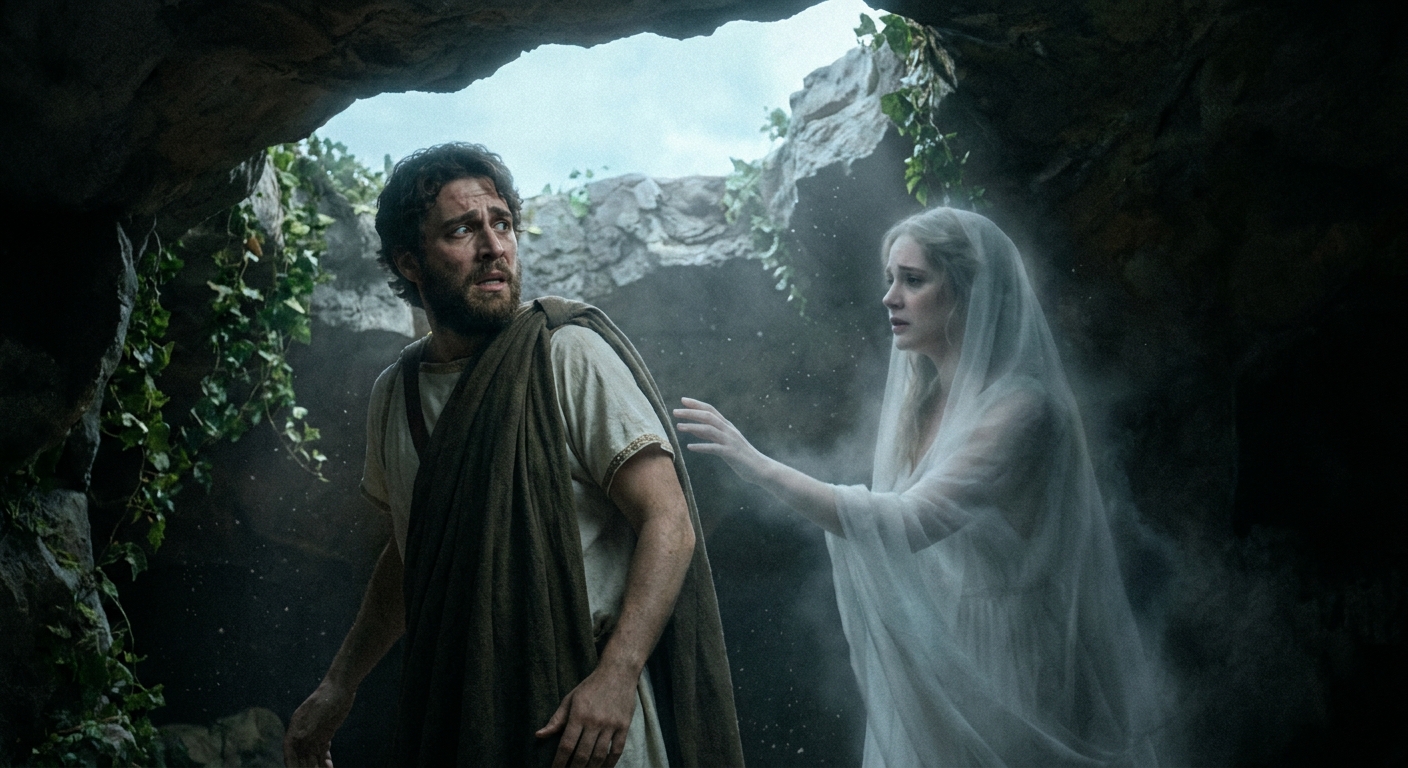
And yes, Eurydice is there. The cruel genius of the moment is that he is not hallucinating. He is not paranoid. He is right to believe she is behind him.
But the rule is not about being right. It is about not needing to verify.
Eurydice begins to fade, pulled backward like smoke drawn into a tomb. Orpheus has time for the realization, and that is the worst kind of time.
The Underworld does not punish the living with thunder. It punishes them with the exact moment they will replay forever.
Orpheus tries to return, to bargain again, to force the gates with song. But he is denied. The door he opened with music closes like a verdict.
What the Myth Does to Orpheus
After that, Orpheus becomes the kind of figure the Greeks understood well: a man alive, but not really living. His music changes. What once could charm stones now seems to scrape against the world’s indifference.
He turns away from women, refusing their company. In myth, refusal can be a provocation all its own. Eventually the Maenads, enraged by being denied, tear him apart.
Even then, the story refuses to let the music die neatly. His scattered body does not end the song. His head and lyre drift to Lesbos, still singing, as if grief has become an object the sea itself must carry.

Why the “Don’t Look Back” Rule Still Hurts
The myth survives because it understands something viciously intimate: the easiest way to fail a test is to make it small. The Underworld does not ask Orpheus for heroism in the conventional sense. It asks him to walk forward while his entire body screams to confirm what he loves is still there.
In Ovid’s Metamorphoses, the loss is rendered with a bleak clarity, the moment Eurydice is taken again and Orpheus’s despair spills out in one raw cry. In Virgil’s Georgics, the Underworld journey itself feels like the center of gravity, and the hope that briefly flickers is extinguished by a single tremor of doubt.
Later artists cannot resist that threshold scene either. Painters have returned to the instant of the turn, the face that knows it has just ruined everything. It is a story built for drama because it is built from a human nerve.
Orpheus’s tragedy is not that he loved Eurydice too little. It is that he loved her with the kind of intensity that demands certainty, even when certainty is the one thing the gods refuse to give.
Echoes in Modern Retellings
Orpheus and Eurydice keep returning in new forms because the melody is inexhaustible. The same descent, the same bargain, the same fatal glance, reinvented for each era’s anxieties.
- Opera: Christoph Willibald Gluck’s Orfeo ed Euridice (1762), which famously offers a more hopeful reunion through Cupid’s intervention.
- Musical: Anaïs Mitchell’s Hadestown (2006), reimagining the Underworld with an industrial pulse and love as a stubborn kind of labor.
- Play: Sarah Ruhl’s Eurydice (2003), shifting the spotlight to Eurydice and her relationships in the Underworld, including her father.
- Film: Jean Cocteau’s Orphée (1950) and Marcel Camus’s Black Orpheus (1959), each transforming the myth into its own dream logic.
No matter the costume changes, the story insists on its central wound: love offered a path out, then sabotaged by the most understandable impulse in the world.