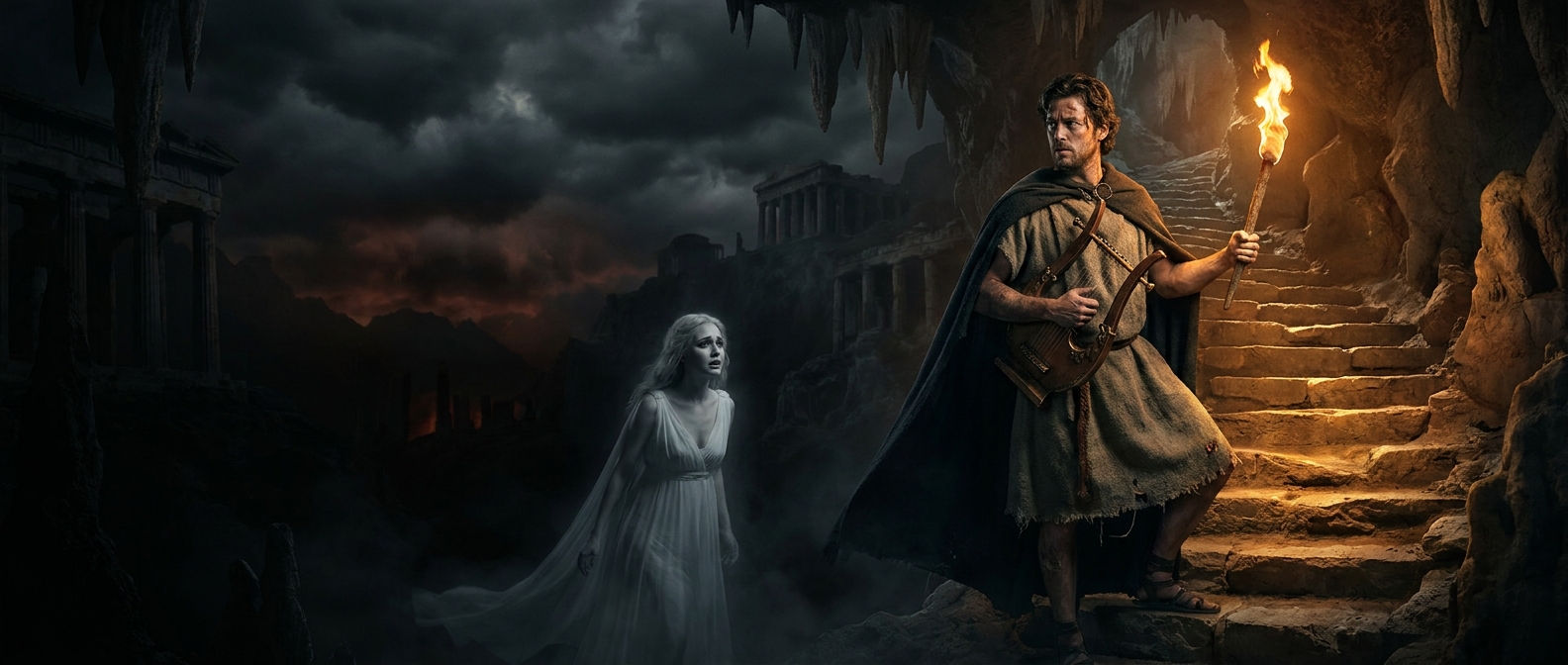
Orpheus and Eurydice: Love That Defied Death
Greek Mythology
Some myths arrive like sunlight on marble. This one arrives like torchlight in a cave.
Orpheus does not sail for treasure, or march for glory, or wrestle monsters into history. He simply wants his wife back. Eurydice, stolen not by a rival but by the oldest thief of all: death.
And because Greek myth adores a beautiful impossibility, it lets him try.

The singer’s bloodline
Orpheus is not quite like other mortals. Even his origin vibrates with the supernatural. Many ancient sources name him the son of the Muse Calliope and the Thracian king Oeagrus, though some accounts give his father as Apollo, which is another way of saying the same thing: his gift arrives already lit.
His instrument is the lyre, and in the stories it behaves less like wood and strings and more like an altar. When Orpheus plays, the world leans in. Trees follow. Stones soften. Wild animals forget their teeth. The line between civilization and wilderness blurs, because beauty does that.
Greek audiences also knew Orpheus as a figure whose music brushes against religion. Later tradition ties him to Orphic rites and mysteries, where song and purity promise a different fate after death. The myth itself stays simpler and more brutal: music is power, and power makes the gods attentive.
A wedding and a bite
Orpheus and Eurydice marry, and for a moment the myth seems inclined toward joy. Then it remembers what genre it is.
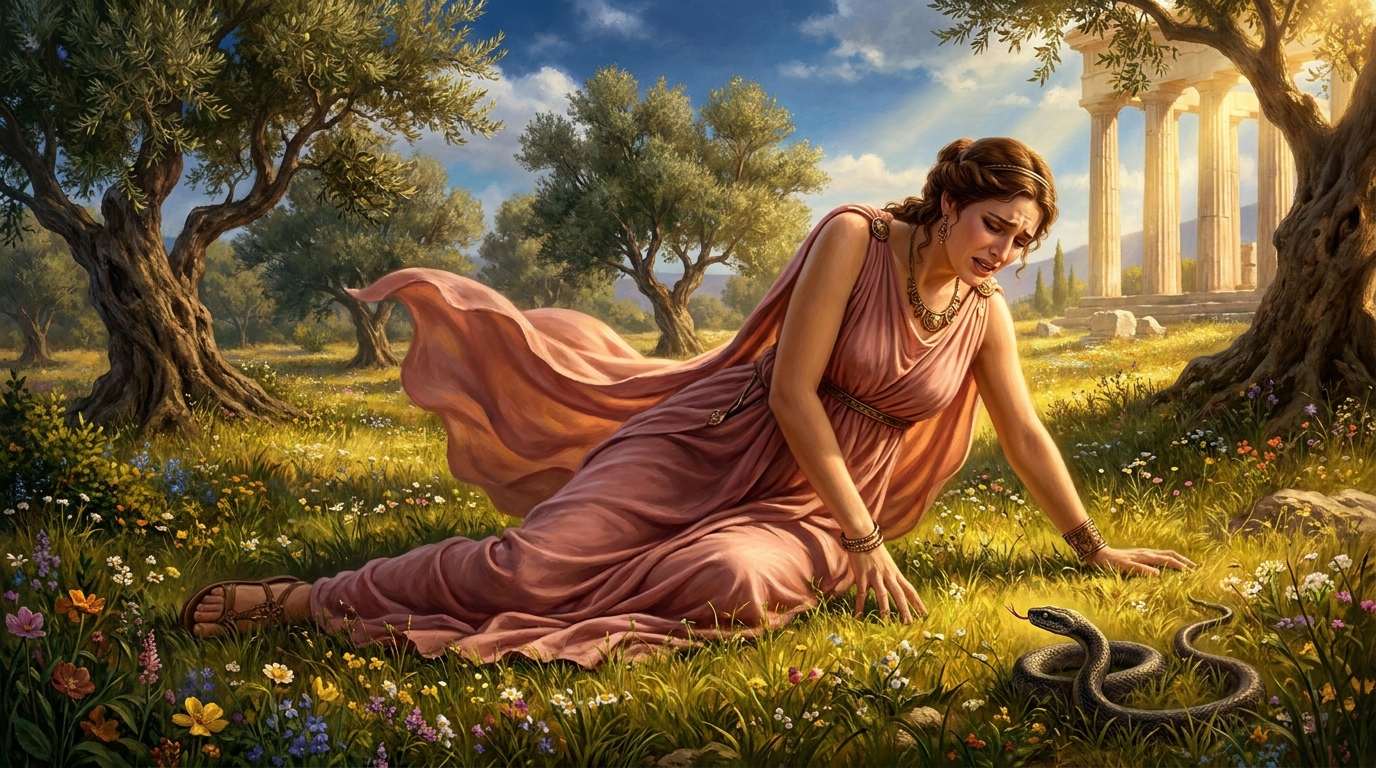
On their wedding day, or soon after, Eurydice dies from a serpent’s bite. Some versions add a pursuer and a flight through grass, but the essential image is always the same: a bright human life extinguished by something low to the earth and sudden.
And Orpheus, who can move nature with song, discovers the one audience that does not clap.
There are losses no mortal is trained to carry. So Orpheus does the most reckless thing a living man can do: he walks toward Hades.
The way down
The Greeks imagined the Underworld not as a cartoon pit of flames, but as a kingdom with geography, gates, and rules. The living do not belong there. That is the first rule. Orpheus breaks it anyway.
He reaches the boundary waters, named as the Acheron or the Styx, depending on the telling, and comes before the ferryman Charon. He meets Cerberus, the many headed guard-dog of the dead. These are not monsters to be slain in this story. They are gatekeepers. They are the border itself.
And Orpheus does not fight the border. He sings.

The bargain
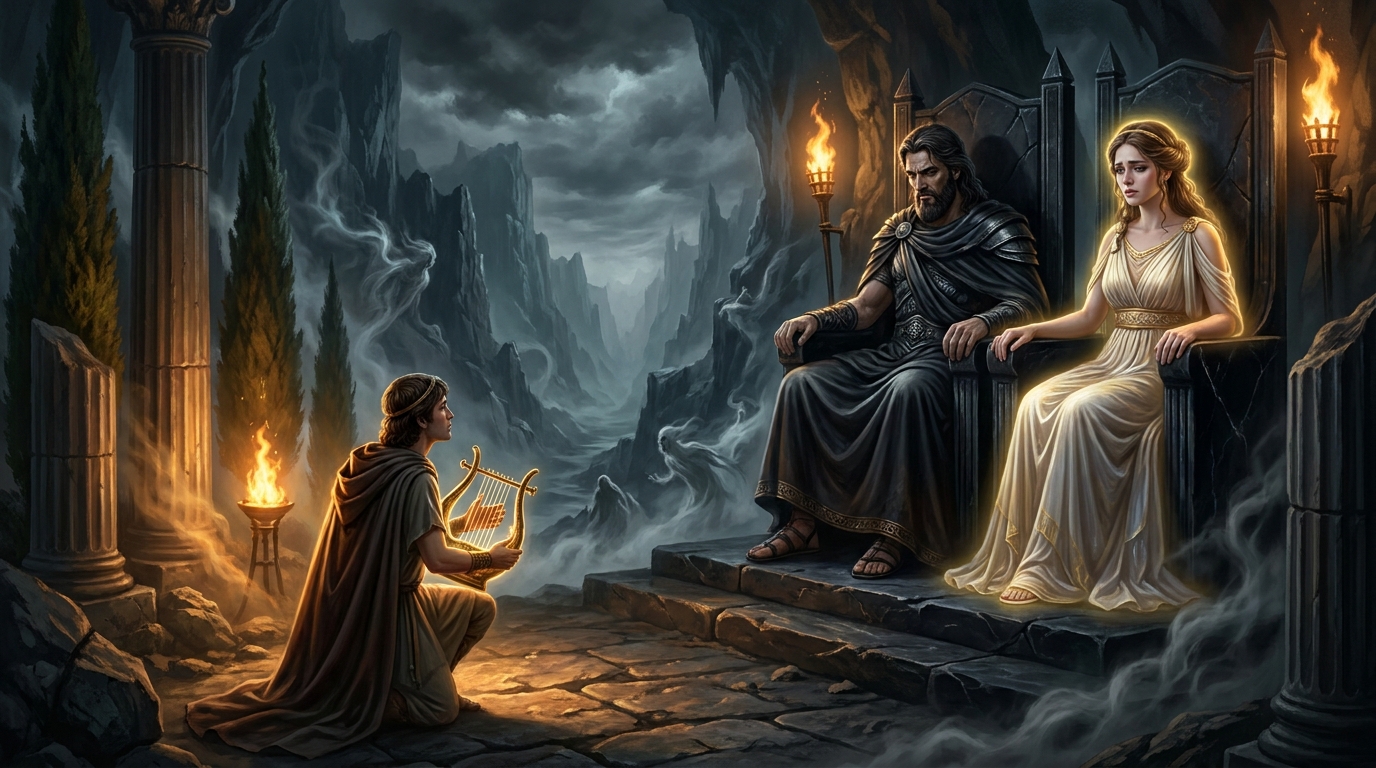
At the heart of the Underworld sit its rulers: Hades and Persephone. Not demons, not devils, but sovereigns. They do not need to be cruel. They simply need to be unmoved.
Orpheus makes them move anyway.
In the most poetic tradition, especially the kind we associate with Virgil and Ovid, his song is not merely pretty. It is an accusation wrapped in beauty. It reminds the dead what they lost. It reminds the gods what they can never quite extinguish in mortals: devotion so fierce it becomes impolite.
And in some tellings, even the Underworld’s punishments pause. Sisyphus rests his hands. Tantalus forgets his thirst. Even the Furies soften, if only for a breath. Persephone, queen who knows what it is to be taken, leans toward mercy.
They agree to release Eurydice. But there is a condition, and it is so simple it feels like fate disguised as etiquette.
Do not look back, they say, until you have both reached the upper world.
The glance
This is where the myth turns from romance to surgery. The incision is small. The bleeding is eternal.
Orpheus leads Eurydice upward. The path is steep, the air thin, the light ahead almost believable. Behind him he hears her footsteps, or thinks he does. In some versions, the Underworld is silent enough that doubt becomes a living creature, pacing beside him.
And then, just before the exit, just before the world returns to color, Orpheus looks back.
Sometimes it is love. Sometimes it is fear. Sometimes it is the unbearable human need for proof. Whatever the motive, the result is the same: Eurydice is still in the realm of the dead when his eyes find her.
She is pulled away like smoke through fingers.
He does not lose her in battle. He loses her in the instant his faith fails to outrun his longing.

Why the rule works
The condition is not random. It is mythic psychology dressed as divine law.
- It tests trust: not only in the gods, but in the beloved who must follow unseen.
- It weaponizes imagination: the mind invents absence, silence, betrayal, and then reacts to its own inventions.
- It makes love finite: you can have her, says the Underworld, but only if you behave like someone who does not need her.
Greek myths often punish not the wicked, but the human. Curiosity, grief, desire, panic. The gods do not have to hate you to ruin you. They merely have to insist on rules that mortals cannot keep for long.
After Eurydice
Once the rescue fails, the story does not end. It changes shape. It turns from a descent-and-return into a life lived with a wound that will not close.
What happens next depends on the tradition, and Greek myth is a house with many rooms.
In several versions, Orpheus refuses other love. He turns away from marriage, sex, and ordinary consolation, as if daylight itself has become offensive. Some traditions frame this as a rejection of women, others as a shift of devotion toward Apollo, and others as the kind of affront that invites a god’s attention simply because it refuses the world’s expected order.
His death is often placed in the hands of Maenads, frenzied followers of Dionysus, who tear him apart in a violence that feels like a ritual gone feral. Even then, the myth cannot let his song stop. According to later tradition, his head and lyre, still singing, drift to Lesbos, a poetic landing for a figure who belongs to music as much as to flesh.
And in the Underworld, at last, some tellings reunite Orpheus and Eurydice. Not as a triumphant rescue, but as the quiet acceptance of the only place where the condition no longer matters.

What the Greeks heard
We modern readers tend to treat Orpheus and Eurydice as a pure love story. The ancient world heard additional notes vibrating underneath, especially in the later literary tradition that preserves the tale most fully.
1) Art can move even gods
Orpheus proves that beauty can bend the universe. For a moment, it does. The myth honors art as a force that negotiates with power.
2) But art cannot rewrite mortality
Hades is not tricked. The rule remains. If anything, the story warns that the cosmos can be courteous without being kind.
3) The living cannot face death unscarred
The glance backward is the most human reflex imaginable. The myth does not condemn love. It condemns the impossible expectation that love should be calm while walking through darkness.
The shadow it leaves
Orpheus and Eurydice have been retold for centuries because the story is not really about a man who failed a rule. It is about the way grief edits reality.
We all know the feeling the myth crystallizes: that if you just do the right thing, obey the condition, keep walking, do not look back, you might get the lost thing back.
And then you look back anyway.
On Paleothea, I always want the gods to feel close enough to hear. In this myth, they do hear. They listen. They even grant a miracle. Then, with the elegant brutality Greek myth is famous for, they remind us what mortals are made of.
Not stone. Not bronze. Not law.
Longing.