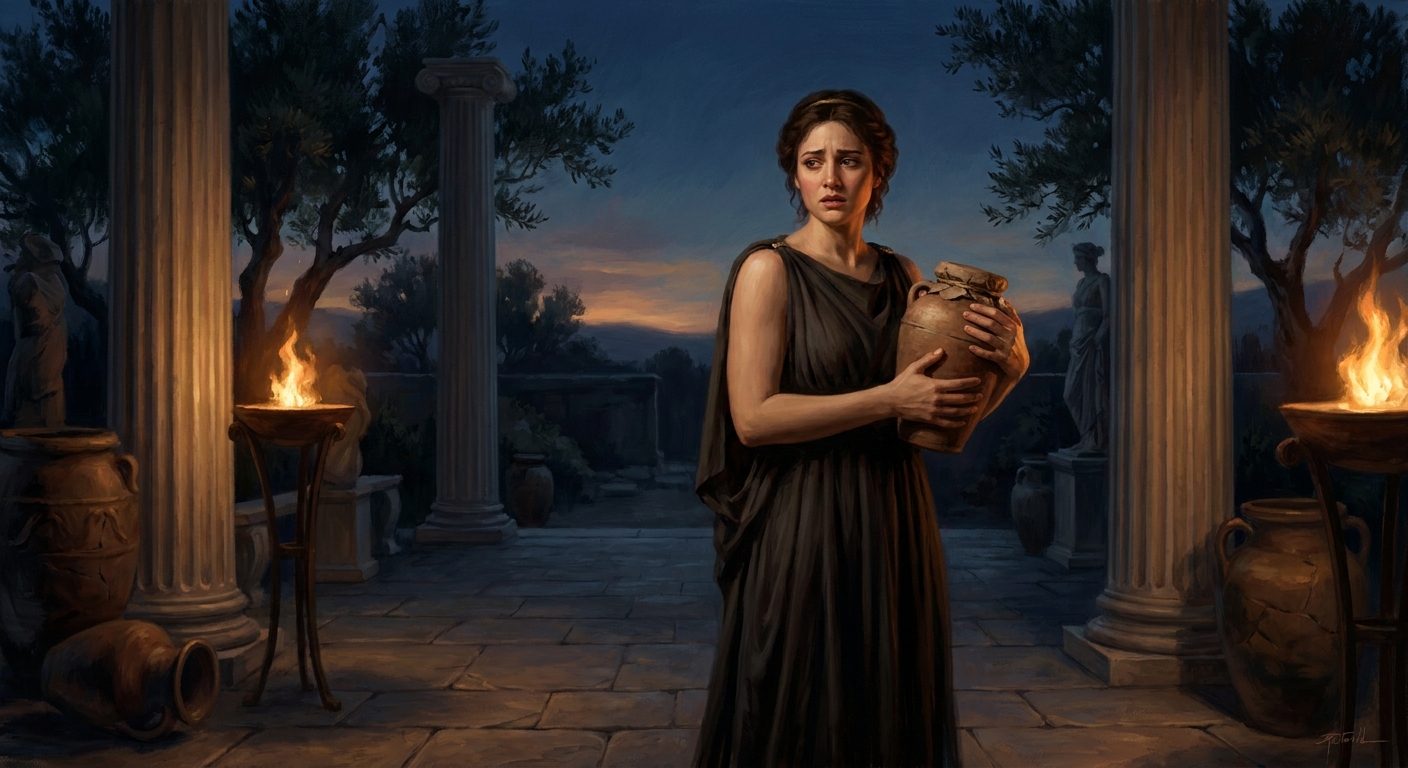
Pandora’s Jar: A Gift with Teeth
Greek Mythology
There is a particular kind of cruelty the Olympians seem to prefer: the elegant kind. Not the blunt thunderbolt. Not the obvious monster. The kind that arrives braided in silk, scented with honey, and introduced with a smile.
That is how Pandora enters Greek myth, not as a villain twirling in torchlight, but as a gift presented with ceremony. And like so many divine gifts, she comes with a hidden hook.

Made to be welcomed
Pandora is often flattened into a punchline: she got curious, she messed up, we all suffer. But the older shape of the story is colder and more interesting. Pandora is not merely a person who makes a bad choice.
She is a consequence dressed as a reward, or at least the myth can read that way when you watch how carefully she is constructed.
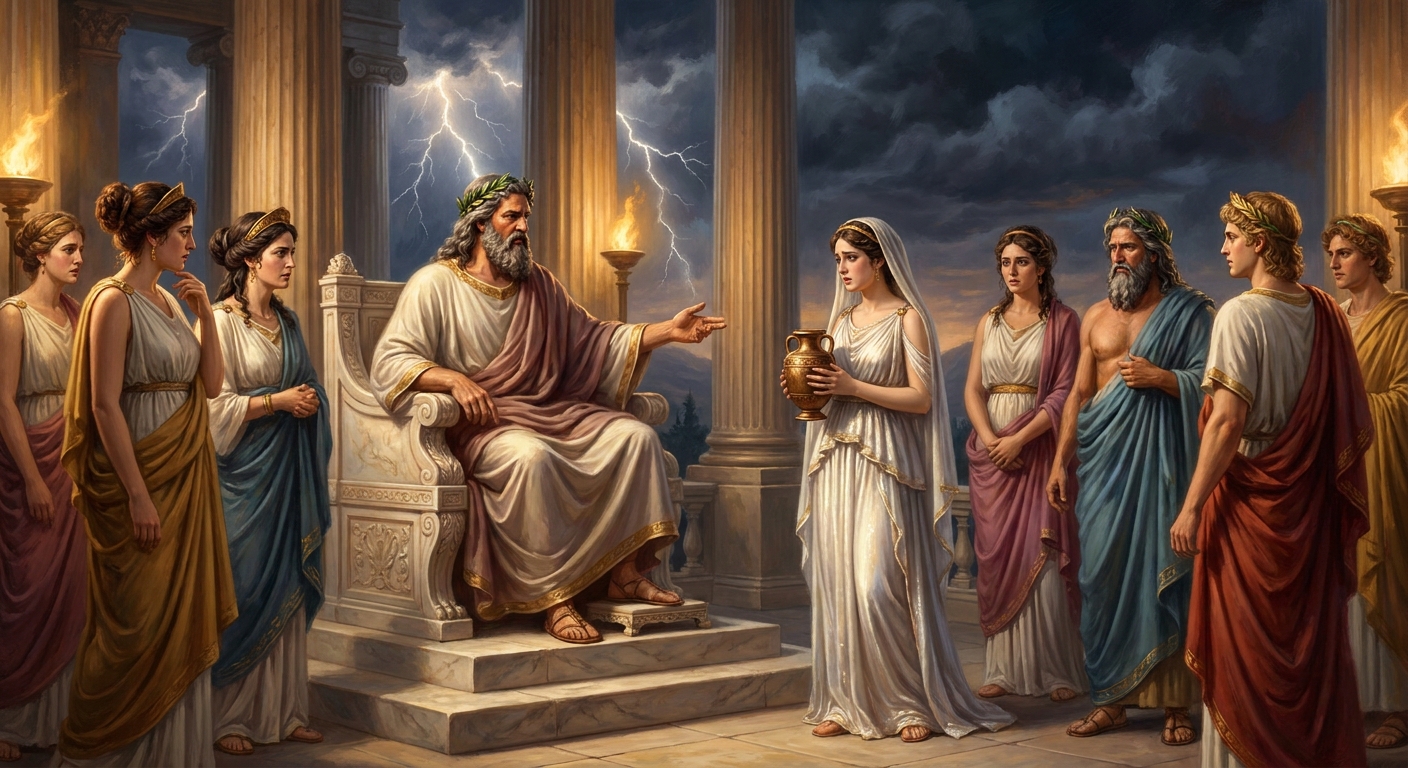
Zeus, furious over Prometheus stealing fire for humanity, chooses a punishment that looks like a blessing. Pandora’s very name, “all-gifted”, gleams with misdirection. The story almost invites you to imagine her assembled like a masterpiece meant to walk, breathe, and change a household simply by being welcomed.
- Hephaestus shapes her from clay, giving her a body crafted like sacred sculpture.
- Athena grants her wisdom, the kind that makes a person luminous in conversation.
- Aphrodite adds beauty, that dangerous gravity that bends rooms toward her.
- Hermes supplies wit and charm, because trouble travels faster when it is delightful.
The trap may not be the jar alone. The trap may be that the gods made her the sort of person the world would trust.
The forbidden jar
Then comes the prop: the infamous container, a jar (or a “box,” if you’re feeling modern). It is filled with the world’s evils, and Zeus makes sure the rule is clear.
Do not open it.
Which, in divine psychology, can feel like placing a glowing red button on a pedestal and daring a mortal to be more obedient than human nature.
When it opens
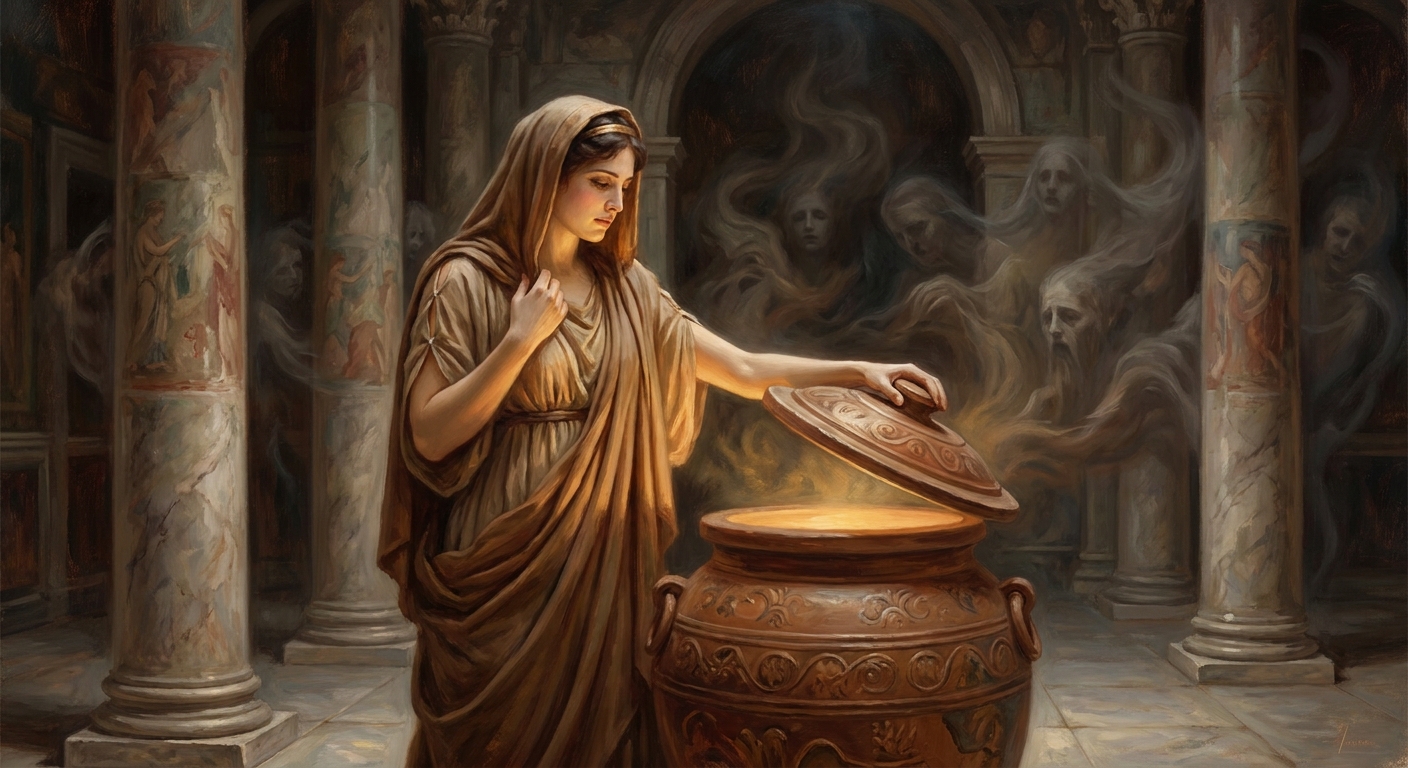
When Pandora lifts the lid, the story does not release mild inconveniences. It unleashes the great evils, the ones that rewrite human life into something bruised and vigilant.
The myth imagines misery spilling out in a rush: sickness, despair, the whole ugly chorus that follows humanity like smoke after a fire. The moment is not dainty. It is catastrophic.
And yet, in the wreckage, something remains.
Hope stays behind, lingering in the jar like a small, stubborn flame. Not a reversal of the damage, not a magical eraser, but a consolation that changes the moral shape of the myth. Pandora’s act does not merely doom. It also leaves humanity with the one thing that makes endurance possible.
Curiosity, on purpose
If you read Pandora’s story as a moral scolding, it sounds like this: do not ask questions. But the myth itself keeps betraying that simple lesson.
Because Pandora’s curiosity does not feel random. It can feel expected, almost cultivated: a being stacked with gifts, placed beside a forbidden object, and then treated as if her very humanity is the surprise.
This is the part that makes my teeth grind a little, in the way only ancient stories can. The Olympians punish humans for being human, and then call it justice.
Reclaiming Pandora
Across centuries, Pandora’s image keeps shifting, like a figure seen through temple smoke. In ancient Greece, she is sharpened into a warning, aimed at women and weakness. Later, the story turns like a kaleidoscope.
During the Renaissance, artists and writers begin to treat her as something more complex: a curious, tragic heroine, with the jar standing in for human life itself, a package deal of good and evil.
Modern readers tend to recognize the double bind. Pandora is punished for curiosity, yet curiosity is also the engine of every human triumph. Exploration, knowledge, invention, art, love. We open doors. We open jars. We open each other. We are the species that cannot leave the sealed thing alone.
The world was not ruined by a woman’s curiosity. The world was changed by a god’s grudge, and endured because hope refused to leave.
What remains
Pandora’s story is not a neat moral. It is a paradox, and Greek myth loves a paradox the way the sea loves shipwrecks.
- Curiosity is power, and it is peril.
- Gifts can be traps, especially when they arrive from the hands of the offended divine.
- Hope is not naïveté here. It is survival, left behind like a final blessing or a final joke.
And if you have ever stood before a choice you were warned about, felt the rule tighten around your throat, and still reached out anyway, then you already understand what the gods understood too.
They did not just count on Pandora’s curiosity.
They may have been counting on ours.