Prometheus Myths: Fire, Foresight, and Eternal Punishment
Greek Mythology
There are gods you worship because they are beautiful, and gods you fear because they are powerful. Prometheus is neither. He is the Titan you remember because he is useful and therefore dangerous, a mind lit from within, a figure who turns myth into a brutal explanation for why human life feels like progress purchased with pain.
His name is usually translated as “Forethought”, and that is the first warning. In Greek myth, foresight is not a comforting gift. It is the ability to see consequences and keep walking toward them.

The Titan Who Would Not Fade
Prometheus belongs to the generation before the Olympians. He is a Titan, often counted among the sons of Iapetus, brother to Atlas, Epimetheus, and Menoetius. After the Titanomachy, when Zeus remakes the cosmos like a new regime polishing its marble clean, Prometheus remains an uncomfortable survivor.
Some traditions place him among those who sided with Zeus. Others simply show him as the Titan with the sharpest instinct: stand with the winning thunderbolt, then spend the rest of eternity regretting the fine print.
And from the start, his story carries a quiet contrast that becomes a verdict. Prometheus is Forethought. His brother is Afterthought. Between them, the human condition is practically already written.
In the new order of Olympus, Prometheus does not lose because he is weak. He loses because he keeps choosing humans over kings.
Prometheus and the Making of Mankind
Greek sources do not give one tidy creation story for humanity, but Prometheus repeatedly appears where humans begin to look like more than clay and breath. In later sources and retellings, he is the craftsman who forms people from earth and water, then dares to make them stand upright and face the sky.
Sometimes Athena appears nearby, lending a divine spark of intelligence, the finishing touch that turns a figurine into a creature with eyes that ask questions. Prometheus is not “humanity’s father” in a sentimental sense. He is the patron of the most suspiciously divine trait mortals have: the urge to build, to learn, to steal the secrets of nature and call it civilization.
Mecone: The Sacrifice Trick
The rupture between Zeus and Prometheus becomes official at Mecone, later identified with Sicyon in some traditions. In Hesiod’s telling, humans and gods negotiate the terms of sacrifice, which is really the terms of power. Who eats what. Who gets the rich portion. Who settles for smoke.
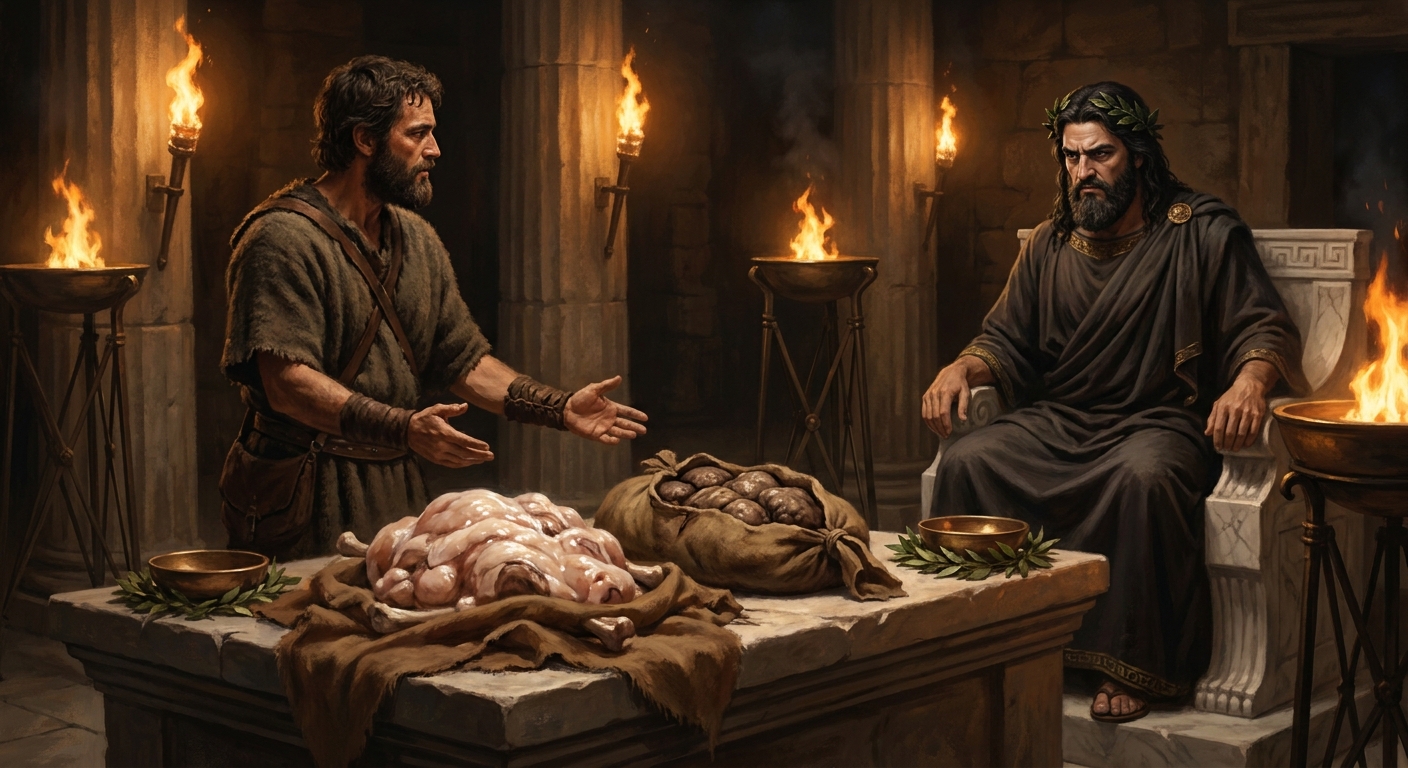
Prometheus arranges a test: two portions from a slaughtered ox. In one pile, he hides the meat and edible innards inside the stomach. In the other, he dresses bones in gleaming white fat, making poverty look like a feast.
Zeus selects the shining fat and finds bones. In Hesiod, the humiliation carries an extra edge, because Zeus is not simply fooled. He perceives the trick, yet accepts the choice anyway, as if to secure a pretext, as if the king of gods prefers an insult he can punish to a bargain he must respect.
The myth explains a ritual pattern, where humans burn bones and fat to the gods and keep the meat for themselves. But it is also a political fable. Prometheus teaches mortals how to negotiate with a ruler: with optics, with misdirection, with the dangerous art of appearing obedient while moving the profit to your side of the altar.
Theft of Fire: The Fennel Stalk
Zeus responds as kings do when embarrassed: he punishes the entire population. He withholds fire from humanity, the resource that means cooking, warmth, metalwork, brick, and the first glow of technology against the dark.
Prometheus steals it back.
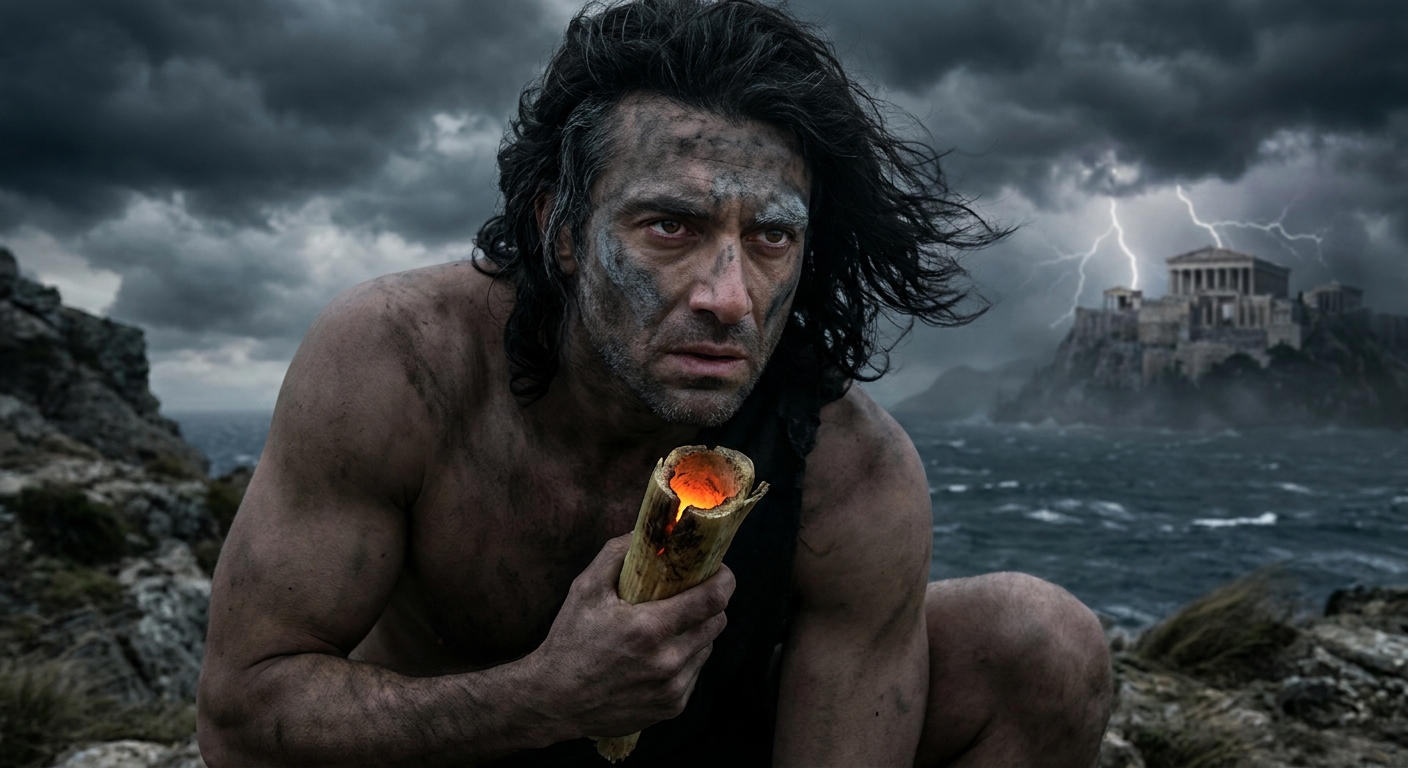
The detail is exquisite: he conceals the flame in a narthex, a hollow fennel stalk. This is not a chaotic blaze torn from heaven. It is a carefully transported secret, smuggled like contraband from the divine realm to the mortal hearth.
Pandora: A Gift with Teeth
Olympus does not strike Prometheus alone. Zeus widens the punishment to include the entire species he favors.
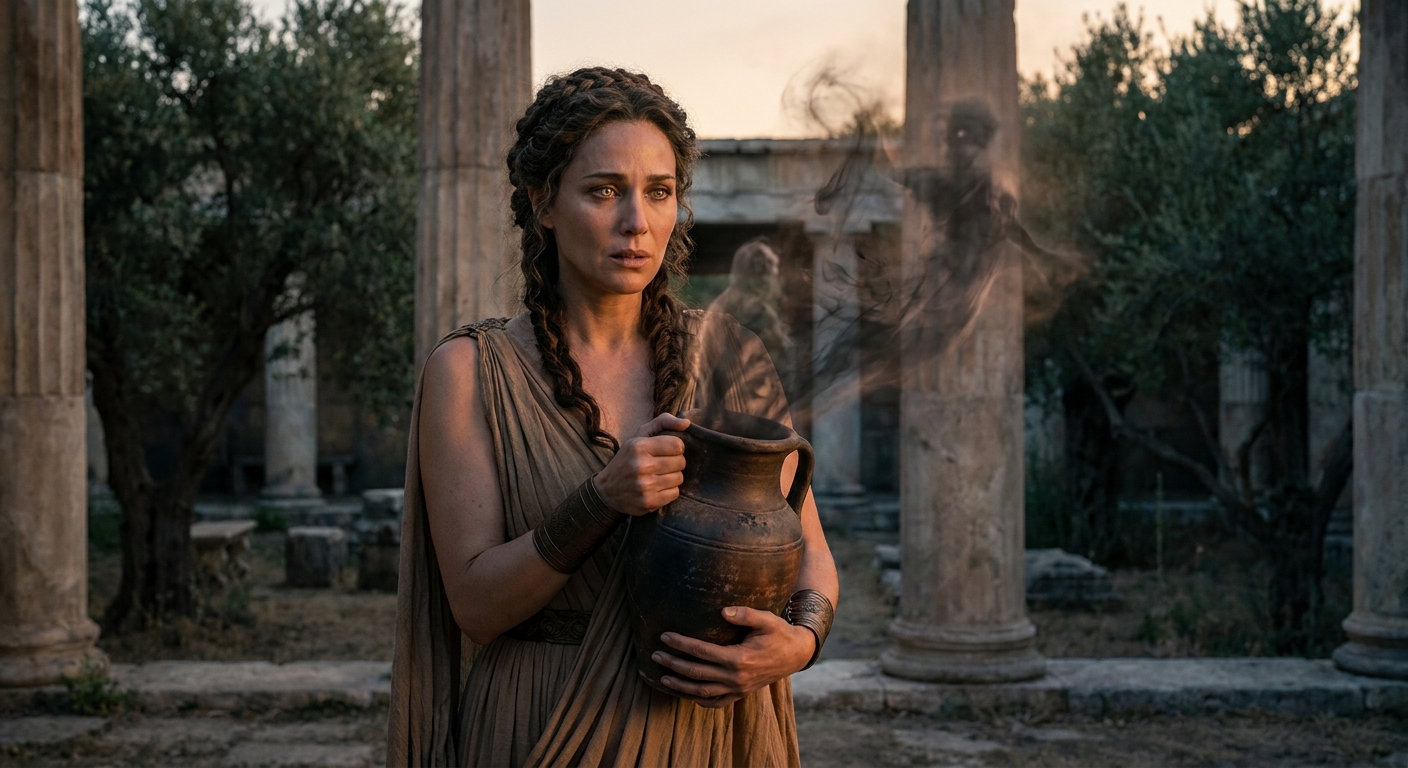
In Hesiod’s telling, Zeus commands the creation of Pandora, “all-gifted,” formed by the gods as a dazzling trap. Hephaestus shapes her, Athena clothes her, Aphrodite lends her dangerous charm, and Hermes supplies the sharper ingredients: persuasion, deception, and the talent for making ruin sound like welcome.
Pandora is given to Epimetheus, Prometheus’ brother, “Afterthought,” which is either the cruelest joke in Greek etymology or the most accurate. Prometheus warns him not to accept gifts from Zeus. Epimetheus accepts anyway, because mortals are easy to bait with bright offerings and soft hands.
Then comes the famous container, often called a “box” in modern retelling, but more accurately a jar (a pithos). Once opened, it releases suffering into the world: labor, sickness, grief, ruin, and the quiet torments that make mortals look up at the stars and wonder what they did to deserve being alive.
One thing remains inside: Elpis, usually translated as “Hope.” Whether that is mercy or another cruelty is the argument the myth refuses to settle. Is hope the last comfort Zeus allows, or the last illusion that keeps humans obedient to a life that hurts?
Zeus does not merely punish. He designs a world where humans keep living anyway.
The Caucasus: The Daily Unmaking
Now Zeus turns back to Prometheus himself.
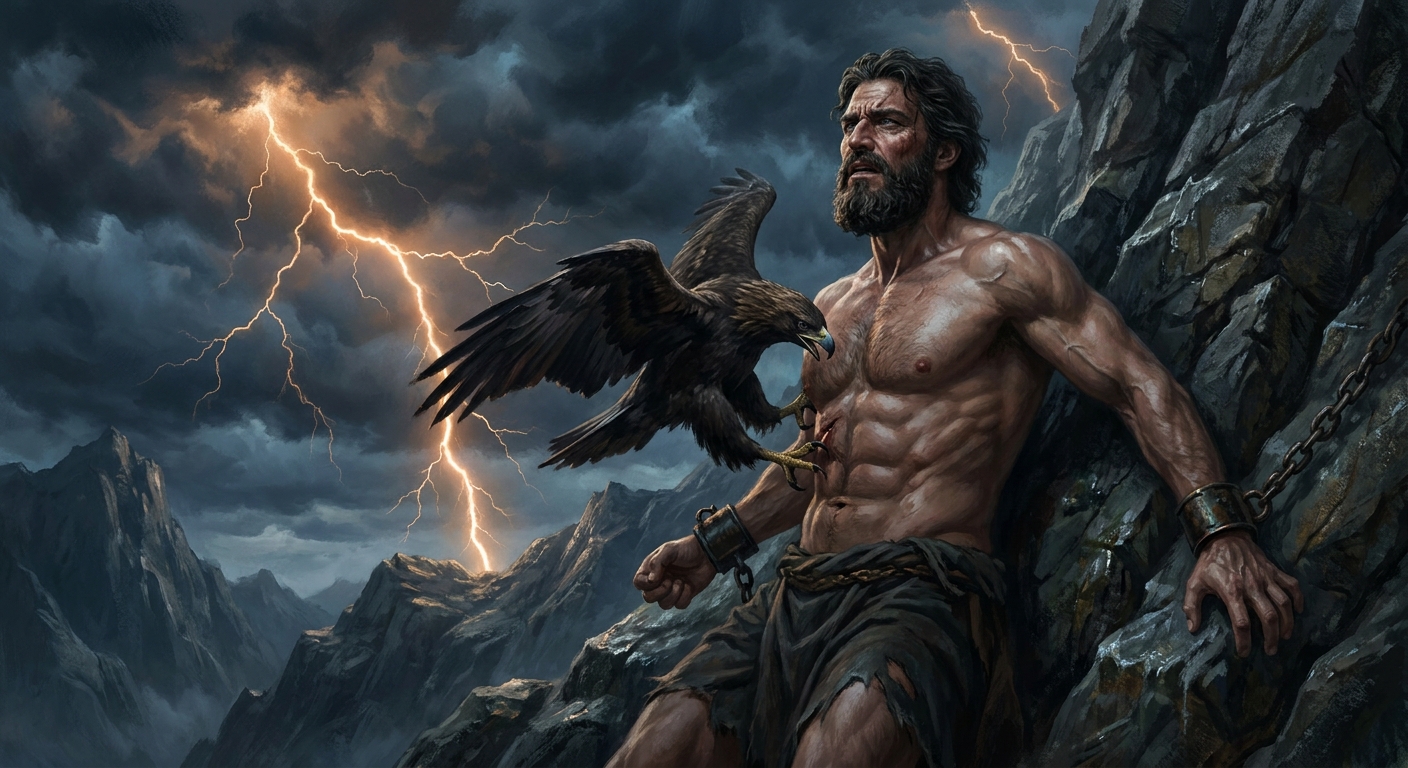
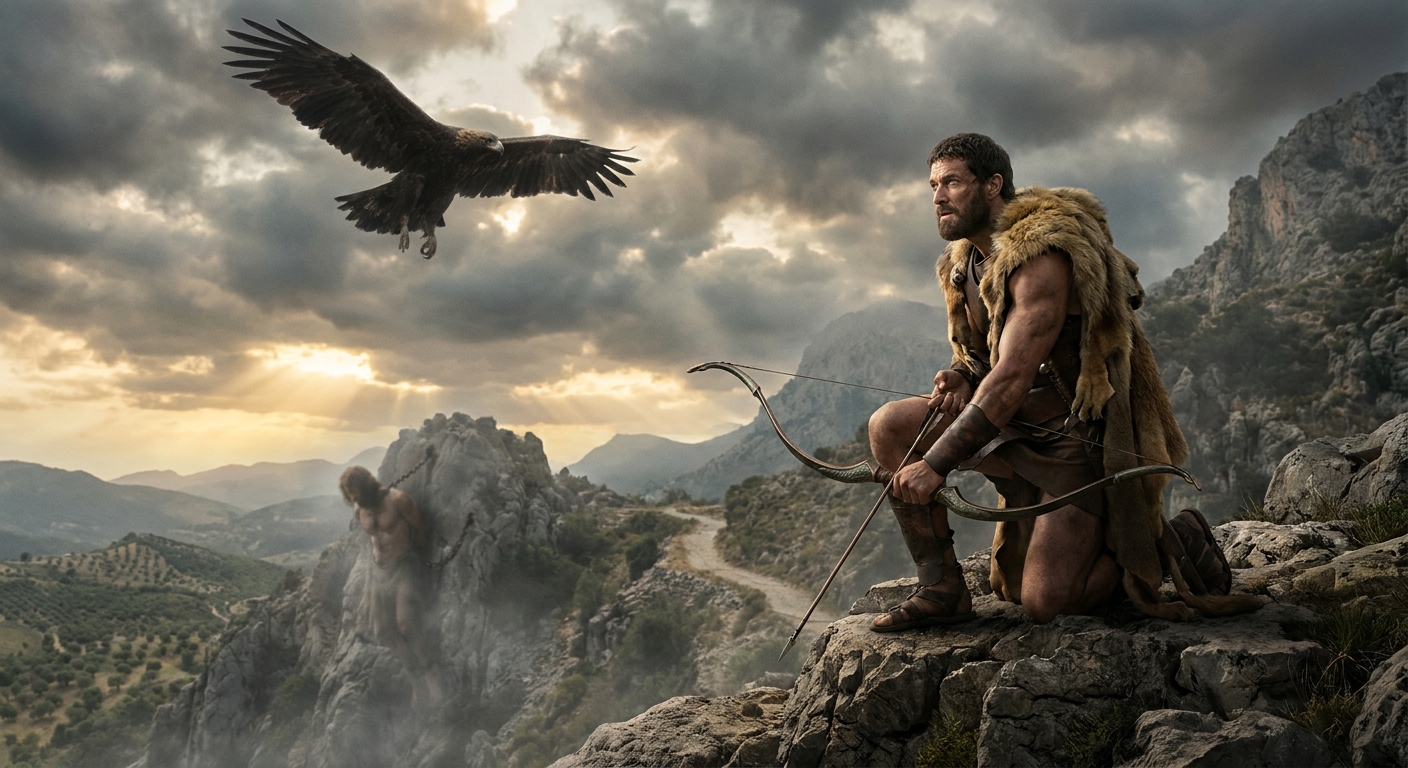
The Titan is bound to a remote wilderness, commonly named the Caucasus mountains. In art and imagination it becomes a place of sheer cliffs and thin air, where snow looks like old ash and the sky feels indifferent. There Zeus sends an eagle, a divine instrument with a simple, obscene rhythm: it devours Prometheus’ liver each day, and each night the organ grows back so the torment can begin again.
The liver matters. In ancient thought it is tied to life and vitality, and it is also the organ associated with divination. Zeus is not only punishing a body. He is punishing a mind that sees too far ahead. This is the cost of being Forethought in a universe ruled by a god who wants the future to belong to him.
The Prophecy Zeus Fears
Prometheus is not only a thief and a martyr. In many traditions he is also a keeper of prophetic knowledge, and the most explosive secret he holds concerns Zeus himself.
In the mythic web surrounding Thetis, Prometheus, or another prophetic figure depending on the source, knows that a certain goddess will bear a son greater than his father. If Zeus takes her as a lover, he risks fathering his own overthrow. The ruler of Olympus, who toppled Cronus and calls it justice, does not want to become a myth with the same ending.
This gives Prometheus leverage. Even chained to rock, he possesses what tyrants fear most: information that changes the future. The torment is meant to break him into surrender, but Prometheus is stubborn in a way that feels almost modern, the kind of defiance that does not expect to win quickly, only to endure longer than the threat.
In Aeschylus’ Prometheus Bound (with authorship debated in modern scholarship), Prometheus’ refusal to yield his knowledge becomes the drama’s central tension. Zeus can crush bodies. He cannot easily crush a secret that will outlive his anger.
Heracles and the Loosening of Chains
Prometheus’ story does not end in the same place in every source, but one of the most beloved turns is his eventual release through Heracles.
As Heracles travels through the wild edges of the world on his labors, he comes upon the bound Titan. He kills the eagle with an arrow, a clean heroic act against a divine machine of suffering. In some versions, Zeus allows this, because politics has shifted, because the prophecy has been negotiated, because even thunder must occasionally perform mercy.
Yet Greek myths rarely permit a debt to vanish completely. Some accounts say Prometheus still must wear a ring set with a fragment of the Caucasus rock, a legalistic workaround that keeps Zeus’ sentence technically intact. Prometheus is still “bound,” just in a way civilized enough for Olympus to tolerate.
It is a classic divine compromise. Zeus keeps his authority. Prometheus keeps his life. Humanity keeps its fire. The universe keeps its scars.
Why the Greeks Needed Him
Prometheus is often called the champion of mankind, but the phrase can sound softer than the myths feel. He is also a warning label stitched onto progress.
- Innovation is not neutral. Fire makes homes and weapons. It creates bread and it creates war.
- Suffering is not always portrayed as a mistake. Sometimes it is governance, a policy decision by a god who must maintain distance between immortals and mortals.
- Defiance is thrilling, but costly. Prometheus embodies the idea that challenging power may bring punishment that lasts longer than you do.
And yet the myth refuses to be purely bleak. Prometheus is the reason humans are not left shivering in a divine shadow. He represents the ache at the center of civilization: the desire to know, to make, to reach for more than we were assigned.
When Greek storytellers wanted to explain why mortals toil, why they bury their dead, why they light their hearths and still feel watched by cold forces above them, they returned to the Titan on the cliff. He is the one who dared to make humanity complicated.
Prometheus is the myth that admits a brutal truth: progress is taken, not handed down.
Prometheus at a Glance
Key figures
- Prometheus: Titan of forethought, fire-bringer, helper of mortals, keeper of dangerous prophecy.
- Zeus: king of the gods, enforcer of sacrifice, punisher of transgression.
- Epimetheus: “afterthought,” the one who accepts Zeus’ gift.
- Pandora: crafted “gift” whose arrival reshapes the human condition.
- Heracles: hero who kills the eagle and helps secure Prometheus’ release.
Signature motifs
- Fire in a fennel stalk: technology smuggled into mortal life.
- Bones wrapped in fat: ritual, deception, and the politics of appearances.
- The jar of evils: suffering released into the world, hope left behind.
- The eagle and regenerating liver: punishment that repeats, torment aimed at vitality and foresight.
- Prophecy: knowledge that becomes leverage against a god.