Pan Myths: Wild Pipes, Panic, and Mountain Desire
Greek Mythology
Pan enters Greek myth the way a sudden wind enters a pine grove: uninvited, unmistakable, and somehow intimate. He is the god you meet when the road narrows into rock and shadow, when the last farm fence gives way to bracken and wolf tracks, when your own thoughts become loud enough to startle you.
To call him a “goat-god” is accurate in the way calling the sea “wet” is accurate. Pan is Arcadia made flesh, that mountainous inland Greece the poets treated like an older world still breathing under Olympus’ marble manners. He is music and rutting spring, yes, but also the kind of dread that seems to rise from heat-hazed air and empty paths. Later Greeks and Romans would name that shock after him: panic, the fear that arrives before you can give it a face.

Who is Pan?
Pan belongs to the category of gods that never fully learned the city’s oaths. His domain is the wild: mountains, forests, shepherd paths, storms that feel personal. He is also tied to fertility in the older, earth-forward sense, the pulsing insistence of animals and sap and seasons.
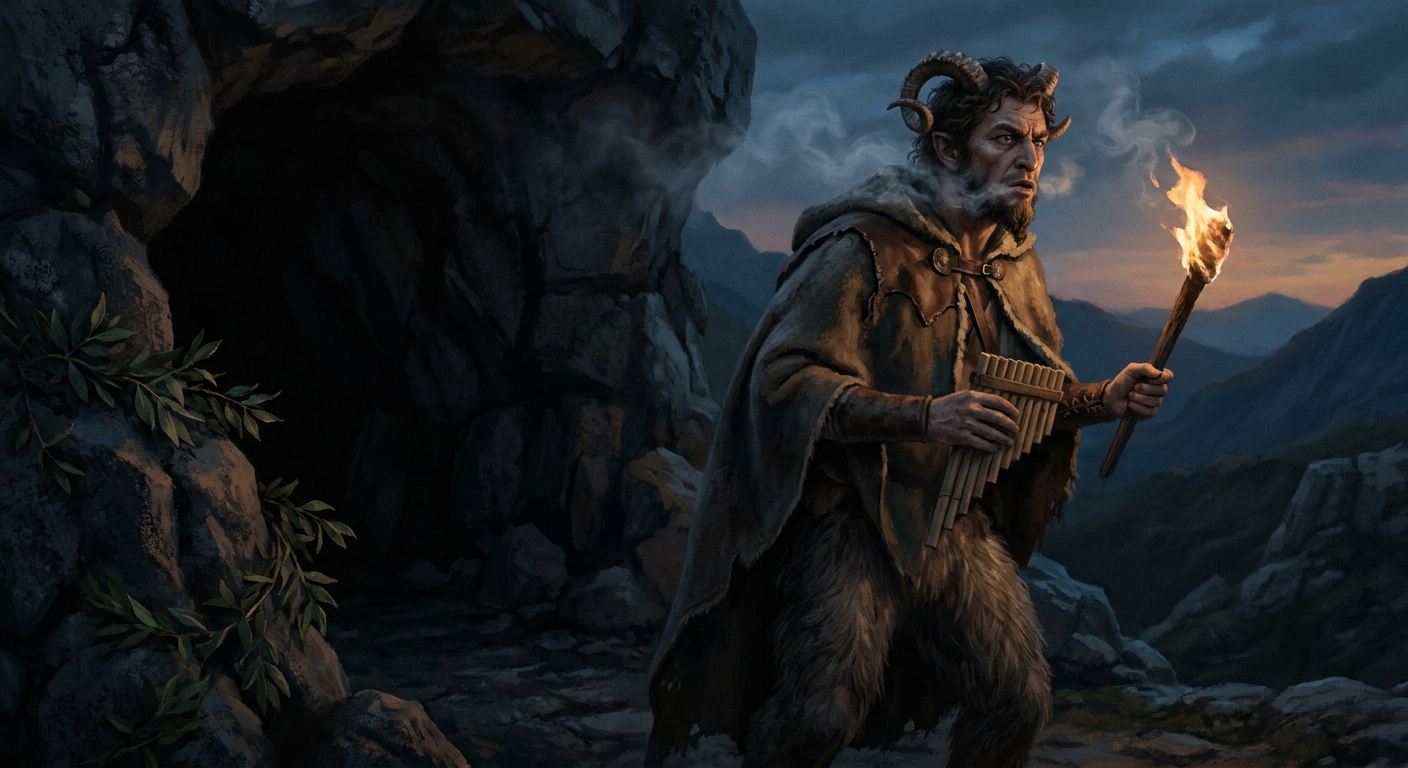
In art and poetry he is typically shown with goat legs, a shaggy body, and horns. He lives at the edge of civilized life, where a polis can no longer make promises it can keep.
Birth stories
Pan’s origin is famously unruly because Pan is. Different regions and authors give him different parentage, and the contradictions are part of the point. Wilderness does not keep a single family register.
Hermes and the nymph
One of the best-known accounts, celebrated in the Homeric Hymn to Pan, makes him the son of Hermes and a nymph, often named Dryope (though other names appear). Hermes, who walks boundaries for sport, is a fitting father for a god who treats borders like thin smoke.
In some tellings, the newborn Pan is so startling in appearance that his mother flees in fear. Hermes, delighted, carries the child up to Olympus where the gods laugh with the bright, uneasy relief of immortals who do not have to raise him.
A god is born, and the first sound he draws from the world is not a lullaby, but a startled reaction.
Other lineages
Other sources offer other roots. Some make Pan the child of Zeus and Penelope. Others tie him to rustic kings or local spirits. This is how old gods survive new stories: their names shift houses, but their footprints remain in the same mountain dust.
Syrinx
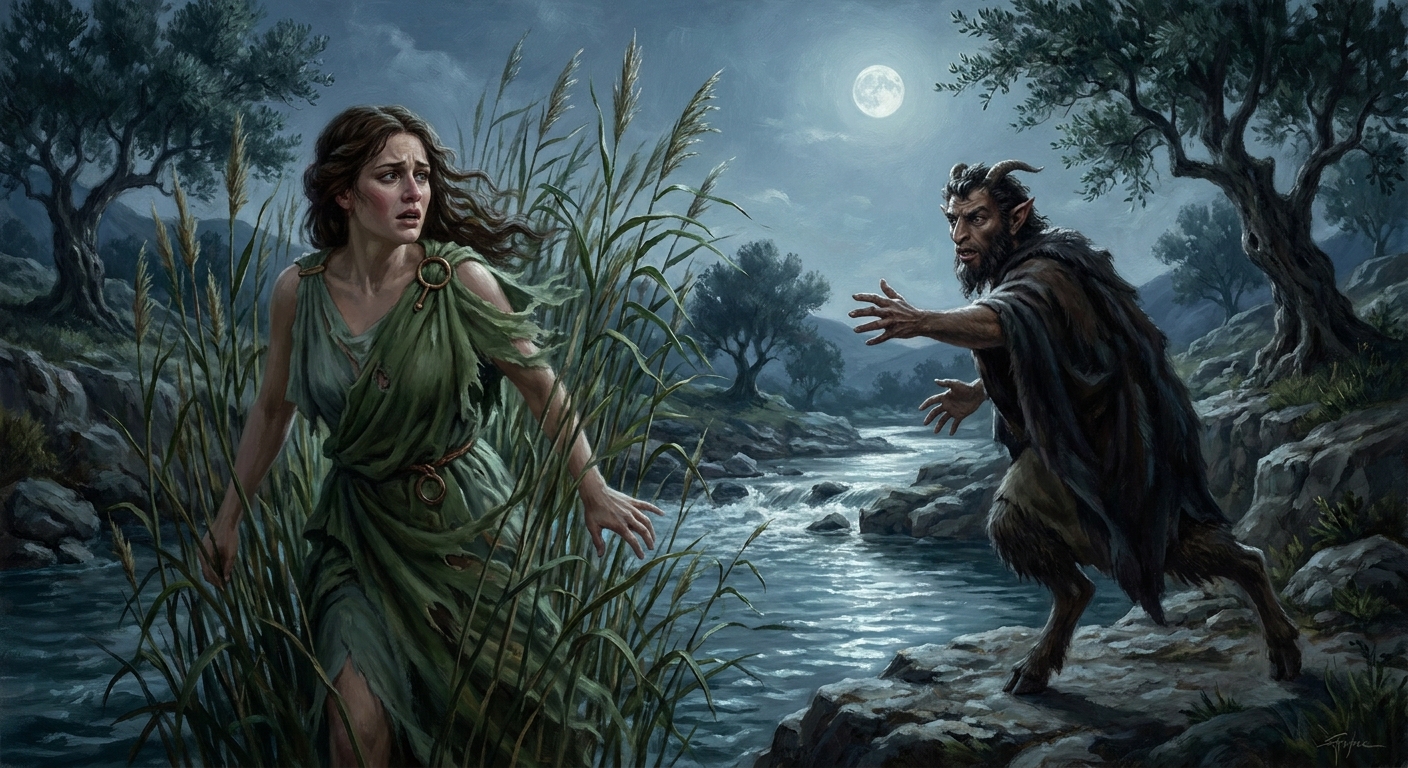
If you know one Pan myth, it is probably the one where desire becomes an instrument. Pan sees the nymph Syrinx, associated with wild places and reeds, and he pursues her. The story is not a romance. It is pursuit with teeth in it, the kind that turns the woods into a trap.
Syrinx flees to the edge of water, where escape runs out. Depending on the version, she prays to river gods or to her fellow nymphs for rescue. They answer in the most mythic way possible: they change her shape. Syrinx becomes reeds, thin and trembling on the bank.
Pan arrives and finds not a body, but a thicket of hollow stalks moving in the wind. When he sighs, air passes through the reeds, and the reeds answer with sound. In grief, frustration, and fascination, he cuts them to different lengths and binds them. Thus the syrinx, Pan’s pipes, are born.
Pitys
Pan’s love stories do not stay soft. Another Arcadian tale follows his pursuit of Pitys, a nymph whose name is bound to pine. The details vary, as they do with myths that outlive their earliest poets, but the emotional shape remains: Pan desires, Pitys flees, the wild itself decides the ending.
In later retellings, a rival force intervenes. Sometimes it is Boreas, the North Wind, jealous and violent, who hurls Pitys from a cliff. Sometimes the story leans more directly into metamorphosis as rescue. Either way, Pitys becomes a pine tree, her body translated into bark and green needles, rooted in the very mountains Pan roams.
And Pan, who cannot keep a nymph, keeps a symbol. Ancient writers connect him with the pine, and later imagery sometimes shows him crowned with it, as if he wears a memory he cannot unwind.
Echo
Pan also collides with Echo, the nymph whose better-known story binds her to repetition and to Narcissus. Yet in a later tradition, Pan’s desire turns toward her as well.
Echo rejects him. In some accounts, Pan answers rejection with a frenzy that spreads like wildfire through shepherds, and Echo is torn apart. Only her voice remains, lingering in mountains like a wound that learned to sing.
In the hills, even refusal returns to you. Sometimes it returns too loud.
It is a brutal story, and it should feel brutal. Pan is not a polite woodland mascot. He is the reminder that nature can be ravishing and indifferent in the same breath, and that divinity in Greek myth is not synonymous with goodness.
Panic
“Panic” is not just a modern word borrowed from an old name. Greek uses panikos for a particular kind of terror, sudden and contagious, the kind that snaps through a crowd like flame through dry grass. Ancient writers connect it with Pan, the god whose presence is felt as a shock in the air.
That is his signature in story. He sends fear that arrives without a clear object, fear that makes a traveler listen to their own breath and decide it is an omen.
Marathon
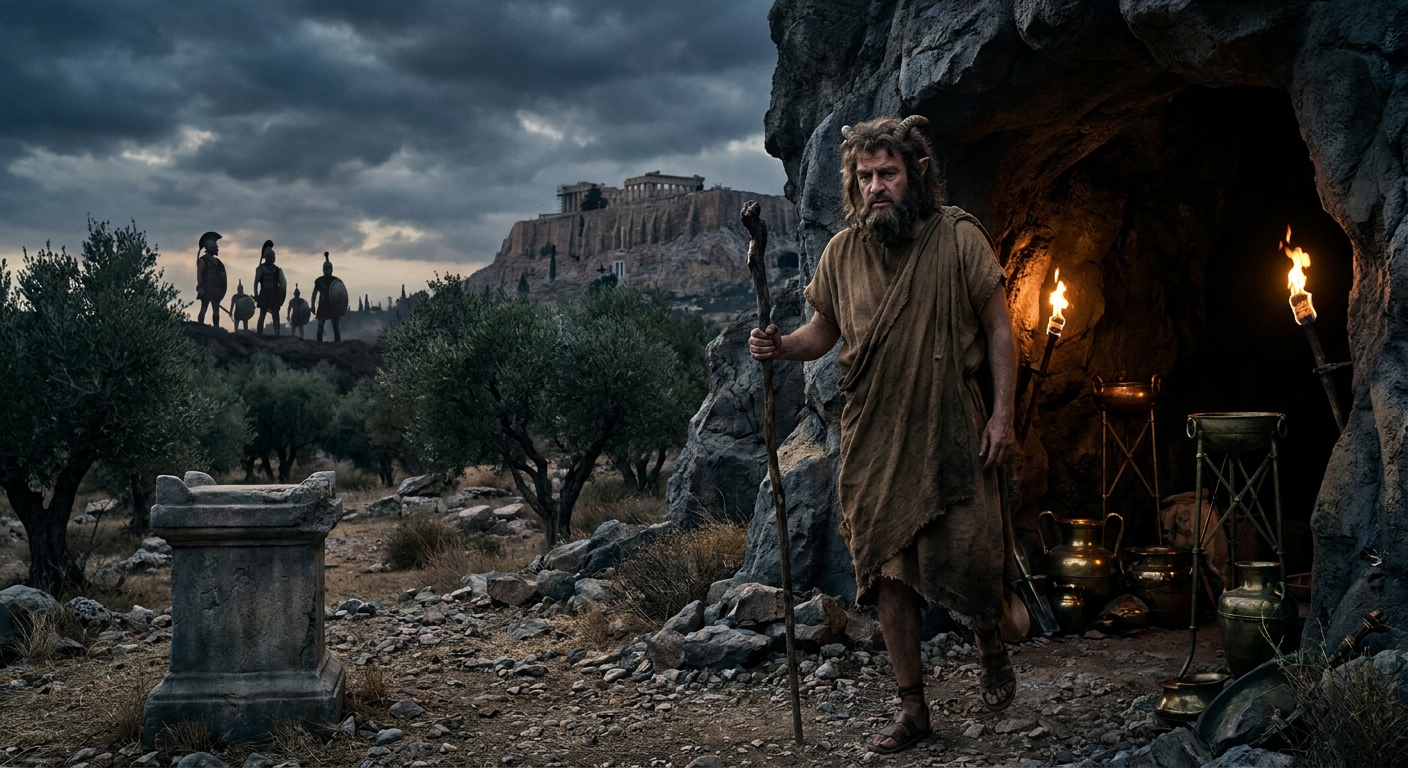
After the Battle of Marathon (490 BCE), Athenians told stories that Pan had helped them by sowing terror among the Persians. The tradition is tied to the messenger Pheidippides (also given as Philippides), who, on a run, encountered Pan and was questioned about why Athens did not honor him. In time, Athenians established worship for Pan, including a shrine in a cave on the slopes beneath the Acropolis.
Is it history as a modern historian would file it? No. It is something older and more revealing: a city-state admitting that in a crisis, you take help where it appears, even if it arrives hairy, laughing, and smelling faintly of goat.
Cult and thresholds
Pan’s religion was not primarily a grand temple affair. He belongs to thresholds, and his sanctuaries often reflect that. Arcadia, his homeland in the imagination, is full of mountains and caves, and Pan is repeatedly associated with cave shrines, rocky hollows where offerings meet darkness.
Shepherds, hunters, and travelers had reasons to respect him. He could protect flocks and grant luck in the hunt. He could also break composure with a sound at the wrong hour. Worship is often a negotiation with power, not a celebration of moral perfection.
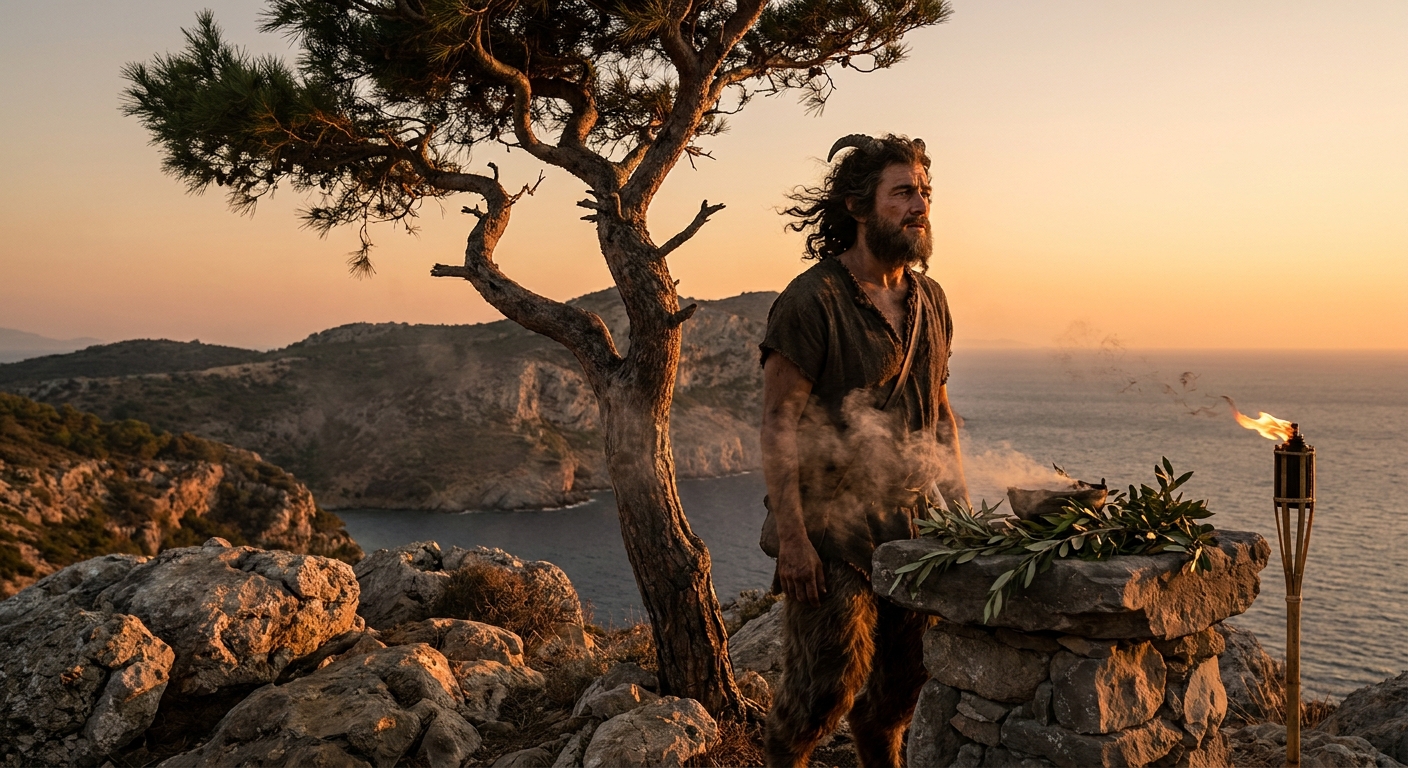
In practice, this can look simple: a handful of offerings left where a path tightens into stone. A libation poured onto earth dark with old ash. A wreath of pine or laurel hung where torch smoke stains the rock.
- Arcadia as Pan’s mythic heartland, a landscape Greeks romanticized as rustic and ancient.
- Caves and grottoes as natural shrines, places where the earth feels close to the divine.
- Mountain passes and lonely roads where travelers are most vulnerable to groundless fear.
- Athens adopting Pan after Marathon, giving the wild god a sanctioned foothold near the city.
Satyrs are not Pan
Pan is often blurred with satyrs in later art, but the difference matters. Satyrs are a riotous crowd, companions of Dionysus, a chorus of appetite. Pan is singular. He is a god, not merely a wild attendant. Where satyrs belong to wine and revel, Pan belongs to lonely places, noon hush, and the shock that makes a throat close.
What Pan represents
Pan is not merely a character in quaint pastoral scenes. He is a pressure in Greek myth, a reminder that civilization is a thin cloak and the hills are older than our names. The Greeks understood these forces as intertwined.
Rustic life
Pan is spring and libido, goats and shepherd songs, the rough comfort of flocks bedded down safe. In a culture that depended on fields and animals, that force was sacred and volatile.
Music born from a wound
The pipes are not a neutral invention. They are metamorphosis turned into melody. When Pan plays, the sound carries the memory of Syrinx and the ache of what the wild has taken.
Fear without a face
Pan’s panic is the sudden realization that you can be undone by something you cannot negotiate with. Not every terror is a monster with a name. Sometimes it is the forest itself, shifting its mood.
Pan is the god of the moment you realize the mountains have their own appetite.
Not a devil, not a joke
Later cultures often treated Pan like a prototype for devils or reduced him to a rustic gag. Greek myth is more interesting, and more uncomfortable, than that. Pan is neither a moral allegory nor a punchline. He is a god of liminal spaces, and liminal spaces always feel dangerous because they are where identities blur.
To meet Pan in a story is to step into a sacred place where certainty fails. The ground is uneven. The light is unreliable. And somewhere, just out of sight, a reed instrument starts to play like the landscape has learned your name.