
The Birth of Hera
Greek Mythology
Hera’s “birth” is not the soft beginning people expect from a goddess of marriage. It is a rescue from a father who swallows his children like it is statecraft, followed by a courtship that reads like a bargain written in thunder.
She enters a cosmos thick with prophecy and succession panic, a world where power is inherited through violence and maintained through spectacle. When Hera becomes Queen of Olympus, she is not merely crowned. She is installed.

Swallowed, Then Returned
In the most widely cited genealogy, Hera is a daughter of Cronus and Rhea, sister to Hestia, Demeter, Hades, Poseidon, and the last-born disruptor, Zeus.
The story is famously brutal: Cronus learns a prophecy that one of his children will overthrow him, and he responds with preemptive cruelty. He swallows them. Not kills them. Swallows them. The children remain alive, suspended in a nightmare of un-birth, sealed inside their father as if inheritance itself must be kept under lock and rib.
Hera’s first cradle is not a temple or a cloud. It is her father’s hunger, weaponized.
Rhea, unwilling to watch the future disappear down Cronus’ throat, hides Zeus and hands Cronus a stone wrapped like an infant. Zeus grows, returns, and forces Cronus to disgorge what he stole. Hera’s return to daylight is therefore not separate from Zeus’ revolt. It is the opening move, the moment the old order proves it can be made to yield.
Hesiod’s Frame
If you want the cleanest “origin” version, you follow Hesiod. In the Theogony, Hera appears as part of a divine family tree and a political map. Her identity is legible in titles: sister of Zeus, wife of Zeus, queen among immortals. The emphasis is on cosmic succession and the architecture of new rule.
In that Hesiodic frame, Hera’s marriage can be read less as romance and more as structure. Mythically, a new dynasty needs the look of order, a public center that claims permanence even while the sky still rings with challenges and vows.
That is where Hera enters with her terrifying glamour. Marriage, in this world, is not a private choice. It is a divine institution.
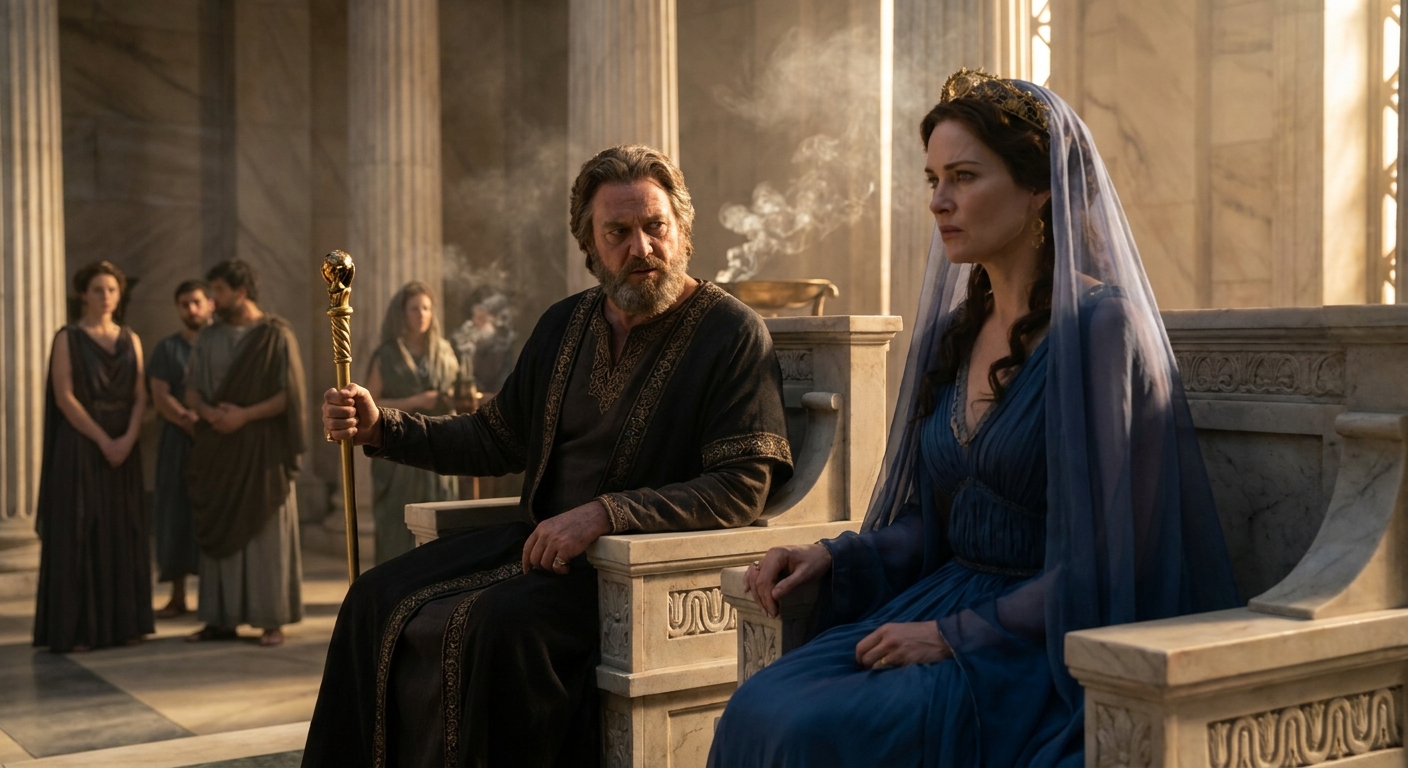
The Cuckoo Trick
Later storytellers cannot resist turning the marriage into a scene you can taste. The air grows perfumed with storm. The curtains of Olympus move like they know secrets. Zeus does not simply propose. He pursues.
In a common later variant, Zeus approaches Hera in disguise as a cuckoo caught in bad weather. Hera’s compassion draws her close, and the moment becomes the hinge. Details shift across sources, but the shape stays the same: intimacy arrives through deception, and the marriage is sealed afterward as if the only acceptable outcome is a throne with two seats.
This matters because it colors Hera’s entire mythology. When your marriage begins as a power play, fidelity is not a domestic preference. It is the one rule that keeps the court from sliding back into pre-Olympian chaos.
Why the Queen Had Teeth
The early Olympian era is not a peaceful golden age. It is a new dynasty still surrounded by older powers and older grudges, still haunted by prophecies and rebellions. Zeus may be king, but kingship in Greek myth is never solitary.
Hera’s queenship signals something crucial: the new order is not merely brute force. It is institution. Hera presides over legitimacy, lineage, and the social laws that make a kingdom more than a battlefield.
That is why Hera can be terrifying without lifting a spear. Her weapons are courtly and therefore permanent: reputation, oath, status, the slow suffocation of divine disfavor. Even when she is portrayed as wrathful, she is enforcing an order the myths insist is fragile.
- As sister-wife, Hera embodies internal stability in Zeus’ regime, a dynastic core rather than a passing affair.
- As queen, she represents hierarchy among the gods, the difference between a divine household and a brawl of immortals.
- As goddess of marriage, she becomes guardian of an institution Greek society treated as foundational and volatile.

Jealousy as Order
Modern retellings often flatten Hera into a single note: jealous wife. But in the older logic of the myths, jealousy is not just an emotion. It is a role.
Zeus’ affairs are not merely scandal. Each liaison produces a new node of power: a hero, a rival bloodline, a beloved mortal whose story will be sung for centuries. Hera’s retaliation, as ugly as it can be, functions like a warding fire at the palace threshold in a court that keeps inviting sparks.
You can feel the pattern in the names that keep returning like embers to dry brush: Io driven across the earth, Semele burned by a vision she was never meant to survive, Heracles pursued from cradle to glory. The queen does not only punish. She tries, brutally, to keep the dynasty from multiplying into threats.
Heraion Origins
If Hesiod gives you genealogy, the Heraion traditions give you place: local cult memory, temple landscape, and the sense that a goddess can be “born” where she is most powerfully worshipped.
Across Greece, Hera’s cult was ancient and intense, especially at major sanctuaries like the Heraion of Samos and the Heraion of Argos. In these settings, stories may lean less on Cronus and disgorging and more on terrain and rite: reeds, rivers, sea air, procession routes worn into the earth by generations of feet.
Some local traditions even focus on renewal rather than first-birth. At Argos, Hera is linked with the spring of Kanathos, where she is said to bathe and become “virgin” again, a ritual logic that treats her power as cyclical and ever-returning.
Here, Hera’s origin can feel like a revelation rather than a line in a family tree. The myths bend to place, because cult does not only ask, “What is the plot?” It asks, “Where does she rule?”

Other Upbringing Tales
Not every tradition lingers on the swallowed children as her whole beginning. Some accounts shift Hera’s early life outward, placing her in the keeping of older divine figures, or among nurturing presences like nymphs, as if her queenship needed a private season before Olympus demanded her in full.
These variants do not replace the hard backbone of succession myth. They complicate it, reminding us that Greek origin stories are less a single document and more a chorus.
What the Birth Explains
Hera’s origin story is an anatomy lesson in Greek power. She begins as a child swallowed to prevent succession, and she ends as a queen forced to manage succession’s messiest forms: lovers, heirs, rivals, and the public theater of legitimacy.
Her myths are painful because they insist on something audiences still recognize. Institutions are not abstract. They live inside people. They create roles that shape emotion until the emotion feels inevitable.
Hera is the guardian of vows in a family that never stops breaking them.
Hera is not simply the goddess who gets angry. She is the goddess whose throne requires anger, because her world keeps calling marriage sacred while letting its king treat it like scenery.
And yet, she remains luminous. Regal. Unignorable. In temple shadow and stormlight, Hera persists as the beautiful contradiction at the center of Olympus.
Quick Myth Notes
Different sources and sanctuaries tilt the story in different directions. Here are the main threads readers usually meet first.
- Hesiodic baseline: Hera is born to Cronus and Rhea, swallowed, then released when Zeus forces Cronus to vomit up his children.
- Marriage focus: Later traditions dramatize Zeus’ pursuit and Hera’s reluctance, including the cuckoo disguise in a well-known later variant.
- Cult distinction: Some Heraion traditions ground Hera in place and ritual, treating “origin” as epiphany, renewal, or local belonging as much as genealogy.
- Jealousy reframed: Her jealousy is not only personal. It is mythic structure tied to succession, legitimacy, and the institution of marriage.