Apollo and Daphne
Greek Mythology
Some myths flirt with romance the way a temple flame flirts with oil: bright, dangerous, and never truly gentle.
The story of Apollo and Daphne is often dressed up as a tragic love tale. Listen closely, and it sharpens into something else. It is a chase that does not end in union. It ends in escape by metamorphosis, in bark rising like armor, in leaves unfurling where fingers used to be.
Not a romance that fails, but a refusal that becomes a symbol the world cannot stop wearing.
Who Daphne is
Daphne is a nymph whose name is both clue and prophecy. In Greek, “daphne” means laurel, as if the ending has been braided into her beginning.
Her father is named two ways in the old traditions: either Peneus, the river god of Thessaly, or Ladon from Arcadia. Different landscapes claim her, but the same idea holds. Daphne belongs to water, woods, and the living pulse of the earth. She is not a figure made for thrones. She is made for wind through branches and the cold honesty of running streams.

Cupid’s revenge
Daphne’s story begins as collateral damage in a celestial bruised-ego moment.
When Apollo mocks Cupid and his archery, Cupid answers like a god who refuses to be laughed at. He does not argue. He does not plead. He fires.
- Apollo is struck with a golden arrow, igniting an uncontrollable love.
- Daphne is struck with a lead-tipped arrow, instilling an aversion to affection.
And just like that, the pursuit is rigged. Not two hearts drifting toward each other under moonlit columns, but a divine imbalance engineered by spite.
The chase
Apollo is usually sold to us as radiant control: the god of music, measure, medicine, prophecy. A beautiful mind with a lyre in hand.
Then the golden arrow lands, and the god of reason becomes fervently irrational. He wants Daphne with the certainty of a spell, his longing swelling into something that does not pause to ask what she wants.
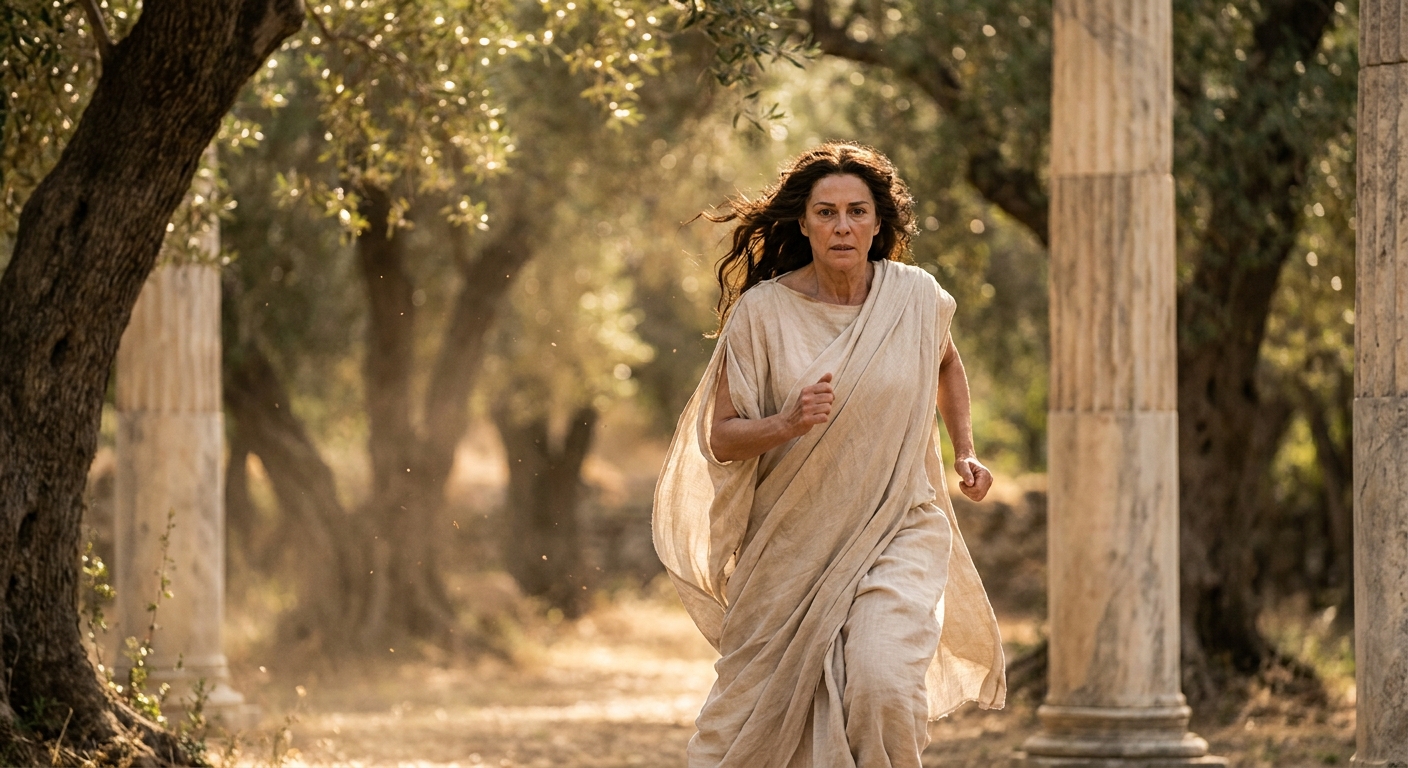
Daphne runs. Not coyly. Not playfully. She runs the way mortals run from storms. The forest becomes a corridor of panic and prayer.
Apollo brings light to the world, and still he cannot learn the simplest lesson: light can also burn.
The prayer
The closer Apollo gets, the more the myth tightens into inevitability. At the crucial moment, Daphne calls for salvation, appealing to her father or to Earth itself.
The answer is not a hidden door, not an armed escort, not a god arriving to scold another god.
The answer is transformation.
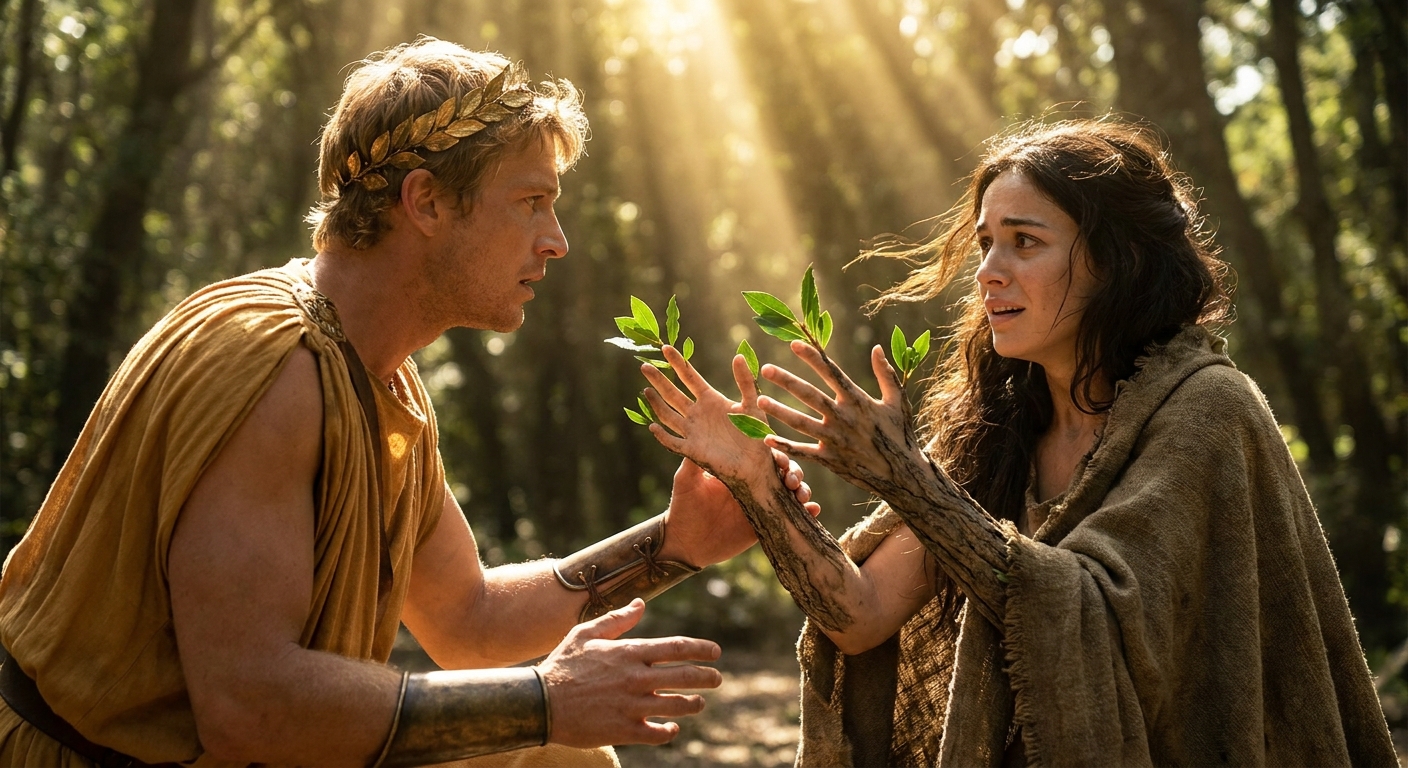
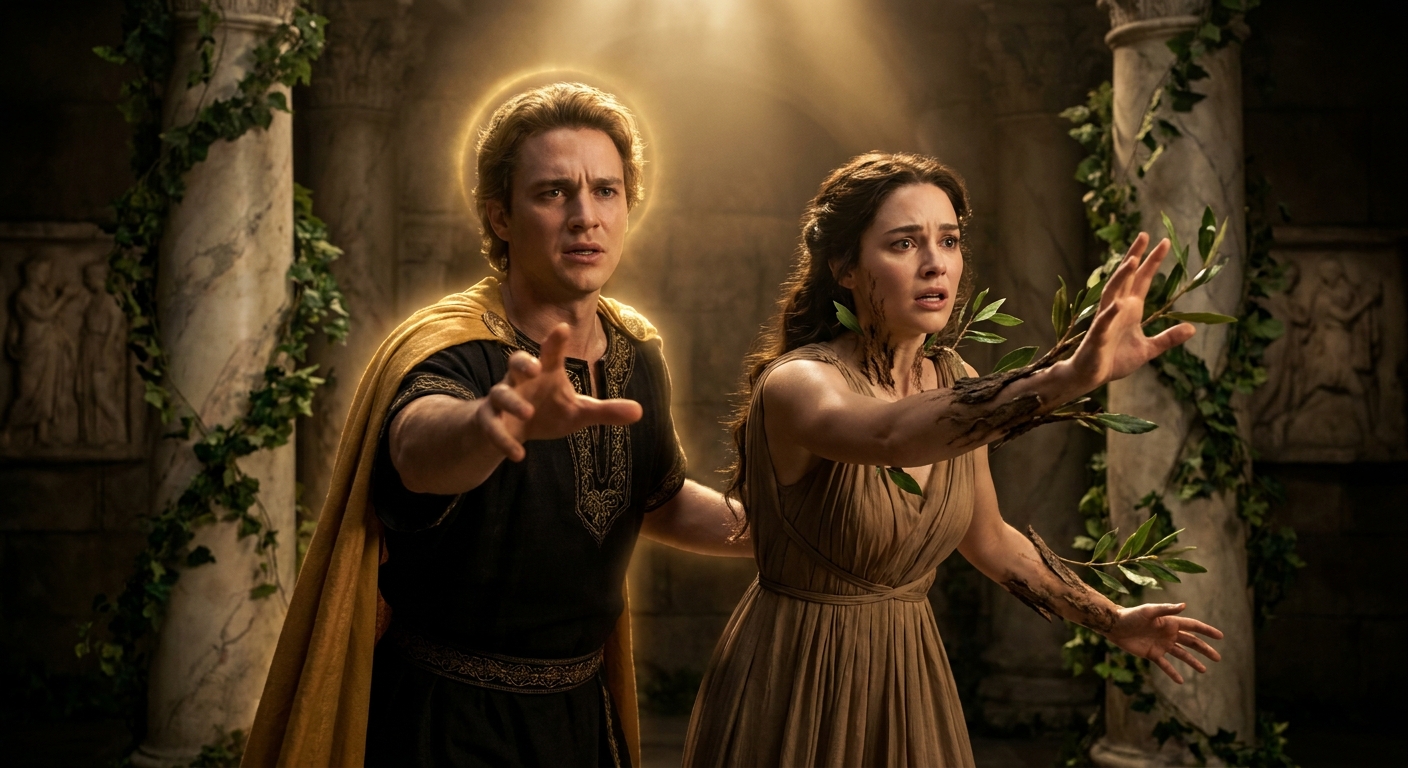
Daphne becomes a laurel tree at the moment of imminent capture. The escape is absolute. So is the cost. To keep her autonomy, she relinquishes her human motion. She trades flight for stillness.
Apollo’s laurel
Apollo does what gods often do when they cannot have a person. He takes the symbol.
Moved by what remains of Daphne’s beauty, he declares the laurel his eternal emblem. The pursued becomes an object of reverence, and reverence becomes a way to keep memory close.
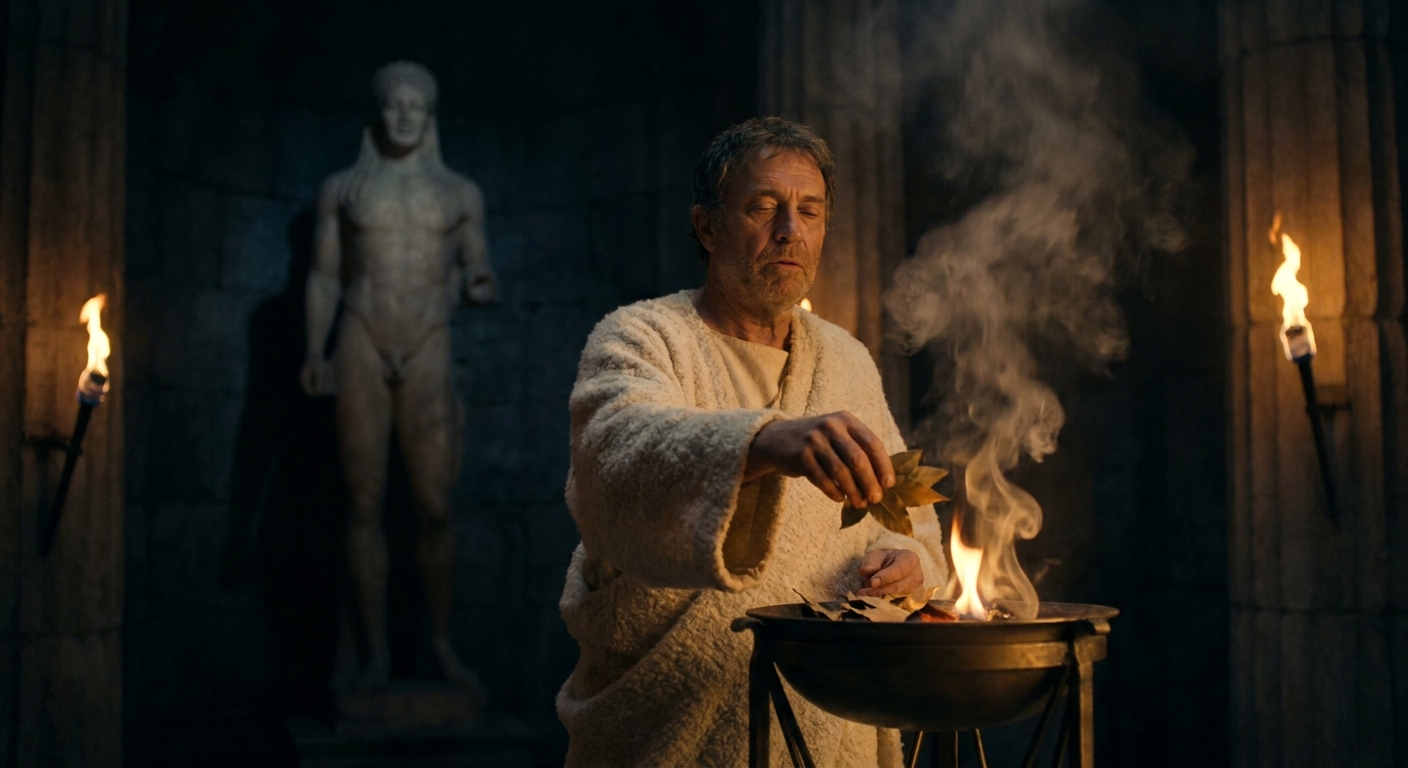
From there, the laurel’s cultural life erupts across Greek civilization. Laurel wreaths crown victors and poets, and they carry prophetic significance, too. Laurel crowns were bestowed upon victors at the Pythian Games at Delphi, games founded by Apollo. The branches also appear in ceremonial rites of protection and purification. Delphic priests used laurel in rituals, and the leaves were believed to enable prophetic visions when burned.
Art and afterlives
Artists kept returning to this moment because it is visually irresistible: flesh becoming wood, panic becoming rootedness, pursuit stopping at a boundary that cannot be crossed.
Ovid retells the myth in Metamorphoses, shaping the transformation leaf by heavy leaf. In sculpture, Gian Lorenzo Bernini captures the instant of change in his baroque Apollo and Daphne (c. 1622-1625), marble turned into breath and bark. Later, John William Waterhouse paints versions that soften the prelude, leaning toward romance and emotional hush before the rupture.
Why it still stings
This myth refuses to let us pretend it is sweet. It sits in the uncomfortable space where power meets autonomy. Apollo’s desire is supernatural, but that does not make it sacred. Daphne’s “no” is not a misunderstanding. It is her whole body insisting on a boundary.
That is why the story stays modern in the way lightning stays modern. Different century, same charge.
The aftermath
If you came looking for romance, Greek mythology offers you something else: a cautionary relic wrapped in greenery.
Apollo does not get the girl. Daphne does not get her old life. What survives is the laurel, forever caught between admiration and mourning, between art and alarm.
And maybe that is the final cruelty and the final triumph. Daphne escapes. But she also becomes a symbol the world keeps celebrating, often without remembering why it was born.
In every crown of laurel, victory shines. In every leaf, a boundary remains.