The Sphinx: The Riddle That Turns Survival Into a Trap
Greek Mythology
Some monsters kill you with teeth.
The Sphinx kills you with a pause.
With the smallest, most delicate violence imaginable, she turns the human instinct to survive into a test that can only be passed by naming what you are. Not your lineage. Not your city. Not your victories. Your nature.
And like all the best Greek nightmares, the trap is that the answer was always inside you, waiting like a secret you forgot you were carrying.

From guardian to executioner
The Sphinx is one of mythology’s most revealing transformations, the kind that happens when a symbol crosses a sea and arrives in a new culture wearing a different mood.
In Egypt, the Sphinx was a monumental presence tied to royal authority and protection: a colossal, tranquil figure, human-headed and lion-bodied, without wings. It faced the horizon like a promise carved into stone, less predator than permanence.
But the Greek imagination, addicted to drama and thresholds, could not leave that serenity untouched.
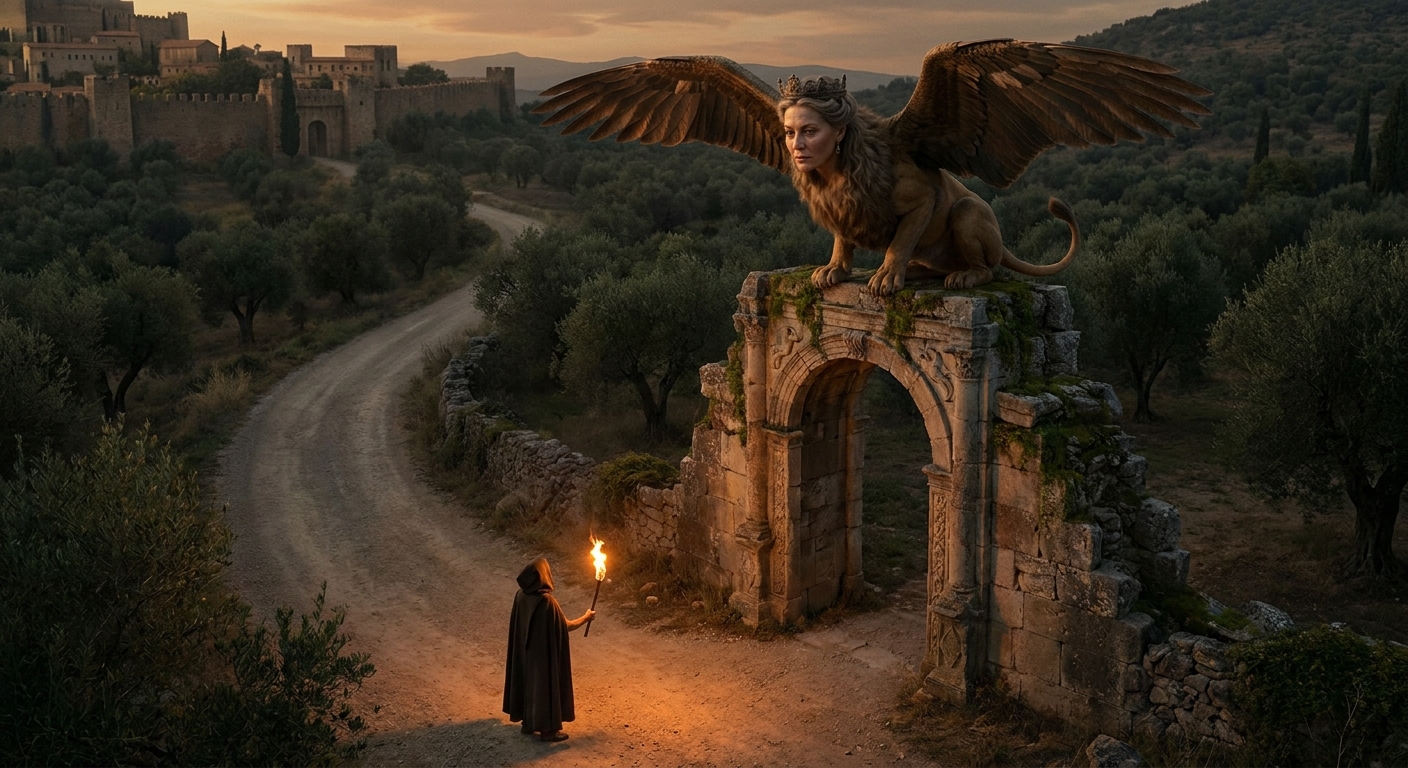
In Greek lands, the Sphinx becomes a winged creature with a woman’s face, no longer a quiet guardian of order but a living crisis. Wings, borrowed from the Greek bestiary of sky-haunting terrors, shift her from statue-still to suddenly mobile, capable of appearing where she should not be and departing before help can arrive.
Thebes: where knowledge becomes a toll
The Greek Sphinx is most famous as a gatekeeper at Thebes, the sort of city that seems built for tragedy. Not because it lacks beauty, but because its beauty is always standing too close to a cliff.
At the entrance, where travelers should smell bread smoke and hear market noise, they find a different civic ritual: a question asked like a sentence being read aloud.
The road does not end at the gate. It ends at the question.
This is why her riddle feels uniquely Greek. It turns philosophy into infrastructure. Your ability to interpret life becomes as practical as a city wall. The Sphinx does not merely threaten bodies. She threatens entry, future, belonging.
And if you fail, the punishment is not a lesson. It is final.
The riddle that makes your life a timeline
The Sphinx’s most notorious challenge is preserved like a dark jewel in myth:
“What travels on four legs in the morning, two legs at noon, and three in the evening?”
The answer is man, meaning a human being across the arc of life:
- Morning: childhood, when we move close to the earth and the world is too large for our balance.
- Noon: adulthood, upright and fast, convinced the sun will stay there forever.
- Evening: old age, when the third “leg” appears as a cane, not as weakness but as evidence of survival.
It is a brilliant riddle because it forces a mortal to confess mortality. It makes you describe the very thing you try not to look at directly: that you will change, you will decline, and you will need help.
At the Sphinx’s gate, the “correct” answer is not trivia. It is self-recognition.
Oedipus: solving the monster and stepping into the next trap
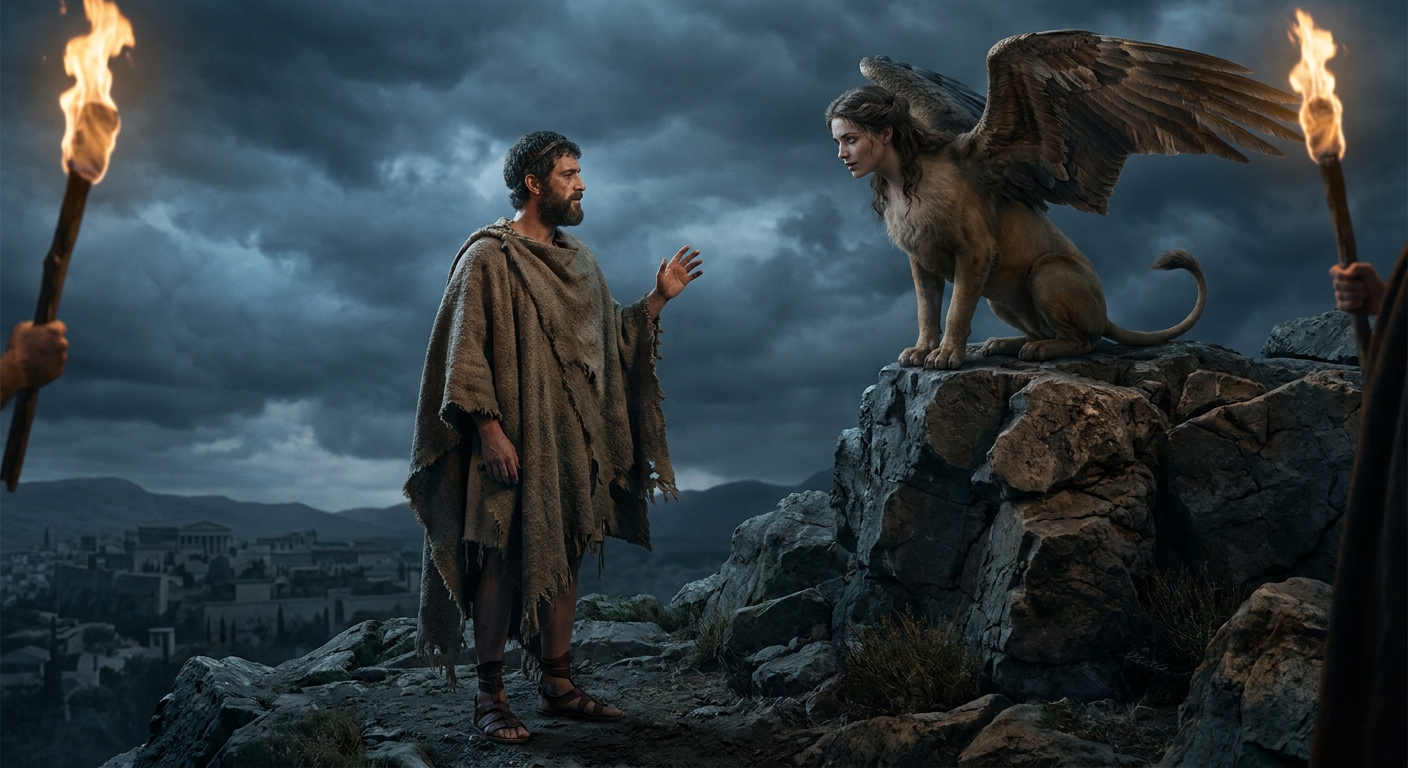
When Oedipus meets the Sphinx, the moment reads like a collision between myth and philosophy, the kind of scene you can practically see lit by torchfire: the beast poised above stone, the air taut as a bowstring.
He answers correctly, and the story immortalizes him for it. He does not only outthink a monster. He wins access to a city and, with it, power.
But Greek myth loves a bargain with hidden ink.
In Greece, the riddle is never just a question. It is a doorway.
The Sphinx frames wisdom as a key, yet the lock opens into consequences. Oedipus’s victory at the gate becomes a hinge in his rise at Thebes, proof that the Greeks understood something bitterly modern: that intelligence can be a ladder, and ladders can lead you somewhere you did not intend to go.
Why the Sphinx feels like a trap even when you know the answer
Here is the cruelty, and also the seduction.
The riddle’s solution is simple enough to memorize, but the Sphinx is not ultimately asking for memorization. She is asking whether you can face the entire human arc without flinching. She forces a traveler to compress a lifetime into a sentence and say it aloud at a city’s threshold.
That is why the Sphinx is such an elegant predator. She makes survival itself feel conditional, as if life must be justified to continue.
A monster with a woman’s face
The Greek Sphinx is also a study in how mythology dresses fear.
She is winged, leonine, and unmistakably feminine in face, a configuration that invites an uncomfortable question: what did Greek storytelling do with the idea of female intelligence when it appeared where men expected to control the conversation?
Greek myth has a familiar habit of turning certain kinds of power into monstrosity, especially when that power is difficult to domesticate. The Sphinx’s weapon is not seduction in the shallow sense. It is intellect, the ability to stop a man on the road and make him answer.
In that light, her riddle is not only a puzzle. It is a form of gatekeeping that reverses the usual order: the traveler is interrogated, the city is withheld, and the woman-faced monster gets to decide who deserves to pass.
It is no wonder the Greeks made the price of failure so high. The story needs the hero to win. The story also needs the audience to feel the danger of a mind that cannot be bribed, charmed, or shouted down.
The Sphinx across borders, the Sphinx across time
Across cultures, the Sphinx keeps her hybrid body and changes her meaning.
In Egypt, she reads as cosmic stability and royal permanence, the gaze that outlasts generations. In Greek myth, she becomes an intellectual gatekeeper, proof that ideas can be as lethal as claws. Further east, versions appear with more ornamental, mystical flourishes, emphasizing divinity and protection in ways that mirror different spiritual aesthetics.
Same bones of a creature. Different moral weather.
And if she still haunts modern stories, it is because we never stopped living at gates. We simply changed the architecture. We still face thresholds that demand the right response, the right proof, the right identity, the right phrase spoken in the right order.
The Sphinx endures because she asks what every threshold asks: who are you, really?
What the Sphinx teaches when the road goes quiet
I think the Sphinx terrifies us because she makes a brutal promise: knowledge is protective, but only if you can bear what it reveals.
Her riddle is about the body aging, yes, but it is also about the ego shrinking. The child crawls. The adult stands tall. The elder needs a third leg and keeps walking anyway. It is not a shameful ending. It is the whole point of endurance.
So if you ever feel as though the world is a gate and you are one wrong answer from being turned away, remember the ancient shape crouched in your path.
The Sphinx is not asking you to be perfect.
She is asking you to admit you are temporary.