
The Birth of Hermes
Greek Mythology
Some gods arrive with trumpets. Some arrive with blood.
Hermes arrives with a grin, a plan, and the kind of audacity that makes the older Olympians check their jewelry.
His birth myth does not treat infancy as innocence. It treats it as cover. Hermes is the god who proves, on his first day alive, that the universe can be slipped through with speed, charm, and an almost religious devotion to loopholes.

Maia’s Cave on Cyllene
Hermes is born to Maia, one of the Pleiades, in a cave on Mount Cyllene in Arcadia. Not a palace birth, not a public coronation. A hidden room of stone and smoke where secrecy is not a mood, it is a survival tactic.
Maia is also, inconveniently for her peace of mind, a lover of Zeus. Which means Hermes enters the world already threaded into Olympus’ long, glittering web of betrayals. His mother wants quiet. The myth refuses to provide it.
In the Homeric Hymn to Hermes, the child is barely born before he begins moving like a thought. He slips from his cradle. He steps into the world as if the world has been waiting for him.
A newborn leaves the cradle not to cry for milk, but to go hunting for opportunity.
The First Theft
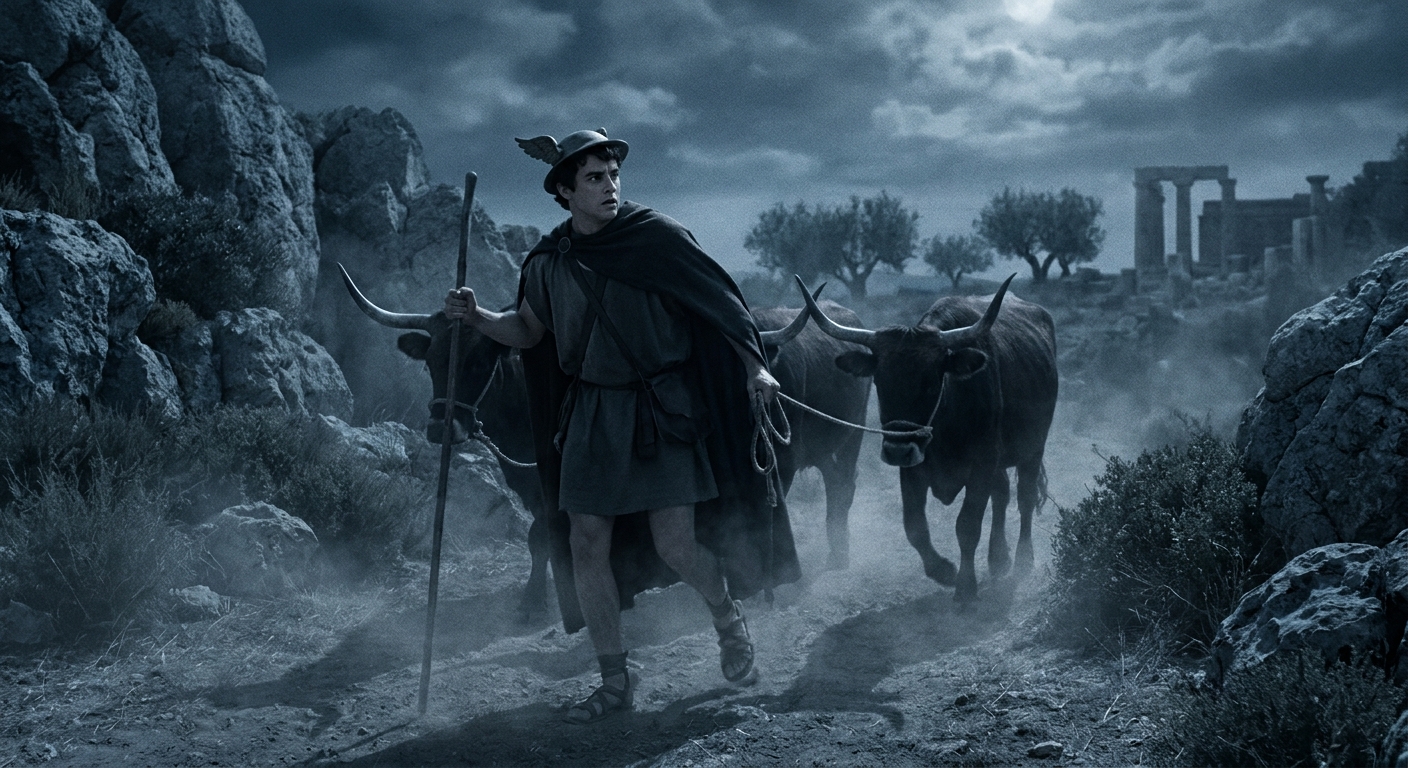
Hermes does not start small. He targets Apollo, radiant prince of laurel and prophecy, and steals his cattle.
This is not random mischief. It is a declaration of rank. In Greek myth, cattle are status, wealth, sacrifice, the kind of moving treasure that proves you can take and keep what matters. Hermes is saying, in the only language Olympus truly respects: I can.
The details are deliciously technical. Hermes drives the herd in a way meant to confuse pursuit. In the hymn, he makes the cattle walk backward so their tracks point the wrong way. Some tellings add a further insult: sandals of brushwood to blur the prints, as if the road itself has learned to lie in dust and moonlight.
From Shell to Lyre
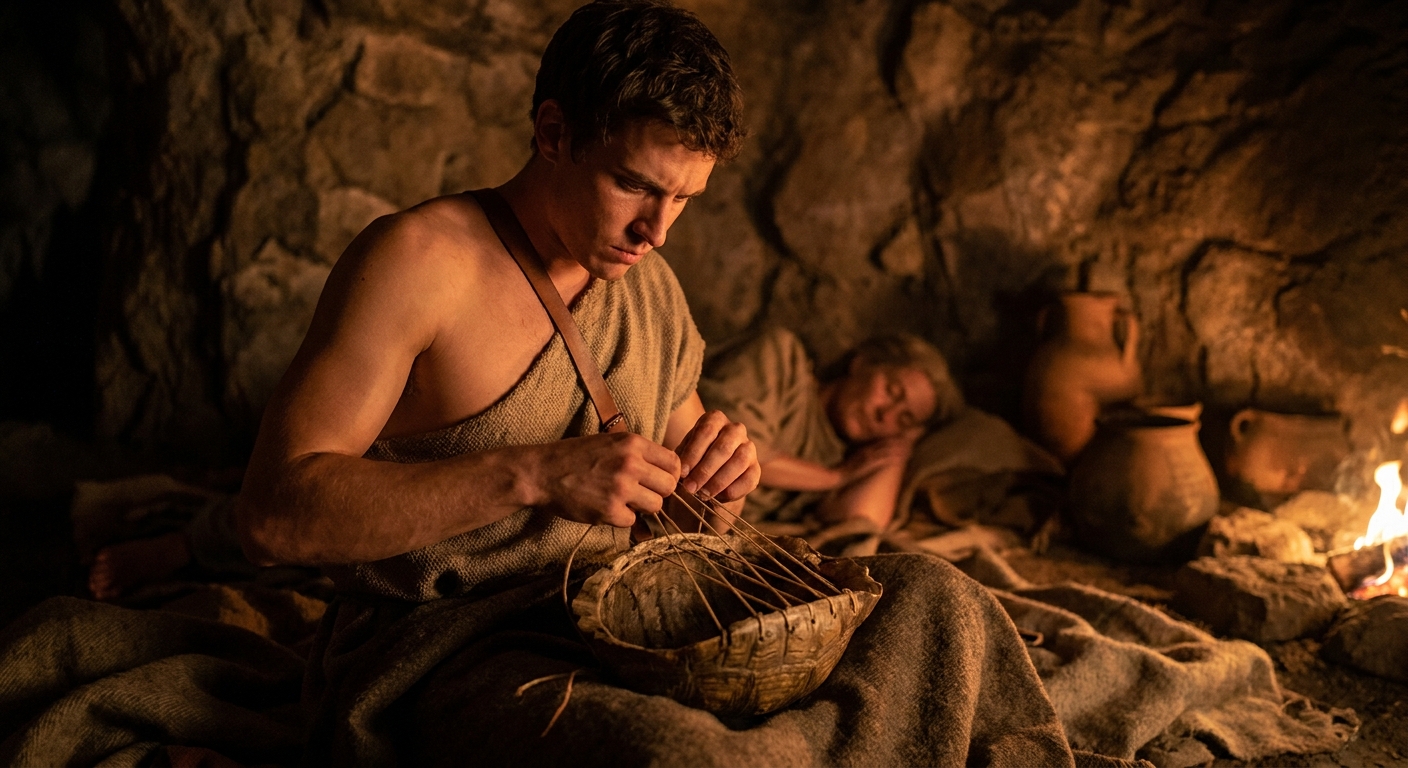
On the same day, Hermes makes something that should not exist yet: the lyre.
The hymn gives him a tortoise, slow and ordinary, the kind of creature nobody writes epics about. Hermes turns it into an instrument by stretching strings across a hollow shell. It is an act of invention with teeth in it, the creation of beauty as leverage.
Greek myth often treats craftsmanship as a form of power. Athena makes strategy. Hephaestus makes weapons. Hermes makes music, and then waits to see who it changes.
Apollo in the Doorway
Apollo, understandably, notices his cattle are missing. The god of clear sight and clean lines follows the trail of confusion until it leads, humiliatingly, to a cave with a baby inside.
Hermes performs innocence like theater. Swaddled. Wide-eyed. A newborn who could not possibly have dragged a herd across Arcadia. It is the first time we see his true gift: not speed, not stealth, but the ability to make the truth look optional.
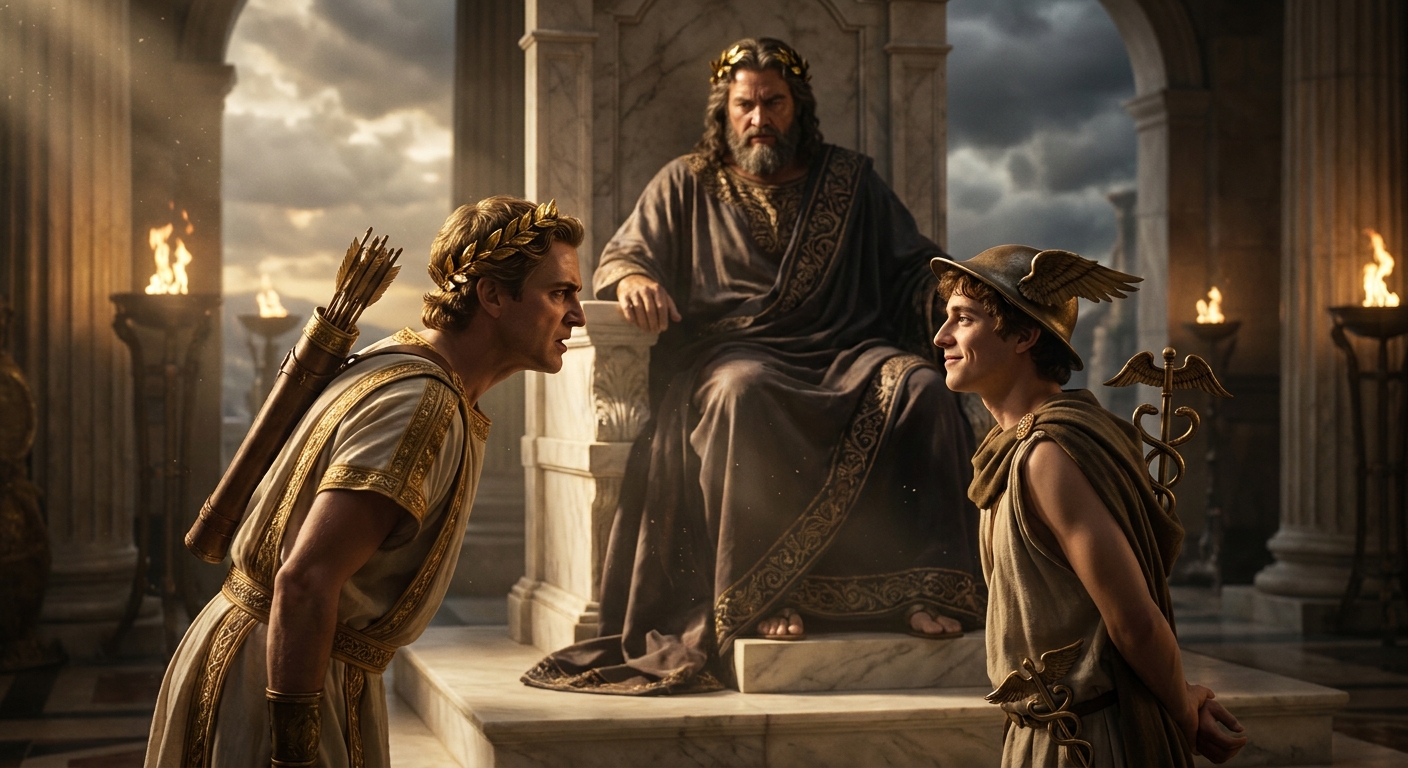
Yet Apollo is not easily moved. He hauls Hermes to Zeus, and suddenly the prank becomes a trial, a family dispute under the bright ceiling of Olympus.
On Olympus, even theft becomes diplomacy when the thief is the king’s son.
The Bargain
Here is where Hermes shows what kind of god he will be: a god of exchange.
Zeus orders the cattle returned. Hermes complies, but not like a defeated child. He offers Apollo a trade, and this is the brilliant pivot of the myth. Hermes plays the lyre. Apollo, already bound to song and later famous for it, is stunned by the sound of a new thing entering the world.
So the bargain is struck: cattle for the lyre. Apollo takes the instrument that will become part of his identity. Hermes gains something more lasting than livestock. He gains recognition, and a place carved out by wit rather than war.
In some traditions Hermes also gains the caduceus, the staff associated with heralds and the settling of disputes, linked in later stories to a moment of separating two serpents and turning living conflict into pattern. The timing shifts by source, but the theme holds: Hermes does not merely escape consequences. He turns trouble into office.
A Place in Olympus
Zeus laughs. Not because theft is harmless, but because the boy is unmistakably his. Clever in the way Zeus values most: clever enough to be useful, dangerous enough to be interesting, and shameless enough to survive divine politics.
From this clash, Hermes wins a place among the gods. Later tradition will know him as messenger of the gods, the one trusted with errands that require speed, discretion, and a tongue that can make peace sound like profit.
- He runs between Olympus and earth, where prayers rise like temple smoke and answers return as omens.
- He becomes patron of travelers, roads, merchants, and yes, thieves. Because movement creates opportunity, and Hermes is opportunity with a pulse.
- He becomes a god of persuasive speech, of negotiations that end wars or start them, depending on what is carried in the hand and hidden in the sleeve.
From the beginning, his domain is not one element like sea or sky. It is the space between: between cities, between promises, between what is said and what is meant.
Guide of Souls
And then the myth turns colder, as Greek myths often do when you start to feel too charmed.
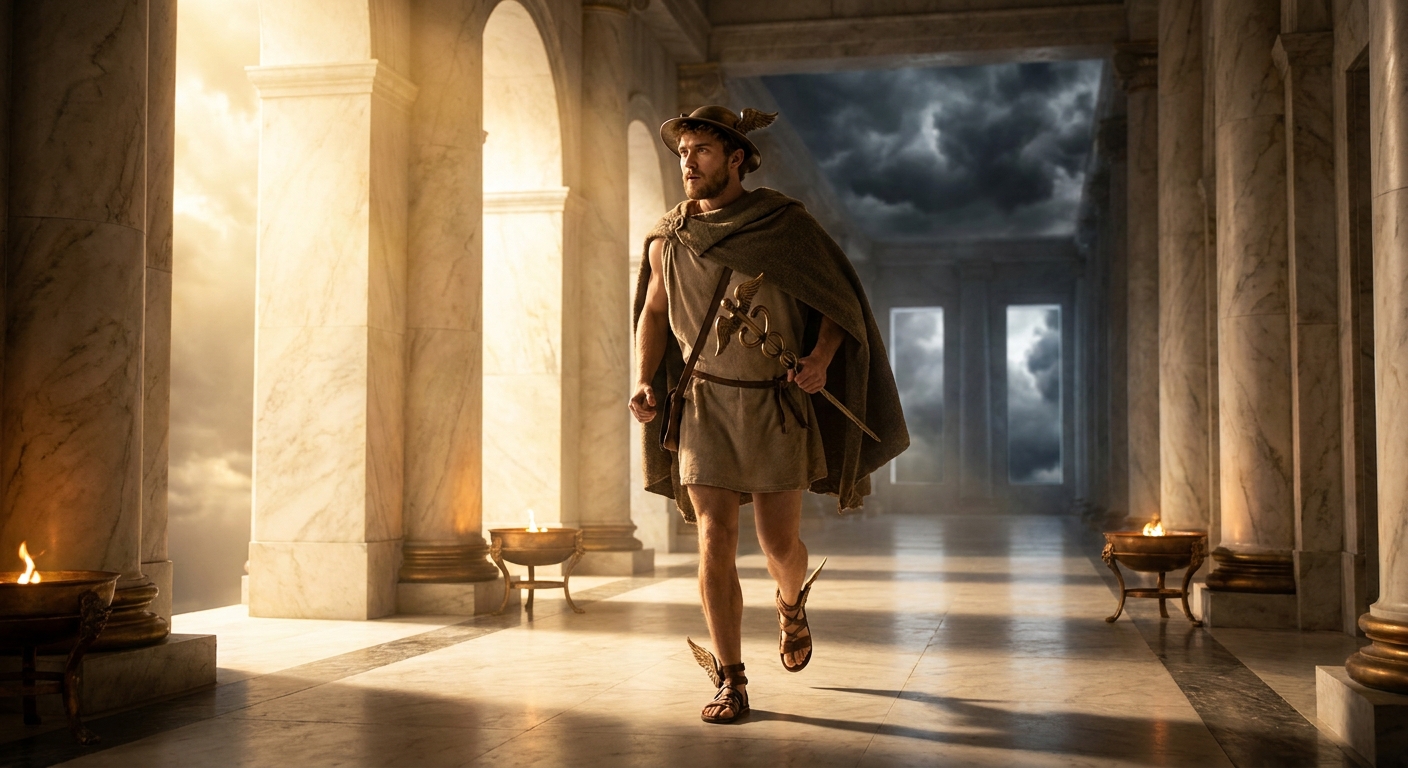
Hermes is also the one who guides souls to the Underworld. Not as a single scene of investiture, but as a natural extension of what he already is: the god who knows thresholds, who handles crossings, who can walk a border without flinching.
When mortals die, it is not Apollo’s sunlight that escorts them. It is Hermes’ steady, unsentimental competence. A hand at the elbow. A torch in the dark. A guide who does not panic when the world changes shape.
The same god who steals cattle can also shepherd the dead. In Greece, that is not a contradiction.

Why It Explains Him
Hermes’ origin story is not a cute tale about a clever baby. It is a blueprint for the most adaptable god in the Greek imagination.
Everything that comes later is already inside that first day:
- Trickster: He bends perception, not just rules.
- Inventor: He makes new tools, new paths, new solutions.
- Diplomat: He turns conflict into contract.
- Messenger: He belongs to motion, not to thrones.
- Guide of souls: He understands the geography of thresholds, where everything is uncertain and everyone is vulnerable.
Hermes is Olympus’ patron of the in-between. Roads. Markets. Doorways. Border stones. The moment before you speak a lie, and the moment after you realize you have told the truth by accident.
And maybe that is why he still feels so modern. Not because he is harmless, but because he is adaptive. He is the god who thrives in messy systems, who finds the crack in the marble and slips through smiling.
If Athena is the calmest person in the room, Hermes is the one already halfway down the corridor, carrying the keys, the message, and the advantage.
Quick Myth Notes
Hermes’ birth and early exploits are most famously told in the Homeric Hymn to Hermes, a work that delights in his wit and his impossible competence. Later authors and local traditions expand his symbols, including his herald’s staff and his broad patronage over travel, commerce, language, and liminal spaces.
As always in Greek mythology, details vary by source and region. But Hermes’ essence stays consistent: movement, exchange, and the sacred art of slipping through.