The Birth of Hephaestus
Greek Mythology
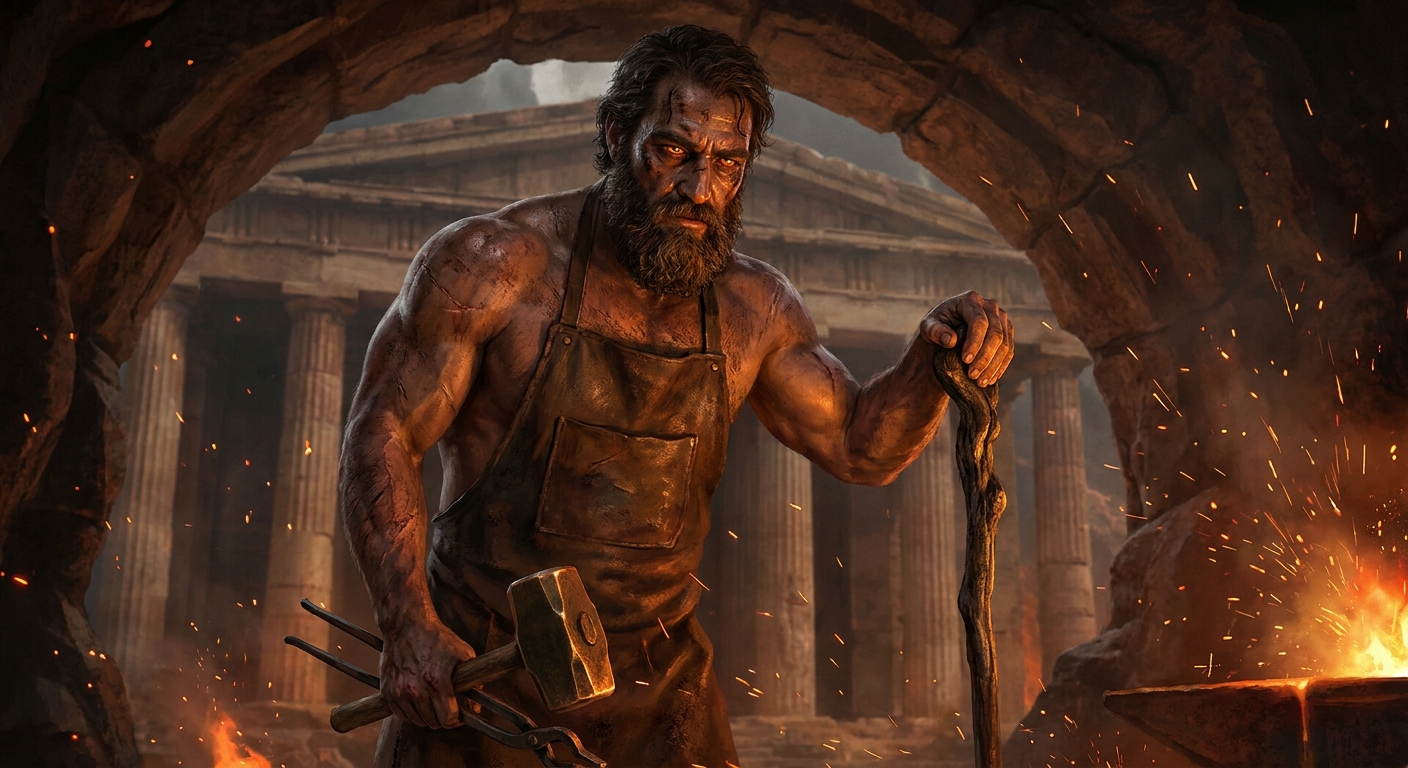
Some gods enter the world like sunrise. Hephaestus arrives like a hammer blow.
His beginning is not a single clean hymn, but a tangle of competing traditions, each revealing the same truth from a different angle: Olympus can be dazzling, but it is not gentle. The smith of the gods is defined early by rejection, by a body marked as different, and by the kind of genius that survives being thrown away.
If you want a through-line for his mythic identity, it is this: exile and craft are not separate chapters. They are the same fire, fed from different sides.

Two births
Ancient sources do not agree on how Hephaestus first came into being. They do, however, often frame his beginning as a divine household crisis.
Hera alone
In one influential tradition, Hera produces Hephaestus without Zeus at all, a kind of retaliation. The provocation is Zeus’ famous “solo” begetting of Athena, who springs armed from his head, an insult to Hera’s role as queen and mother. Hera answers with her own miracle, except hers is not a gleaming strategist in polished armor.
Instead, the child is bound from the beginning to what Olympus prefers to keep offstage: smoke, heat, and the unforgiving labor of making what endures.
A goddess of marriage gives birth alone, and Olympus learns that vengeance can be maternal.
Zeus and Hera
Other accounts name Hephaestus as the child of Zeus and Hera together, born into an already volatile marriage. In that version, the tragedy is not the absence of a father, but the presence of parents who treat kinship like a contest of thrones.
The fall
No matter which origin you follow, the story turns on one of Greek myth’s coldest motifs: a god cast down like refuse.
In some traditions, Hera looks at her newborn, sees what ancient poets describe with harsh terms for lameness, and in a burst of disgust and divine impatience, throws him from Olympus. The language is cruel because the attitude is cruel. The myth does not ask you to admire it. It asks you to see what shame can do when it has power.
In the Iliad, Hephaestus himself recalls a different fall. He tries to defend Hera during one of the Olympians’ quarrels, and Zeus answers not with argument, but with gravity. He seizes his son and hurls him from the sky. The message is the same: on Olympus, tenderness is not always rewarded.
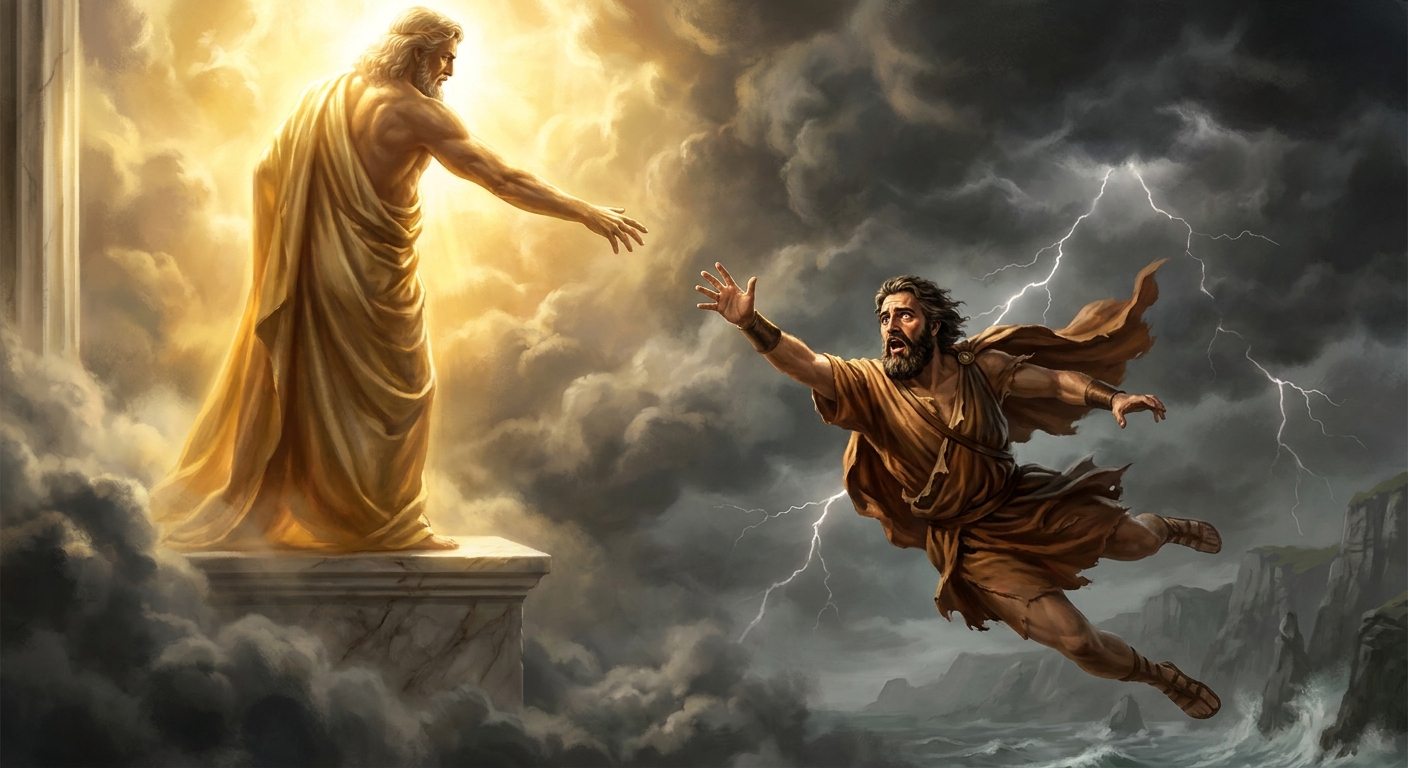
In the most luminous palace in myth, the punishment is simple: you do not belong.
The sea shelter
The fall does not end in a heroic landing. It ends in distance and silence, far from the marble terraces where gods pretend they are above consequence.
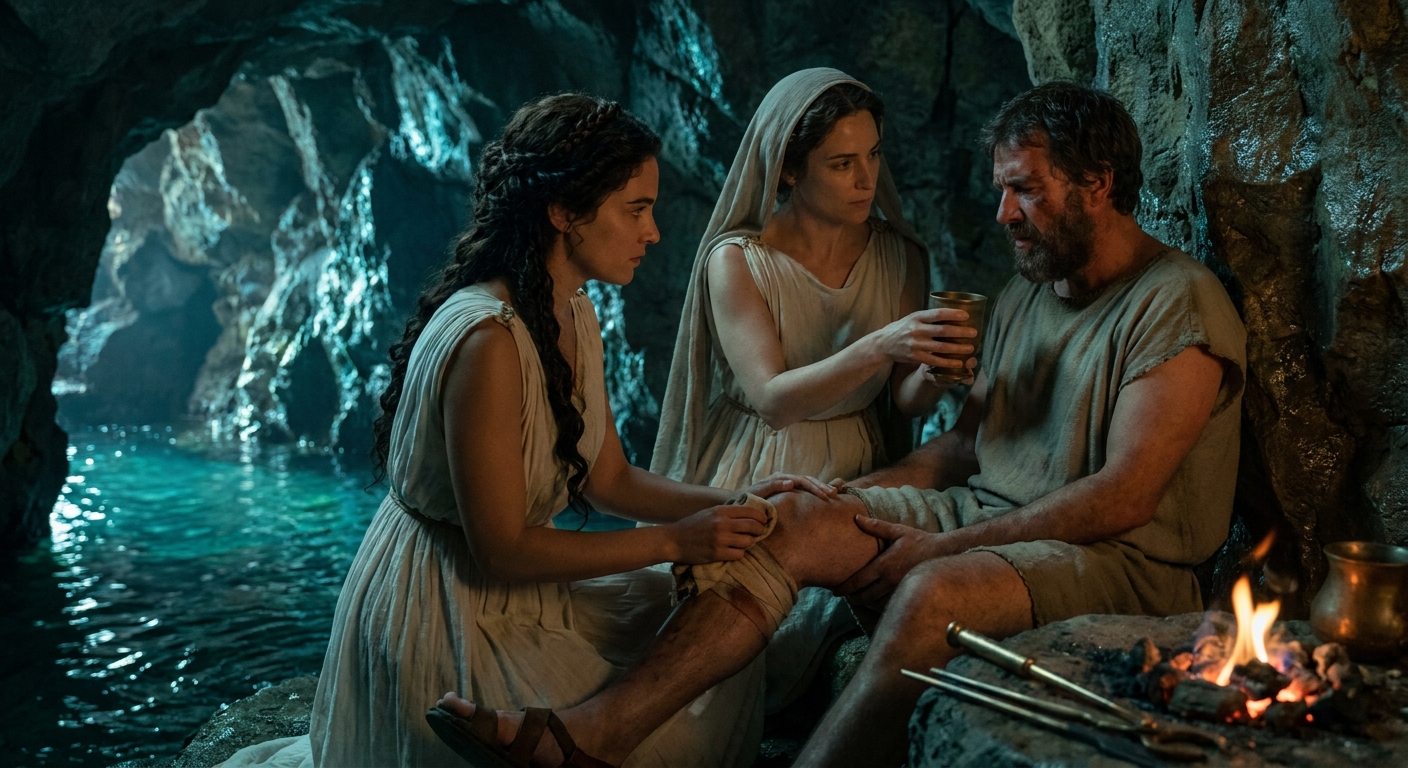
In the Iliad, Hephaestus says he was taken in by two sea divinities, Thetis and Eurynome. They hide him for nine years, as if exile needs a sacred measure.
Salt air on bruised skin. Dark water below sea cliffs. The hush of a grotto where even thunder cannot intrude. In that shelter, the rejected god begins to make. Not speeches. Not pleas. Work.
He forges wonders there, shining objects born of solitude and skill, offerings of gratitude and proof of survival. The sea, so often the stage for Poseidon’s rage, becomes for Hephaestus a refuge that teaches patience and precision.
Return by craft
Eventually, Hephaestus returns to the world that discarded him, and he does it in the only language Olympus cannot dismiss: craft.
One famous later episode makes the leverage literal. Hephaestus fashions a beautiful throne for Hera, a gift that becomes a trap. When she sits, the chair holds her fast. The gods bargain. Their quarrels suddenly acquire manners. In many tellings and images, Dionysus is sent to fetch the smith, coaxing him back with wine and companionship, because force has already failed and pride has already bled enough.
He does not return as a forgiven child. He returns as a necessary god, and necessity is the closest thing Olympus has to respect.
Exile teaches him what Olympus never will: power is not inherited. It is built.
Fire and rule
Hephaestus becomes the divine engineer behind the Olympians’ most iconic marvels. The forge’s sacred violence reshapes raw matter into authority, and that authority stains everything it touches, from scepter to shield.
It is tempting to say he forges Zeus’ thunderbolts, because later retellings and popular memory often put that power in the smith’s hands. But in Hesiod, the Cyclopes are the key makers of Zeus’ thunder. The deeper point still stands: whoever controls the making controls the edge of the world. A craftsman knows where a crown can crack.
Aphrodite
Then comes the marriage, the part of Hephaestus’ story that tastes like wine gone sour.
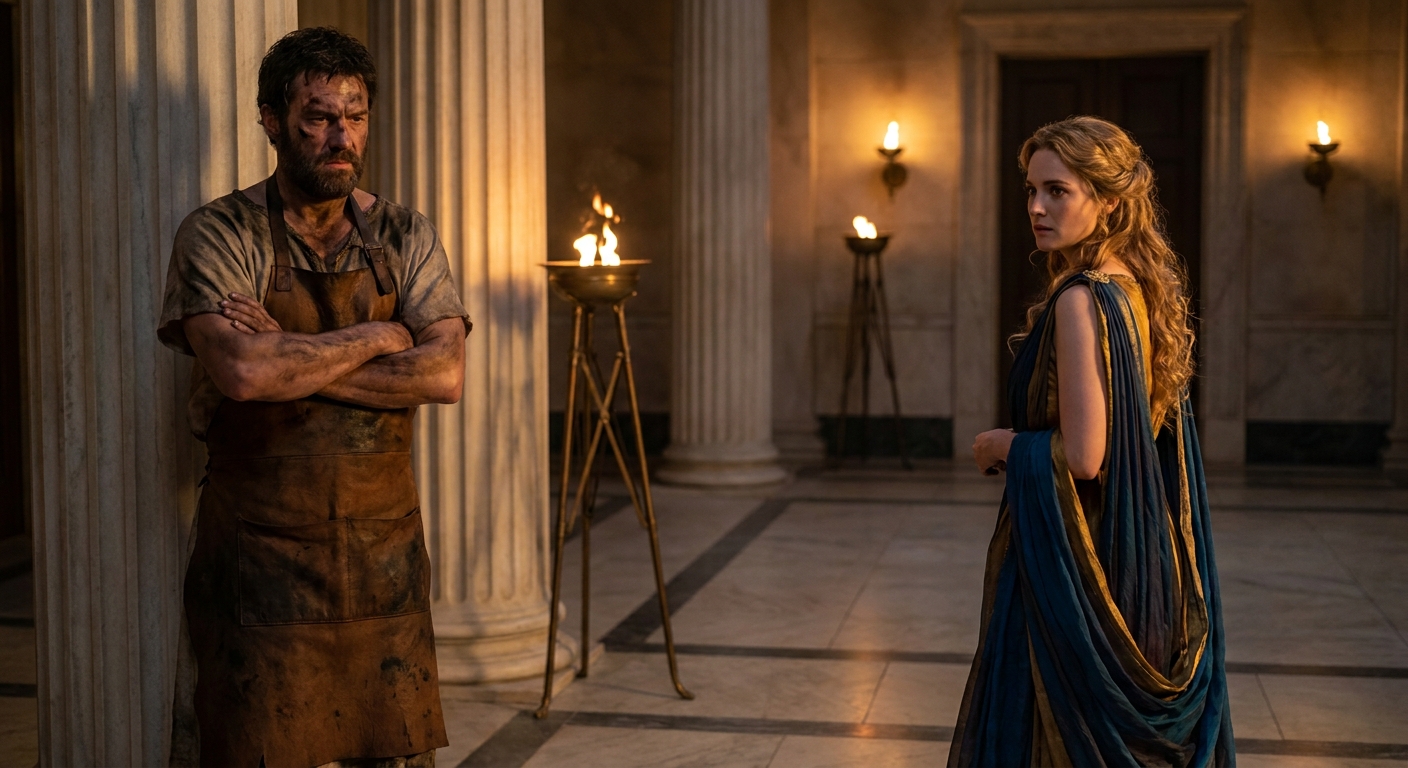
In the Odyssey and much later tradition, Aphrodite, goddess of beauty and desire, is the wife of Hephaestus. The match is rarely framed as tender destiny. More often it reads like a settlement, a bargain struck to quiet rivalry or reward service. In a household of gods, marriage can be less a union than a chain made of gold.
For modern readers, the pairing can feel like cruelty layered atop earlier cruelties, an echo of Olympus’ obsession with appearances. Hephaestus is treated as if he can be paid in prestige, then expected to swallow the private cost. Aphrodite, luminous and volatile, is treated like a prize in someone else’s negotiation. Nobody looks noble here, which is one way myths stay honest about power.
The later stories of Aphrodite’s affairs, famously with Ares, and Hephaestus’ ingenious response belong to his wider cycle. Even here, at the level of origin and place, the marriage tells you what Olympus thinks Hephaestus is for: not beloved son, but useful artisan.
Forge as home
It is tempting to sanitize Hephaestus into a comfortable archetype, the kindly craftsman, harmless among the gorgeous and cruel. The myths do not support that. Hephaestus is gentle sometimes, yes, and brilliant often, but he is also sharp-edged, wounded, proud, and capable of vengeance. Exile does not produce sweetness by default. It produces precision.
His lameness is not a footnote. In the mythic imagination, it becomes part of his meaning. The god with the imperfect stride makes the gods’ perfect bodies look less impressive than the things he creates. His body carries the evidence of Olympus’ violence, and his work carries the evidence of his survival.
He belongs to smoke-stained sanctuaries, to volcanic mouths, to island workshops. Lemnos clings to him in cult and story, a place where the fallen god is not only pitied, but present. Later imagination will move his flames under mountains like Etna, but the image remains: bronze, coal, and the long patience of a hand that refuses to stop working.
Maybe that is why his origin story still aches. Hephaestus reminds us that beauty is not the same thing as worth. That families can be brutal. That rejection can be a beginning. That the ones thrown out sometimes return holding the tools that keep the shining world from collapsing.
Sources
Hephaestus’ origins appear in differing forms across Greek literature. If you like to chase threads into older texts, start here:
- Homer, Iliad 1, for Hephaestus recalling Zeus throwing him from Olympus when he tried to help Hera.
- Homer, Iliad 18, for the nine-year shelter with Thetis and Eurynome, and the forging that follows.
- Hesiod, Theogony, for divine genealogy and the Cyclopes’ role in Zeus’ thunder, a useful counterweight to later assumptions about who makes what.
- Homer, Odyssey 8, for the Aphrodite and Ares episode, which presumes Aphrodite’s marriage to Hephaestus in that tradition.
Myths are not courtroom transcripts. They are cultural weather. When versions disagree, it is often because the story is trying to tell you more than one truth at the same time.