The Birth of Athena
Greek Mythology
Some gods arrive the way weather arrives: gradually, with a change in the air.
Athena does not.
She detonates into the world. Not as an infant, not as a trembling new divinity learning her own name, but as a completed idea. A goddess in full armor. Thought made weapon.

A prophecy tightened around Zeus. Athena arrived as the slip, not the snare.
Metis, the marriage Zeus should have feared
To understand Athena’s birth, you start not with Zeus, but with Metis.
Metis is not “just” a wife in the way Olympian unions get treated like political weather. In Hesiod she is Zeus’s consort, a Titan goddess of cunning intelligence, wise counsel, and the kind of cleverness that does not need a throne to be dangerous.
In older mythic logic, Metis represents something primal: the mind’s ability to transform, to strategize, to survive. A power Zeus admires and, inevitably, tries to keep.
The prophecy that turned love into a trap
Greek myth loves a prophecy the way the sea loves a ship. Not because it is kind, but because it is inevitable.
In Hesiod’s Theogony, Zeus learns the specific danger: Metis will bear him a daughter first, then a son stronger than his father, a child with the power to overthrow him.
Later tellings sometimes blur the details, or speak more generally of a child who will unseat Zeus. Either way, the fear is familiar. Zeus knows the pattern. He has lived it.
Cronus swallowed his children and still failed. Zeus hears the warning and chooses a different act of control, one that feels cleverer, cleaner.
He swallows Metis while she is pregnant.
It is tyrannical and intimate at once, the Olympian equivalent of trying to lock the future inside your own body. Zeus believes that if he can contain the womb, he can contain the outcome.
Zeus tried to solve fate the way kings solve problems: by consuming them.

The headache that cracked the sky
Greek myths are not morality plays. They are older than that. They operate on consequence, not consent.
Metis does not become nothing. In some later accounts, she remains present within Zeus, imagined as a living mind inside his mind, still offering counsel that cannot be fully erased.
Then the pain begins.
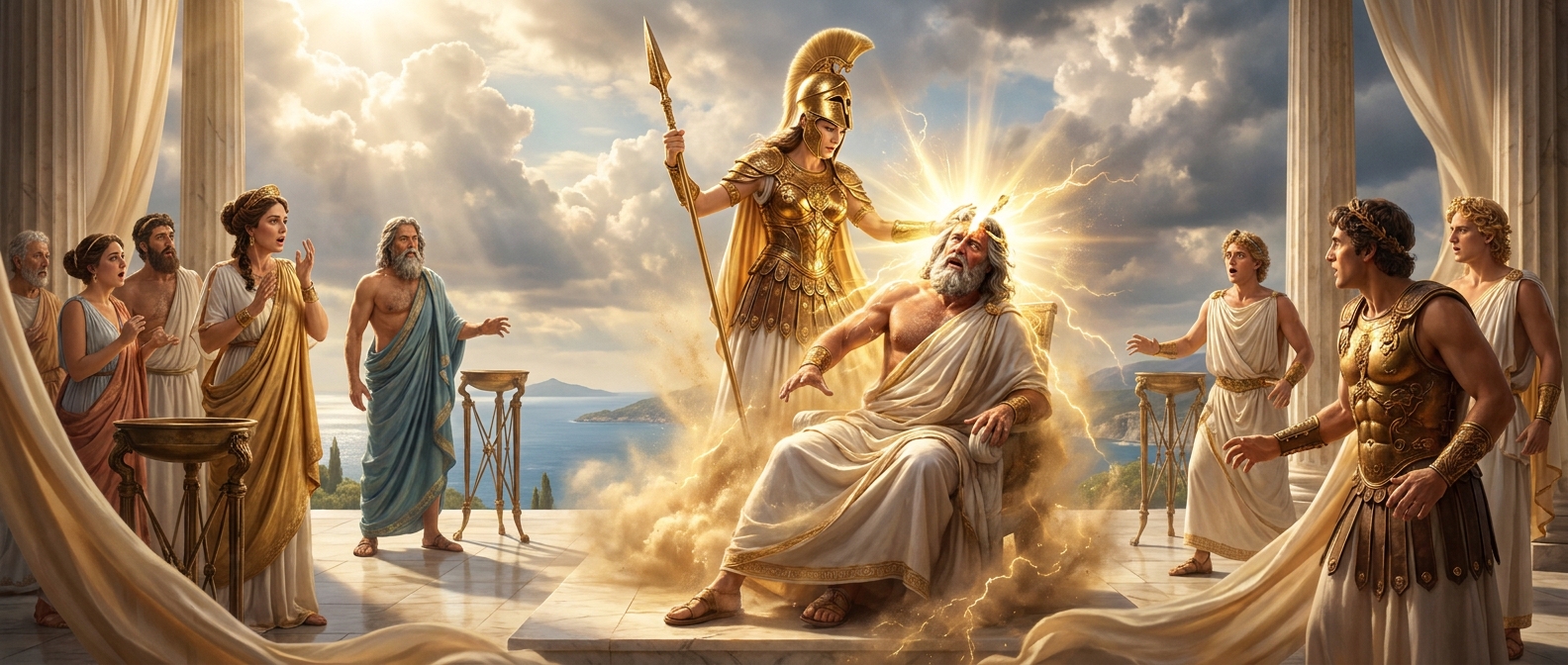
Zeus is struck by a massive headache, a cosmic torment that reads like symbolism and feels like punishment. This is not a mild ache behind the eyes. This is a god buckling under pressure, the king of Olympus brought low by something as human as suffering.
And because the myths favor spectacle, relief arrives as violence: Zeus’s head is split open. Ancient sources vary on who swings the tool, but the role often belongs to Hephaestus, the smith god, whose domain is craft and the decisive swing of an axe.
Athena steps out, already legendary
The skull opens.
And out comes Athena, fully grown, fully armed, and shining with the kind of authority that does not ask permission.
She does not arrive as a soft miracle. She arrives like a standard catching fire in sunlight: helmet, spear, and the unmistakable calm of a mind that has already measured the room.
Many versions add a delicious detail: Athena bursts forth with a triumphant shout, a war cry that makes the heavens tremble. It is an entrance so aggressive, so cinematic, that you can practically see the other gods step back.
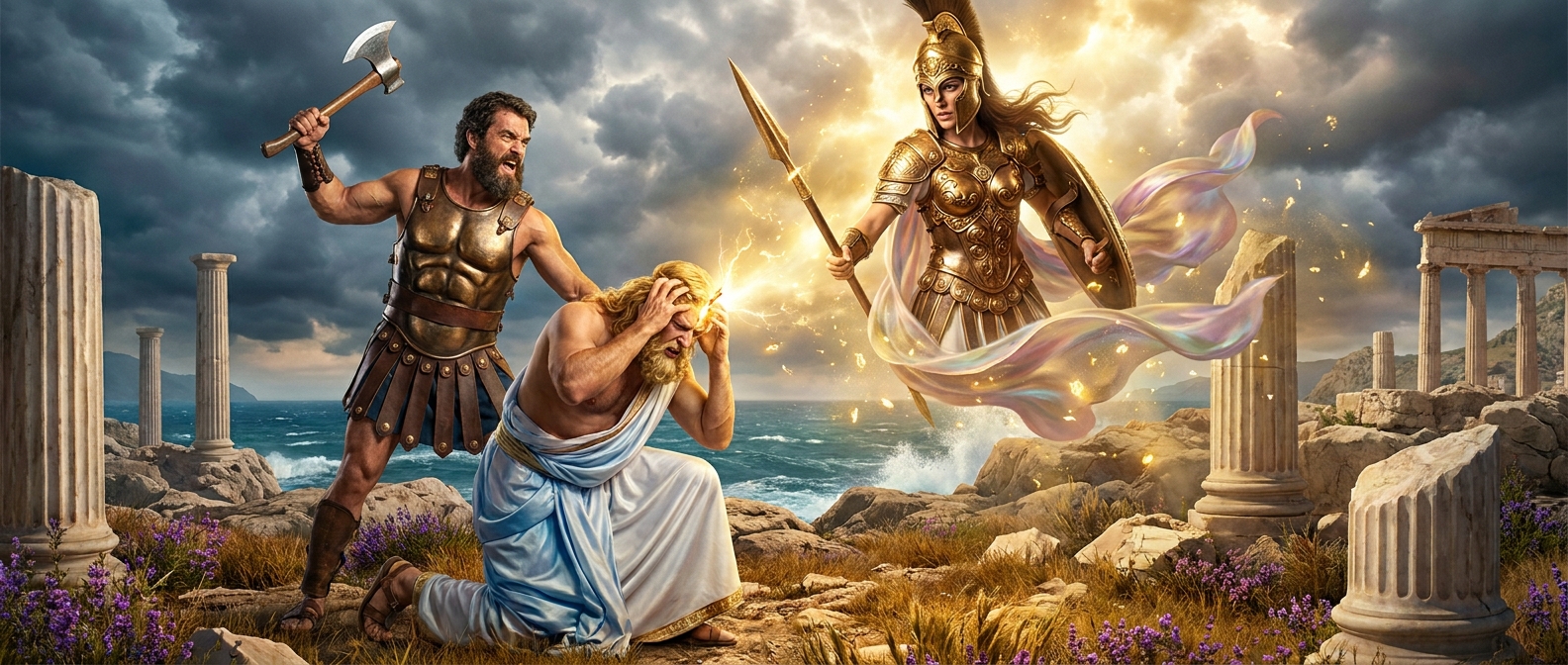
No cradle. No childhood. Just Athena, complete and dangerous, born from a mind that tried to contain her.
Why this birth mattered
Athena’s origin story is not just a strange Olympian medical emergency. It is myth doing what myth does best: turning theology into imagery you cannot unsee.
Wisdom that comes from the head
Athena is the goddess of strategy, craft, and clear-eyed counsel. Her birth from Zeus’s forehead makes that symbolic logic literal. She is intelligence made flesh, emerging not from sea-foam or a dark cavern, but from the seat of thought itself.
A daughter who strengthens the king
Prophecies in Greek myth usually land like a blade. Here, Zeus tries to avoid one and accidentally produces an ally. Athena becomes one of his most important partners in maintaining order, defending cities, and guiding heroes.
There is a sharp joke inside it: Zeus fears a child who will overthrow him and instead brings forth a daughter who reinforces his rule, even when she is unimpressed with his behavior.
Metis carried forward
Even when Zeus swallows Metis, the story refuses to let her be erased. Athena’s nature carries Metis forward as a principle: foresight, tactical patience, the clean strike of strategy over brute chaos.
It also helps explain why Athena’s public identity is so civic. She is Polias, guardian of the city, and in many traditions Pallas, the war-minded protector whose violence is measured, not ravenous.
Sources and variations
Greek mythology is a chorus, not a single narrator, so details shift depending on the tradition.
- Hesiod in the Theogony gives the foundational spine: Zeus swallows Metis after learning the prophecy about the children she will bear, and Athena is later born from Zeus.
- Pindar and later storytellers emphasize the headache and the dramatic splitting of Zeus’s head, often assigning the act to Hephaestus.
- Apollodorus preserves a common mythic summary: the swallow prevents the foretold son, while the daughter still arrives, armored and immediate.
What remains steady is the signature image: Athena emerging armored from Zeus’s head, a divine birth staged as both revelation and rupture.
Athena’s first promise
I live in the present, but I keep finding the old stories in modern air. A stormfront over a ridge. A stand of dripping evergreens outside Seattle. The feeling that the landscape is watching, weighing you, deciding if you are worth noticing.
Athena’s birth carries that same charge.
She is the goddess who proves that power can be elegant, that war can be strategic rather than savage, that intelligence can be both beautiful and terrifying. She enters Olympus not as a question mark, but as an answer.
And Zeus, for all his thunder, learns the lesson the myths keep teaching: you do not escape prophecy by force. You only change the shape of its arrival.