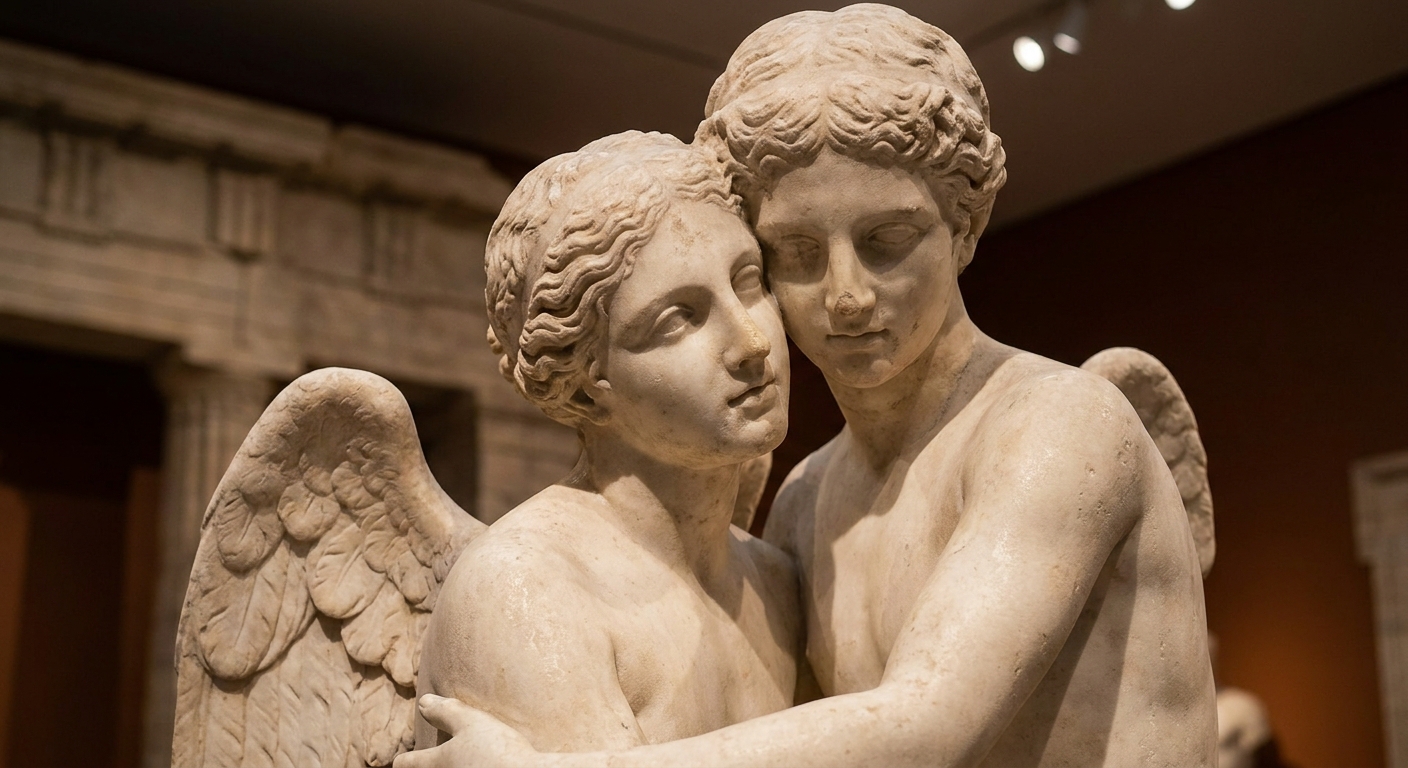
Psyche and Eros: Love Beyond Mortality
Greek Mythology
Some myths feel like they were carved into marble to be admired from a polite distance. The story of Psyche and Eros is not one of them.
It is intimate. It is feverish. It is full of velvet darkness and temple smoke, of faith that trembles, of beauty that becomes a threat, and of the gods doing what they always do when mortals shine too brightly.
If you have ever loved someone you could not fully understand, this myth has been waiting for you.

The Mortal Who Looked Like a Goddess
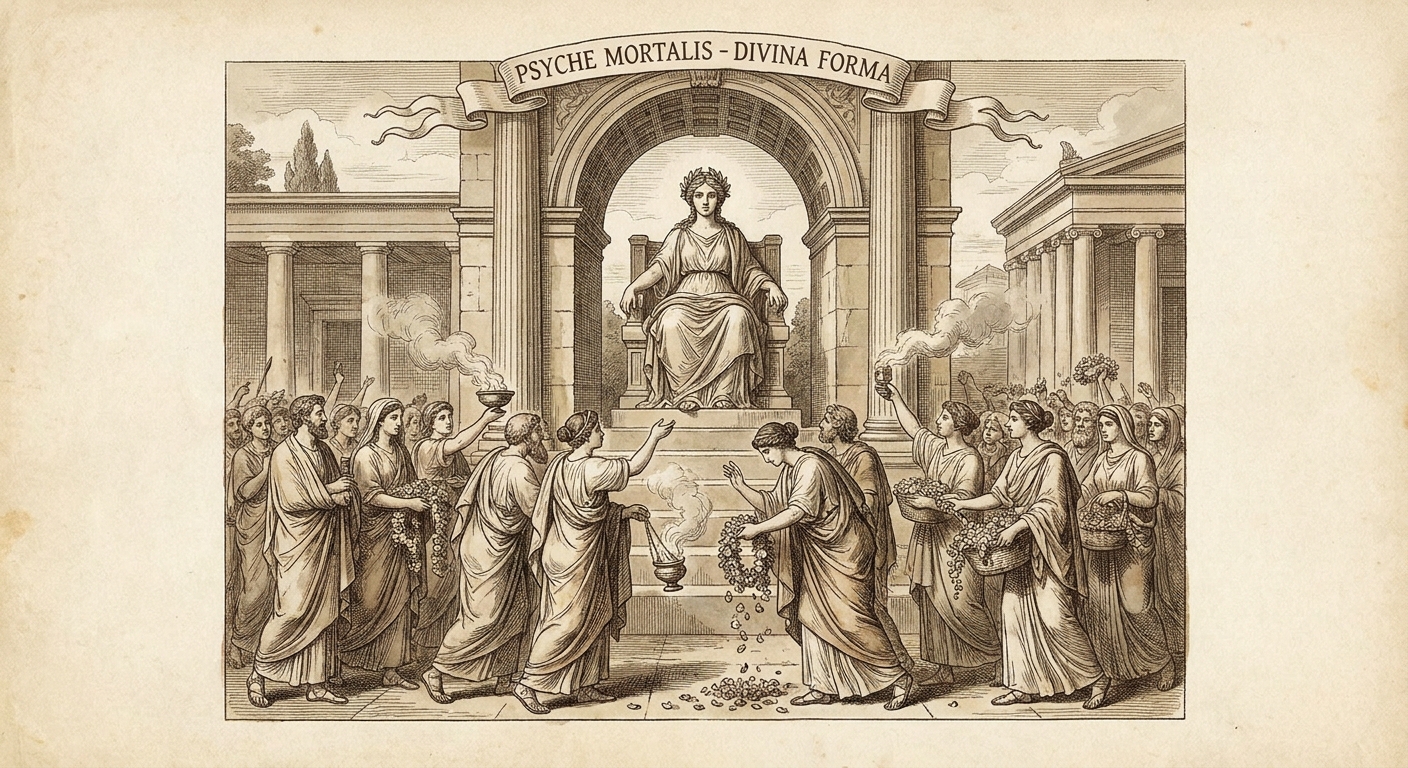
Psyche begins as a princess, yes, but the problem is not her bloodline. It is her face.
Her beauty attracts a kind of attention that should have been reserved for altars. People whisper comparisons to Aphrodite, and in Greek myth, that is not a compliment. That is a provocation. Mortals are allowed to admire the gods. They are not allowed to compete with them, even accidentally.
So the goddess of love does what she does best when her vanity is bruised. She turns desire into a weapon.
A mortal is praised like a goddess, and suddenly beauty becomes a crime with a divine sentence.
Aphrodite’s Order, Eros’ Mistake
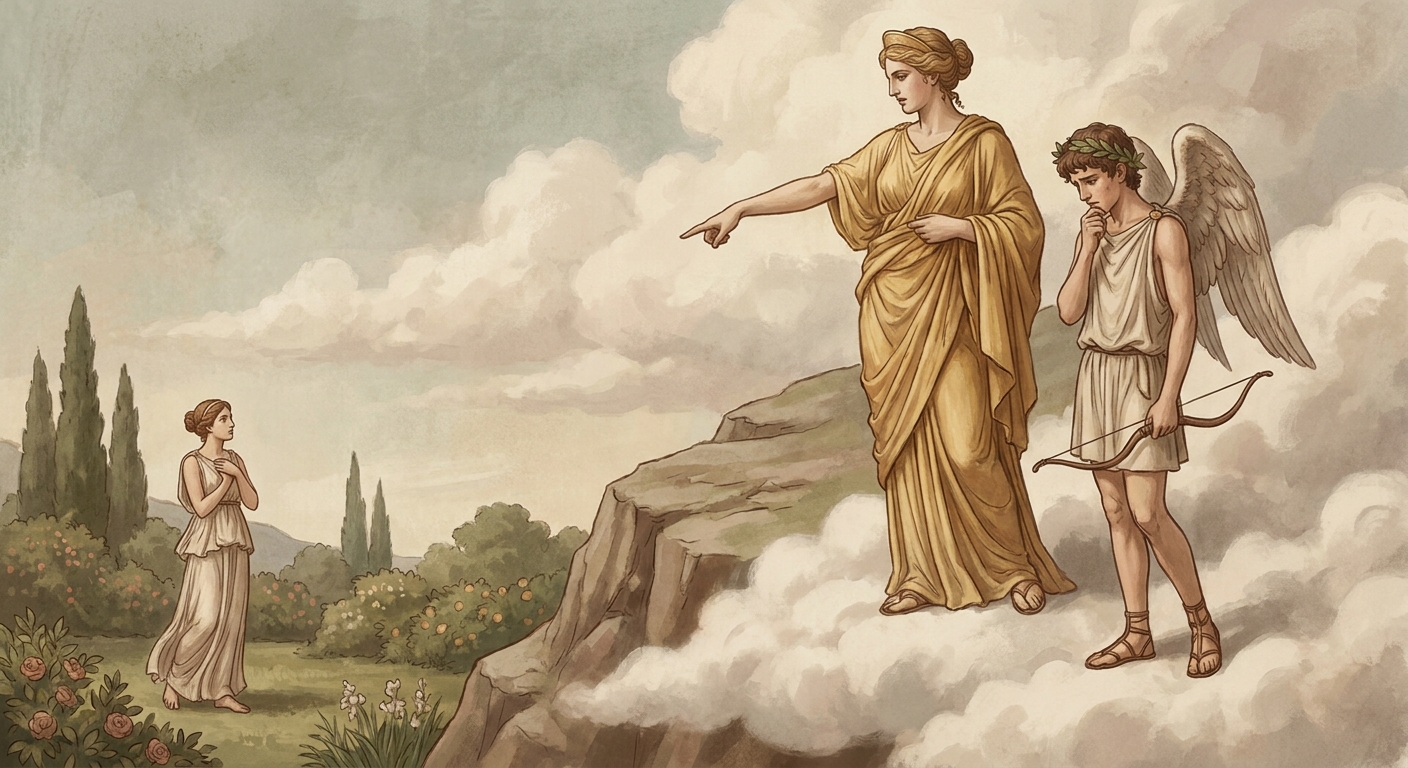
Aphrodite commands her son, Eros, to punish Psyche with one of his arrows, to make her fall for a match that would humiliate her: low, vile, ruinous.
But the myth pivots on a delicious, catastrophic truth. The god of love is not immune to love.
Eros sees Psyche and falls. Whether by accident or rebellion, he refuses his mother’s command and chooses the one thing Olympus always pretends it can control: the heart.
The Secret Palace

Psyche is carried away to a hidden place, a palace that feels like a dream with marble floors and invisible servants. It is luxury without explanation, comfort without context. The kind of gift that makes you wonder what it cost.
At night, her lover comes to her, but he forbids her to look at him. Psyche can have tenderness, pleasure, protection. She cannot have certainty.
Olympus loves a rule that sounds simple until it becomes unbearable.
She is loved nightly, lavishly, faithfully, but only in the dark, where the mind fills in monsters.
In many tellings, Psyche’s sisters sharpen her fear into a blade. They suggest the unseen lover is a serpent, a beast, a thing that will eventually devour her. It is an old human reflex: if you cannot see it, make it monstrous.
The Lamp and the Burn

Curiosity is often framed as a flaw in myth, but it is also the engine of survival. Psyche takes a lamp and a blade to the bed. She will look. She will know. She will be ready to defend herself if the darkness has lied.
And there, in the lamplight, she finds not a monster but Eros himself, radiant and dangerously young, the kind of beauty that makes mortals forget to breathe.
The tragedy is immediate. A drop of hot oil falls from the lamp and burns him. The secret breaks. The spell of safety shatters on the floor like a clay cup.
Eros flees, not only wounded in skin but wounded in trust. In myth, betrayal is not always about malice. Sometimes it is simply about wanting the truth and choosing the wrong way to hold it.
Psyche’s Wandering
Once Eros is gone, Psyche’s story stops being a romance and becomes a pilgrimage.
She wanders like a supplicant through a world that suddenly looks more ancient and more indifferent. This is where the myth earns its name. In Greek, psyche means “soul,” and can also carry the taste of “breath” or “life.” And a soul, in myth, is not a soft glowing thing. It is a thing tested.
Eventually, Psyche reaches the source of her suffering: Aphrodite, who is not interested in reconciliation. The goddess does not simply want Psyche punished. She wants her humbled. She wants the mortal to understand what it means to be crushed under divine attention.

The Impossible Tasks
Aphrodite assigns Psyche labors designed to be unsolvable. This is a favorite Olympian sport: call it justice, call it discipline, call it entertainment. The effect is the same.
In Apuleius, the sequence is brutally specific, each task a different kind of cruelty.
- She must sort a sprawling heap of seeds and grains, a chaos measured out to mock mortal hands.
- She must gather wool from violent, golden-fleeced rams, gleaming with danger in the heat of day.
- She must fetch black water from a deadly height, where a sacred cascade feeds the river of the dead, a place guarded by terror and sheer rock.
- She must descend to the Underworld to ask Persephone for a sealed box of divine beauty.
And here is the detail that always makes me pause. Psyche does not succeed because she becomes strong in the obvious way. She succeeds because the world helps her.
Ants sort the grains. A reed teaches her when to approach the rams and when to wait. And an eagle, bright with borrowed authority, carries her vessel to the perilous waters no mortal should reach alone.
The Underworld Box
Any myth that points a living woman toward the Underworld is telling you, quietly, that innocence is about to die.
Psyche’s descent is not just geography. It is transformation. The Underworld in Greek imagination is not only a place of the dead. It is a place that strips you down to essentials. It teaches you what you are when beauty, status, and sunlight stop mattering.
She returns carrying the box, sealed, heavy with the kind of promise that makes mortals greedy without realizing they are afraid.
Because the last temptation is always the same. The thought: if I take a little for myself, I will be more worthy. I will be safe. I will be unlosable.
So Psyche opens the box.
It does not contain beauty. It contains a deathlike sleep, a divine stillness that drops over her like velvet and shuts her down where she stands.
She goes to the land of the dead for love, and brings back a sleep that makes her look dead anyway.
And this is where the myth shows its strange mercy. Eros returns. He has healed enough to move, and perhaps he has learned what mortals learn too late: love does not survive on punishment.
He wipes the sleep from her, tucks it back into the box like a horror re-corked, and wakes her with the same tenderness that began the ruin.

Zeus and Immortality
At last the myth turns, as myths often do, on authority.
Zeus intervenes. Not because Olympus suddenly becomes tender, but because the situation becomes politically inconvenient. A god in love with a mortal creates instability. Aphrodite’s rage has become too loud. Psyche’s persistence has become too undeniable.
So Zeus offers the only solution the gods truly respect: a bargain. Psyche is made immortal, lifted out of the fragile human category that provoked this disaster in the first place. Now she can belong with Eros without the constant scandal of mortality.
In Apuleius, ambrosia seals the change. The soul becomes deathless. The love becomes lawful.
And later, as if to prove the world can still produce something soft after all that hardness, they have a daughter: Hedone, also called Voluptas, “Pleasure.”
Why It Still Hurts
The story of Psyche and Eros is often summarized as a fairytale with Greek accessories. That misses the point.
This is a myth about what love demands when it is not just a feeling but a force that rearranges your life like a storm rearranges a shoreline. It asks uncomfortable questions:
- How much trust can exist without truth?
- When does curiosity become betrayal, and when is it simply survival?
- What does devotion look like when the beloved leaves?
- Who gets punished when a mortal is seen as a rival to the divine?
Psyche is not rewarded because she is perfect. She is rewarded because she persists. Her soul refuses to be reduced to a cautionary tale about feminine curiosity. Instead, it becomes a story about endurance, repair, and the brutal fact that love, real love, changes the species of the person who carries it.
In the end, Psyche does not simply win Eros back. She crosses the final boundary. She becomes what she was never allowed to be at the start: a mortal who can stand beside a god and not be destroyed by the comparison.
Sources and Context
The most complete surviving version of the tale appears in Apuleius, a Roman-era author writing in Latin, in Metamorphoses (also known as The Golden Ass). In his telling, the lovers are Cupid and Psyche, and the jealous goddess is Venus. Many modern retellings use the Greek names Eros and Aphrodite, and the myth’s themes fit easily inside Greek patterns: divine jealousy, taboo vision, impossible labors, descent and return, and mortal apotheosis.
Like so many myths, Psyche and Eros is a tapestry of themes the ancient Mediterranean could not stop returning to: what the gods demand, what mortals risk, and what it costs to bring love into the light.