Nyx Myths: Night, Secrets, and Primordial Power
Greek Mythology
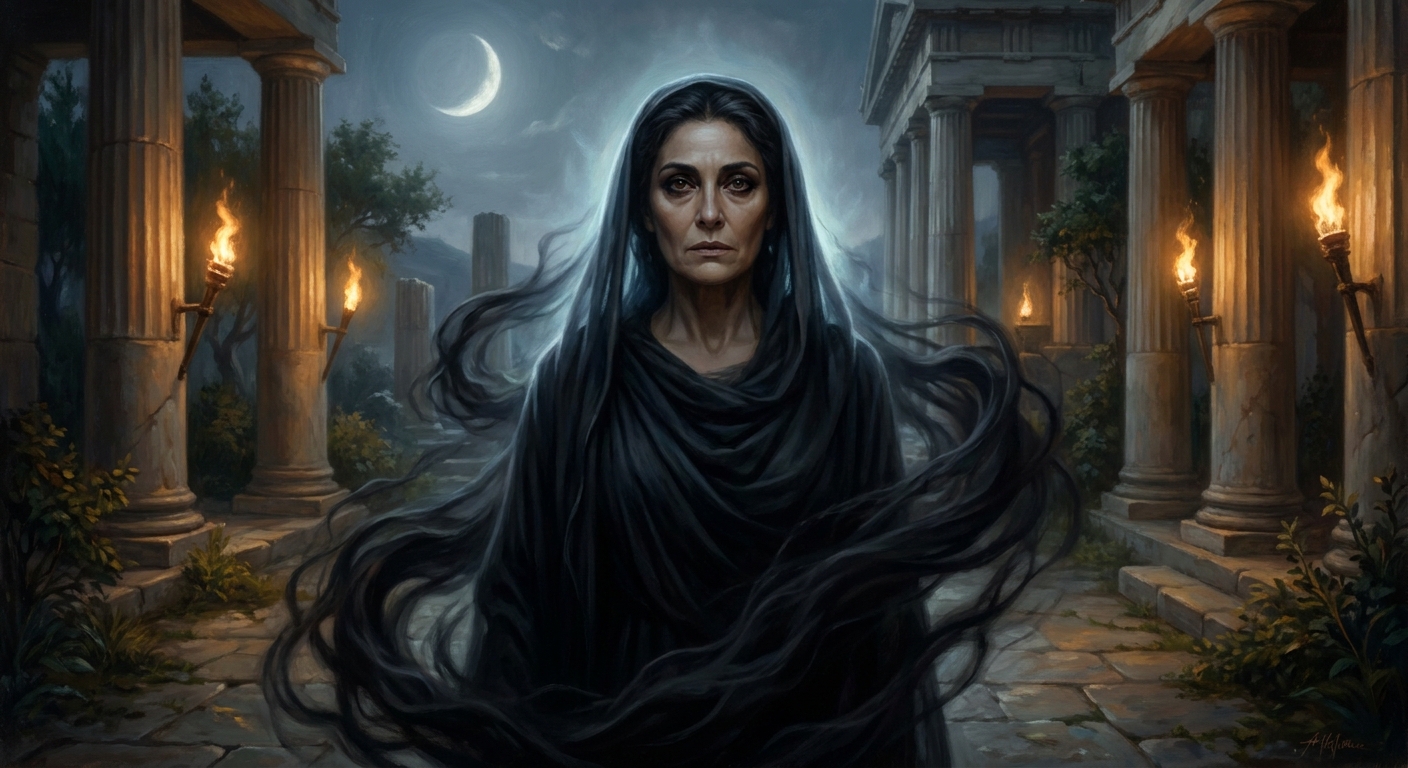
Nyx is not the kind of goddess who needs a temple full of marble columns to feel real. She is the dark behind your eyelids. She is the hush that slides over the sea cliffs when the last gull stops calling. She is the ancient, unbothered fact that night always arrives, whether kings pray or heroes boast or Zeus himself throws lightning at the horizon.
In Greek myth, Nyx is not merely a personified evening. She is a primordial power, born at the beginning of everything, when the cosmos still felt half-formed. She moves through the earliest genealogies like a black veil through torchlight, and wherever she passes, other forces rise behind her, as if darkness is the first doorway and everything else follows.

Some gods rule a domain. Nyx is a domain, wearing a name.
Nyx in the oldest sources
If you want Nyx at her most foundational, you go to Hesiod’s Theogony. The poem is a genealogy sharpened into cosmology, and Nyx is one of its most unsettling entries because she arrives early, and she arrives fertile with consequences.
Hesiod is blunt about the beginning: Chaos bore Erebos (Darkness) and Nyx (Night). From Night and Darkness come Aither (the bright upper air) and Hemera (Day). It is cosmic rhythm rendered as family fact: darkness begets brightness, and day follows night like an heir who cannot refuse the crown.
Already, Nyx feels like a threshold. Not a villain. Not a comforting metaphor. A primordial hinge the world swings on.
The children of Nyx
Nyx is famous for her children, and the list reads like a catalog of what humans fear when the lamps burn low. Hesiod gives one of the most influential versions in the Theogony, while later poets and artists sharpen certain figures into icons. The point is not tidy parentage. The point is mood and meaning.
From Nyx come forces that feel like they step out of the underworld’s deepest hallway, the one without torches.
Hypnos and Thanatos
Hypnos (Sleep) and Thanatos (Death) are among Nyx’s most iconic children. In art and poetry, they are often paired because the Greeks understood the intimacy between sleep and death without romanticizing it. Sleep is the gentler rehearsal. Death is the final closing of the door.
In Homer’s Iliad (Book 14), Sleep is not a soft lullaby. He is a god who can be bargained with and weaponized. Hera seeks Hypnos to put Zeus to sleep, and Hypnos hesitates because the last time he did it, Zeus nearly tore him apart. Hypnos fled for protection to the one being Zeus would not casually offend: Nyx.
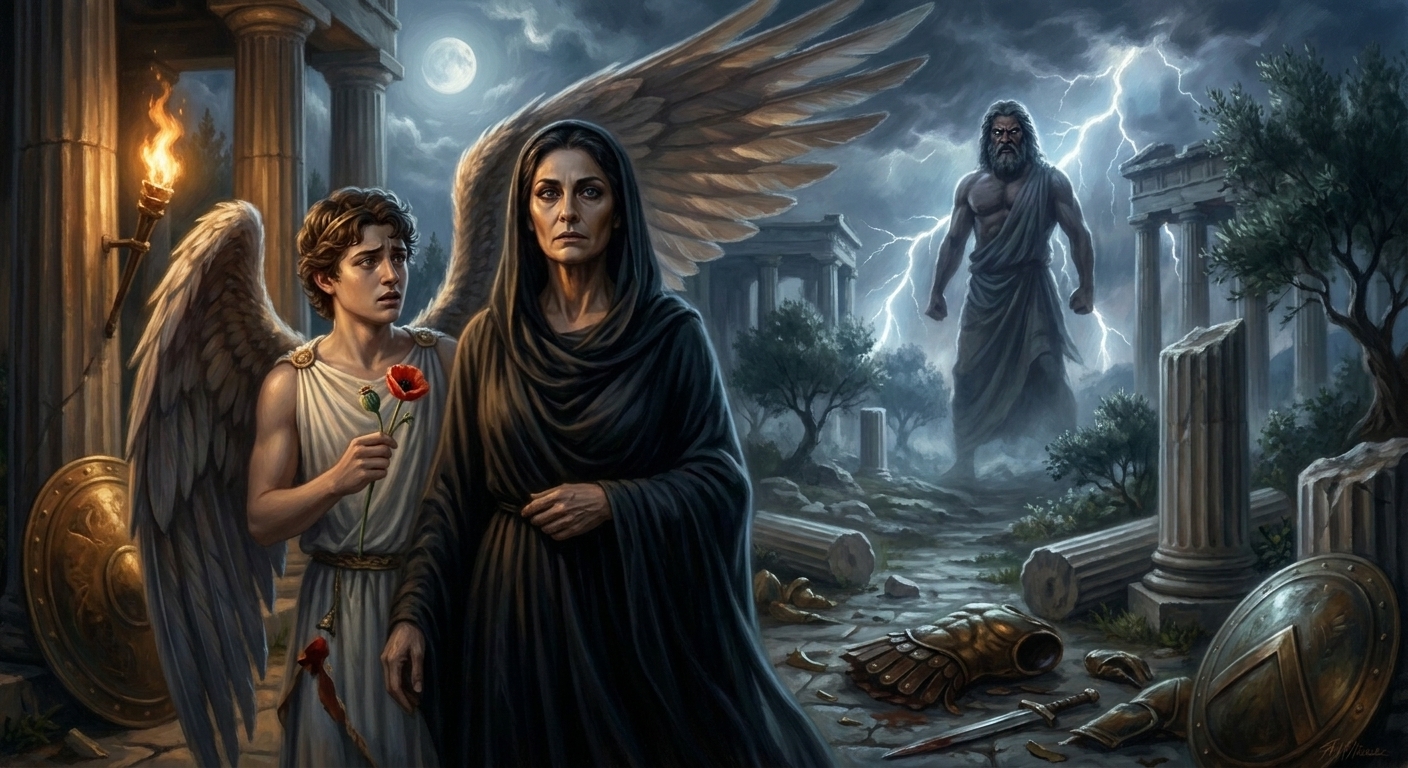
Zeus can punish a god. But Night is not a subordinate. She is the condition he rules beneath.
The Moirai
Nyx is also linked in Hesiod to the Moirai, the Fates: Clotho, Lachesis, and Atropos. In one Theogony genealogy, they are children of Night. Elsewhere, Hesiod also places them among the children of Zeus and Themis, a reminder that even ancient poets could offer more than one divine map for the same terrifying powers.
Whether their authority sits above Zeus or alongside him shifts by tradition, but their implacability does not. If Nyx is the dark veil, the Fates are the cold hand beneath it, doing the work without being seen.
Nemesis and Eris
From Nyx also comes Nemesis, a goddess of righteous retribution, the balancing force that arrives when arrogance has gotten too comfortable. And Eris၊ Strife, whose smallest gestures can end in a war so famous it never stops being retold. Hesiod makes the chill deeper by letting Strife become a mother as well, spawning further miseries like a chain reaction that does not need daylight to travel.
Hesiod goes further and gives Nyx a darker entourage still: Moros (Doom), Momus (Blame), Oizys (Misery), Apate (Deceit), Geras (Old Age), and the Keres (death-spirits), among others. You can read the list like a poem, but it reads back like a warning.
A quick guide
- Hypnos: Sleep, capable of subduing even Zeus when properly coerced or compensated.
- Thanatos: Death, often depicted calm and inevitable rather than monstrous.
- Moirai (Fates): the powers who govern life’s thread, feared and respected across divine ranks.
- Nemesis: retribution and balance, the quiet answer to hubris.
- Eris: strife, whose “small” conflicts grow teeth.
- Moros: doom, the shadow of the ending before the ending arrives.
- Geras: old age, the slow inevitability that no spear can ward off.
When Zeus fears Nyx
If you have ever wondered whether Zeus fears anyone, Greek myth gives you a rare, telling moment.
In the Iliad (Book 14), as the gods maneuver like rival nobles at an endless banquet, Hypnos admits why he is wary of Hera’s request. He once put Zeus to sleep before, and Zeus woke furious, hurling threats through the heavens. Hypnos escaped by running to Nyx for protection. Zeus, in a mood that could level cities, followed.
And then the myth does something that should make you sit up straight: Zeus stops.
He does not strike Nyx. He does not drag Hypnos out of her presence. He withdraws, because Nyx is not a goddess inside his political order. She is older. She is primordial. She is the dark boundary even thunder hesitates to cross.
Nyx’s house at the edge
Nyx appears rarely in narrative myth, but when she does appear in the ancient imagination, she has architecture. Not a civic shrine where citizens line up with olive branches, but a cosmic residence placed where maps start to feel like superstition.
In Hesiod’s Theogony, Nyx and Hemera (Day) share a home, and they pass each other at the threshold like two queens who do not speak, because they do not need to. One exits as the other enters. The image is clean and chilling: the world’s light and the world’s dark exchanging places at a single door.
Later, in Roman-era Greek and Latin poetry, Nyx’s orbit can feel even more oracular. Ovid in the Metamorphoses (Book 11) places the House of Sleep in the far west near the Cimmerians, a region of perpetual dimness. This is not a simple “Night lives here” postcard. It is a statement about distance from the sun, from clarity, from the busy noise of mortal life. The farther you go, the more reality starts behaving like a dream.
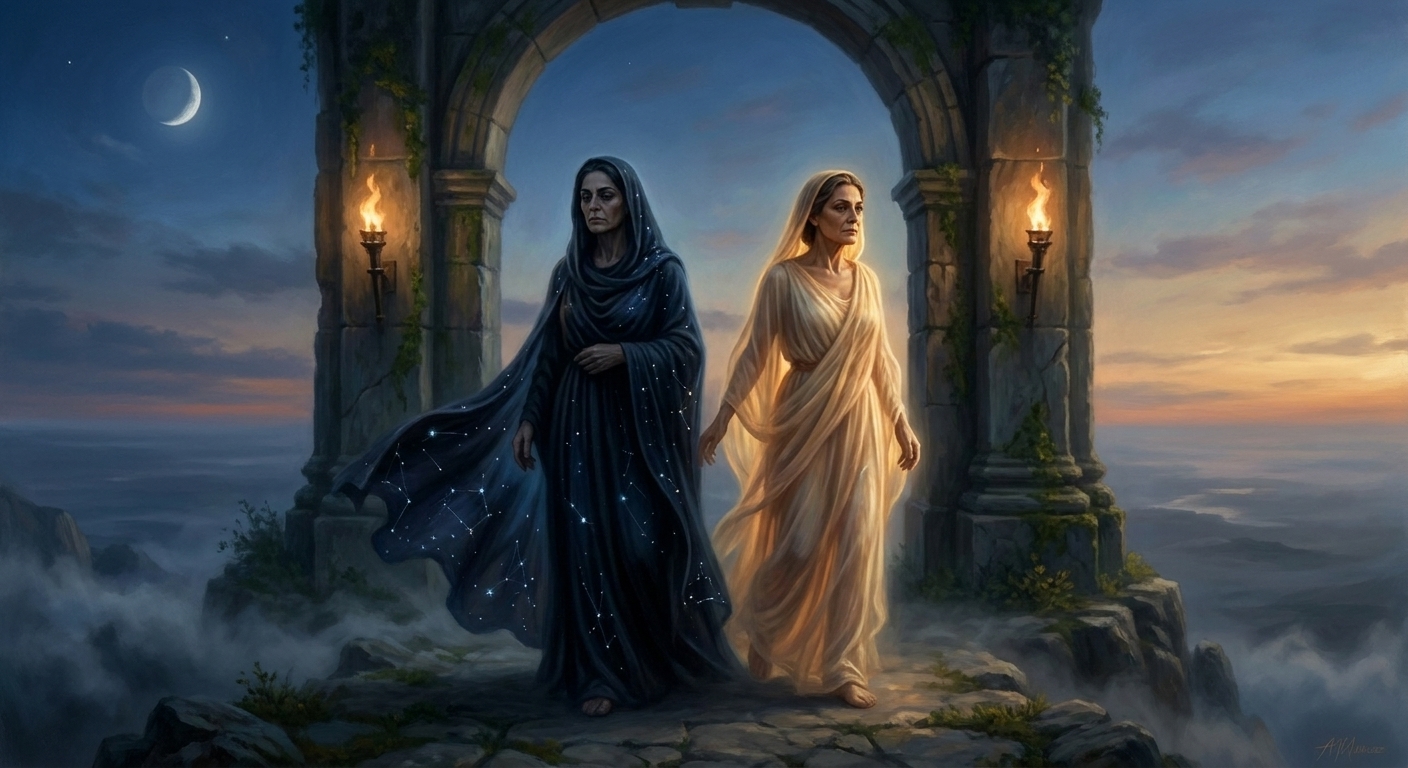
At Nyx’s door, Day does not defeat Night. They simply trade the key.
Nyx and underworld shadows
Nyx is not the ruler of the Underworld in the way Hades is, nor the guide of souls like Hermes in his psychopomp aspect. Yet she belongs to the same ecosystem of dread and inevitability. In the mythic mind, the Underworld is not only a place under the earth. It is a layered darkness, a series of thresholds where names turn into echoes.
Nyx’s children make that connection explicit. Thanatos and the Keres haunt the border between breath and silence. The Moirai operate like underworld accountants with divine authority, indifferent to pleading. Even Nemesis feels underworld-adjacent, because she is the consequence that arrives after the feast, after the affair, after the hubris, when the lamps are snuffed and the cost becomes visible.
Nyx, in other words, is not the Underworld’s queen. She is the darkness the Underworld wears.
And if you are the kind of reader who likes to trace mythology the way you trace rivers on a map, this is where Nyx becomes quietly potent. Follow her and you inevitably reach stories of Hades, Persephone, Hermes, Hecate, and the ancient machinery of death, dreams, and divine bargains.
Why Nyx feels modern
Olympians are glamorous, messy, and loud. They throw parties. They start wars over insults. They seduce, punish, apologize, and do it again. Nyx does not perform like that. She does not need to.
Nyx is a reminder that Greek mythology is not only a soap opera in the sky. It is also an attempt to name the forces that swallow us whole: sleep, death, fate, consequence, fear, and the strange peace of darkness when the world finally stops demanding explanations.
So if you came here hoping for a Nyx “bio,” you can have one, but it will always feel inadequate. A goddess like Nyx is not fully captured by a profile. She is best understood the way the ancients understood her: as a presence. And compared to the Olympians, evidence for an active cult of Nyx is sparse, which only sharpens her power on the page. She remains more atmosphere than altar.
The next time the city goes quiet and the sky over the water turns ink-black, imagine the old stories returning like temple smoke. Somewhere beyond the last light, Nyx is walking, and even Zeus, for once, knows when to lower his voice.