Eris Myths: Strife, Apples, and the Spark of War
Greek Mythology
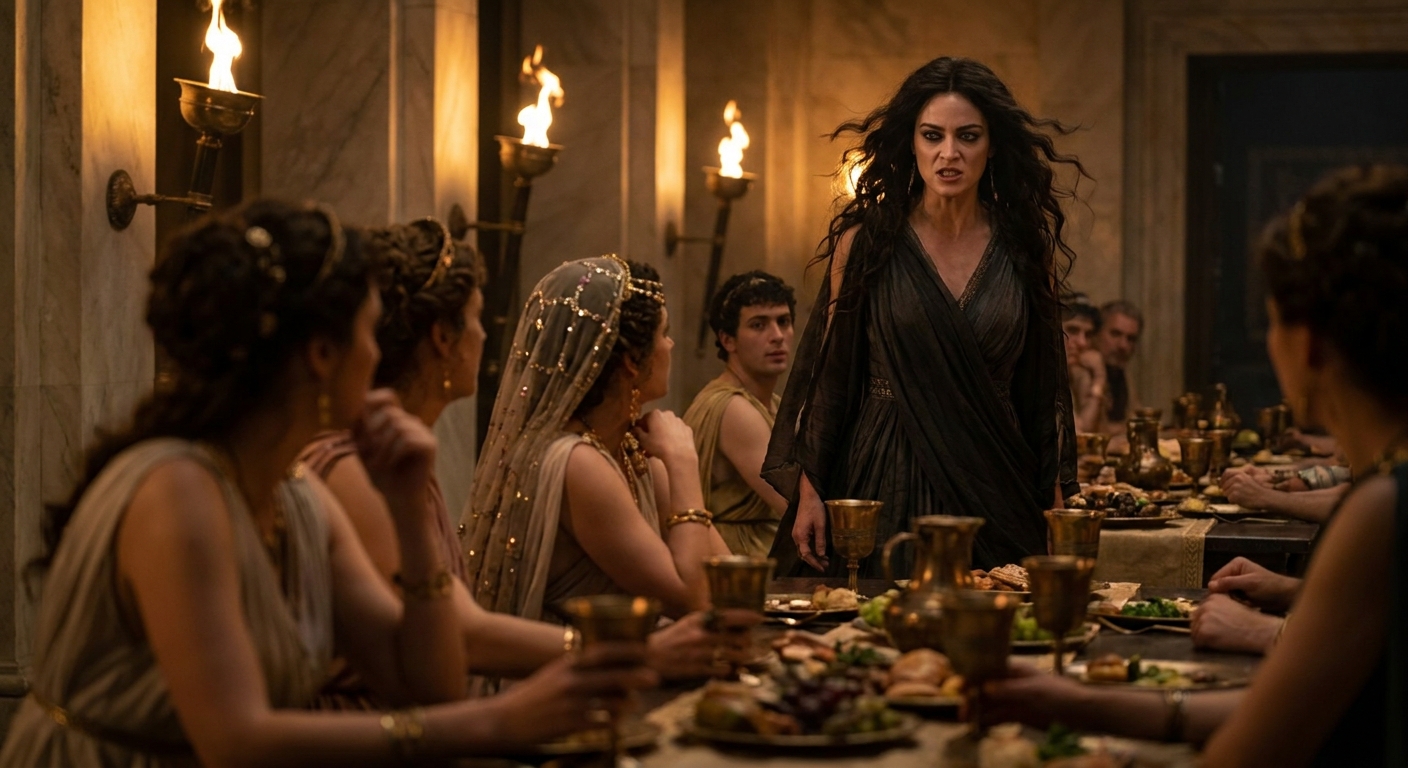
There are gods who arrive with thunder and laurel crowns. And then there is Eris, who arrives like a hairline crack in polished marble. You do not always notice her at first. You notice the pause in conversation. The slight tilt of a smile. The moment the air turns sharp.
If you know her at all, you probably know her by her most famous accessory: the golden apple that enters a wedding feast and, in later tradition, sets a chain of judgments and wounds in motion until it ends at the walls of Troy. But Eris is older than that apple, and far stranger. In Greek myth, she is not only petty insult dressed as divine entertainment. She is Strife as a principle of reality, the kind of force that can split a household, a city, or an age.
Strife does not need a sword. She only needs a room full of proud immortals and one small, shining excuse.
Eris in Hesiod
In Hesiod, Eris belongs to the deep, old family of night. In the Theogony, she is counted among the children of Nyx (Night), and that lineage matters. This is not a cute personification floating in from later poetry. This is an ancient Greek way of saying: some things are fundamental. Darkness. Fate. And conflict.
Hesiod also gives Eris a terrifying kind of fertility. She is not merely present at catastrophe. She produces it. From Eris come personified forces like Ponos (Toil), Limos (Famine), Algea (Pains), Hysminai (Battles), Makhai (Wars), Phonoi (Murders), Neikea (Quarrels), Pseudea (Lies), Amphillogiai (Disputes), and Dysnomia (Lawlessness), among others named in the poem.
It reads less like a family tree and more like a diagnosis.
Two Strifes
Hesiod complicates her further in Works and Days, where he distinguishes between two forms of Strife: one that is hateful and destructive, and another that can be oddly productive. This second Strife stirs people into work, competition, and excellence. It is the jealous itch that makes a potter try harder because the neighboring potter is thriving.
Rivalry can build, and rivalry can burn down everything in sight. The line between those two Erides is thin, and it is drawn in chalk on a windy day.
Eris and Harmonia
If Eris is the principle of fracture, Harmonia is the principle of fit. Her name is the dream of things aligning: treaties holding, marriages stabilizing households, music resolving into something that does not ache.
Greek myth loves a beautiful concept and then immediately tests its structural integrity.
Harmonia is bound to the story of Cadmus and the founding of Thebes, and her marriage is marked by the divine gifts known as the Necklace of Harmonia and her robe, dazzling and ominous in later tradition. These gifts, despite their glamour, become entangled with misfortune across generations. Harmony in myth is rarely free. It is purchased. It is maintained. And it is threatened.
So when Eris moves through the mythic world, she functions as Harmonia’s shadow. Not as a single canonical showdown between named rivals, but as a conceptual pressure that proves how fragile harmony is. To the Greek imagination, social order was never guaranteed. It was a negotiated peace with chaos, sealed with ritual, hospitality, and law.
Harmony is a temple built on a fault line. Eris is the tremor that reminds you.
The Uninvited Guest
The most famous Eris myth is also one of the most socially lethal scenes in all of Greek legend: the wedding of Peleus and Thetis. The sea-nymph Thetis was fated to bear a son greater than his father, which is exactly the kind of prophecy that makes gods step back. So it is arranged that Thetis marry a mortal hero, and the gods gather to celebrate.
Except Eris is excluded.
That detail is not incidental. In Greek culture, being denied a seat at the table is not just rude. It is a tear in the sacred fabric. Hospitality, recognition, honor, the careful choreography of who belongs where, these are not manners. They are protections. Break them, and you invite temple-smoke omens into the room.

Eris does not smash the banquet. She does something worse. She introduces a choice that turns every smile into a weapon.
The Golden Apple
Into the wedding she throws a golden apple inscribed “to the fairest.” In later retellings the Greek is usually given as tē(i) kallistē(i), and the point is brutally simple: make the goddesses judge themselves.
It works because the Olympians are not abstractions. They are gorgeous, powerful, and emotionally combustible. The apple does not create vanity out of nothing. It exploits what is already there, like a spark finding dry pine needles.
- Hera, queen of the gods, hears the apple as a referendum on status.
- Athena hears it as a challenge to excellence and honor.
- Aphrodite hears it as her personal domain, and she does not share domains.
The Judgment of Paris
Zeus refuses to judge in the standard later tradition, sensing what any god with a throne understands: no household survives being made a tribunal. The task is pushed onto Paris, a Trojan prince raised as a shepherd, which is classic myth logic. Let the least appropriate person hold the most explosive decision.
Each goddess offers a bargain. Not a blessing. A bargain.
- Hera offers power and kingship.
- Athena offers victory and skill in war.
- Aphrodite offers the most beautiful woman in the world, Helen.
Paris chooses Aphrodite’s bribe, and that single choice links eros to empire, desire to siege engines. The Greeks did not pretend war was only about honor. They understood it could begin with lust, insult, wounded pride, and one decision that feels private until it ruins a coastline.

A war does not always begin with an army. Sometimes it begins with a prize.
From Apple to Ash
Once Helen is taken and the Greek expedition sails, Eris does not need to keep throwing apples. The machine is already running. But Strife is not merely backstory. In epic tradition she can be both goddess and atmosphere, a name that becomes an event.
In Homeric poetry, Eris appears among the energies of war, intertwined with battle frenzy and the chaos that spreads from one clash to the next. In the same brutal neighborhood of personified war powers, she stands near figures such as Enyo, where violence has many faces and all of them are hungry.
This matters because it shows the Greeks believed discord had stages.
- First, a social slight at a feast.
- Then, a contest of prestige dressed up as fairness.
- Then, a personal desire made political.
- Finally, the open-mouthed hunger of war, where Strife no longer needs a clever trick. She has bodies.

Why Discord Was Divine
It is tempting to treat Eris as a mythic villain with a party trick. But Greek religion and storytelling rarely waste a god on something that small. Eris is personified because discord was experienced as both intimate and enormous.
1) Insults were never just personal
Honor culture makes reputation a kind of currency. A slight is not drama. It is a destabilizing event. Eris thrives in the space where pride is public and humiliation spreads fast, like smoke under a door.
2) Social order was maintained, not guaranteed
Harmonia, justice, and law are sacred achievements. They can be eroded. The Greeks knew cities fracture from within. They saw factions, feuds, and cycles of retaliation. Giving Strife a goddess is a way of admitting that civic life has an enemy living in its walls.
3) War looked like a contagion
Once war begins, it becomes self-feeding. Alliances pull in new participants. Old oaths awaken. Grief demands repayment. Eris is the mythic shape of escalation, the sense that conflict grows larger than the reasons that started it.
Reading Eris Now
Modern readers often try to reduce Eris to a moral: do not be petty, do not be jealous, do not start fights at weddings. Sensible, yes. But myth is not a self-help pamphlet left on a temple step.
Eris is unsettling because she is recognizable. She is the group chat that turns acidic. The colleague who is not invited. The rivalry that begins as fuel and ends as sabotage. The tiny symbolic object that becomes a referendum on everyone’s worth.
In Greek myth, the gods are not distant ideals. They are the immortal versions of our worst patterns, made beautiful enough that we cannot look away. Eris is what happens when glamor, pride, and power share a room and nobody wants to lose.
And if that feels uncomfortably timeless, well. She would be pleased.