
Demeter Myths: Harvest, Loss, and the Turning Year
Greek Mythology
Demeter is often introduced like a pleasant label on a jar of wheat: goddess of grain, giver of harvest, patron of bread. The kind of divinity you thank politely, then forget until the pantry looks thin.
But in myth, Demeter is not domestic wallpaper. She is hunger with a crown. She is the green world that can be coaxed, and the green world that can be withdrawn. When her story turns, it turns the entire year with it.
This is the Demeter who mattered to ancient Greece: not only the one who makes fields sing, but the one who can make them go silent. Her myths are a meditation on dependence, grief, and the terrible intimacy between mortals and the earth.

Demeter Before the Loss
To understand why Demeter’s grief becomes a cosmic event, you have to remember what she governs. Demeter is the sacred agreement between humans and land: the grain that rises from plowed earth, the steady miracle of seed becoming sustenance, the thin margin between feast and famine.
In Greek imagination, grain was not merely food. It was civilization. It was the difference between roaming like a hungry animal and building a city with laws, hearths, and temples that smoked with offerings.
So when Demeter is wronged, it is not a private tragedy. It is an economic collapse written in mythic ink.
Persephone Taken
The most famous Demeter myth begins with a girl gathering flowers. That detail is always a little cruel, like myth is setting a table with springtime beauty just to flip it over.
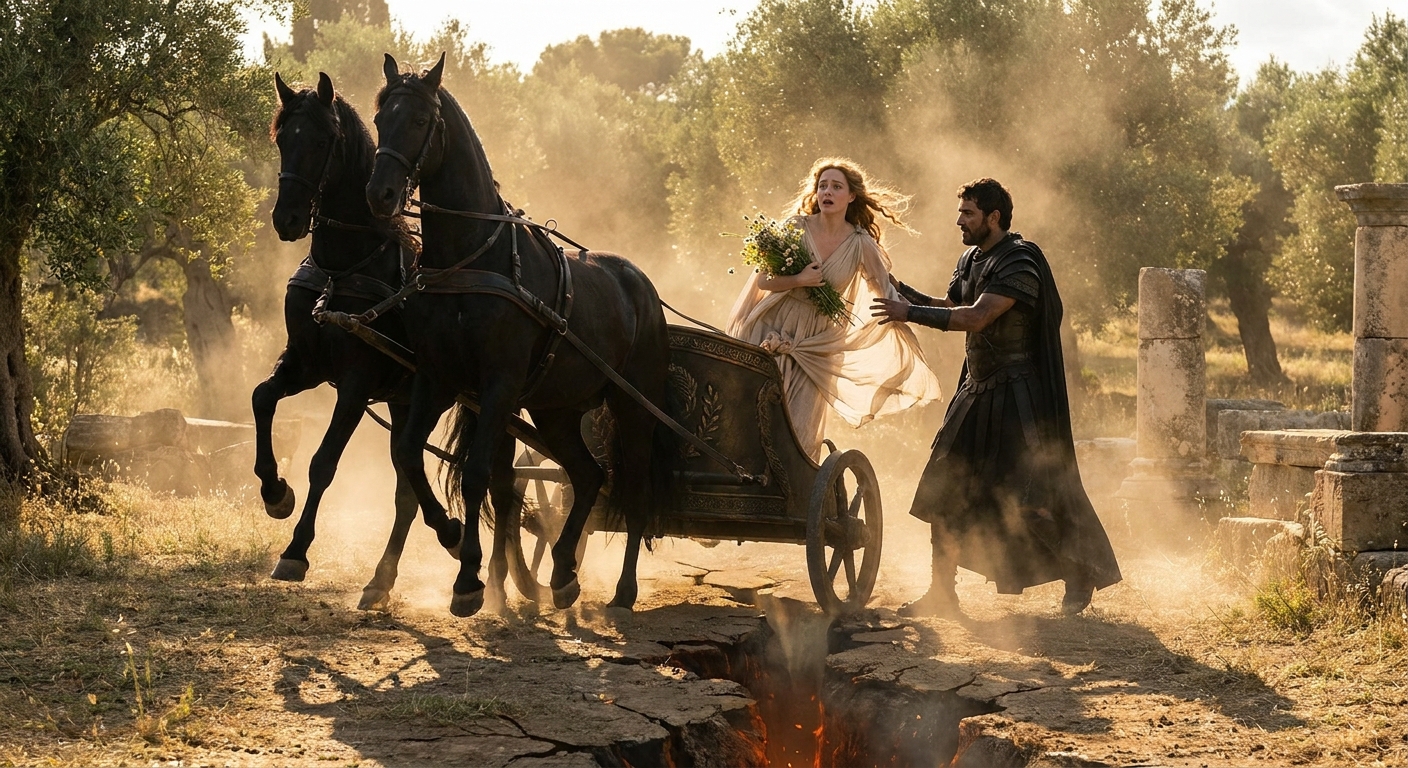
Persephone, Demeter’s daughter, is taken by Hades. In many versions, the earth itself splits open as the lord of the Underworld rises in a chariot and vanishes back below with his prize. Some traditions emphasize Zeus’s complicity, a divine permission slip signed in thunder.
What matters, across sources, is the sensation of a boundary violated. A meadow is not supposed to become a doorway. A daughter is not supposed to become a queen of shadow.
A spring meadow becomes an underworld threshold, and the year begins to tilt.
Demeter’s Search
Demeter does not accept loss like a polite Olympian story beat. She goes searching.
Myth gives her a long, wandering grief. She roams with torches blazing, refusing comfort, refusing distraction, refusing the easy lie that time solves everything. The world becomes a map of her desperation: coastlines, crossroads, shrines, and dark roads where even nymphs go quiet.
In the Homeric Hymn to Demeter, it is Hecate, torch-bearing goddess of thresholds, who helps in the search, and Helios, the all-seeing Sun, who reveals what happened. The horror is not only the abduction. The horror is that it was arranged among gods like a marriage contract, while Demeter was not consulted.
The Famine
Demeter’s grief becomes policy.
She withdraws her gift from the earth. Seeds do not rise. Furrows lie barren. Temples receive prayers, but the fields answer with dust. This is one of the sharpest demonstrations of divine power in Greek myth: not lightning, not armies, but the quiet removal of growth.
And the consequences are immediate. Mortals begin to starve, which means sacrifices thin out. In Greek religious imagination, the gods are sustained by honor and offerings, and a world without bread threatens the entire exchange between Olympus and the living.
Eleusis
Demeter’s myth does not remain in cosmic abstraction. It touches a real landscape and a real city: Eleusis, near Athens, later famous for the Eleusinian Mysteries.
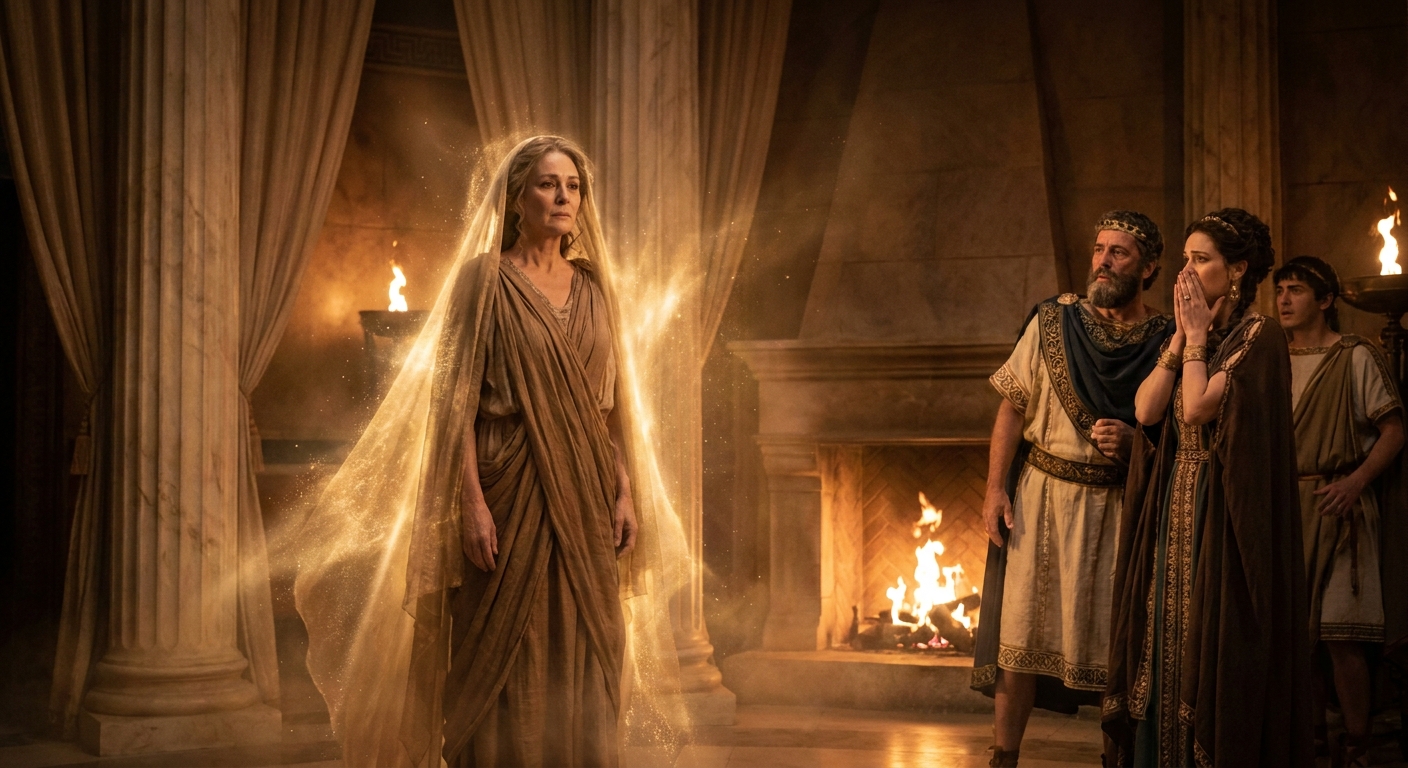
In the hymn, Demeter arrives disguised as an old woman, veiled and heavy with unspoken sorrow. She is received in the household of King Celeus and Queen Metaneira, and she becomes nurse to their infant son, Demophon.
Here the myth gets unsettling in a quieter way. Demeter attempts to make the child immortal, an act described as anointing him with ambrosia and placing him in the fire by night. Metaneira interrupts in terror, and the ritual breaks. Demeter reveals herself, terrible and radiant, and demands the building of a temple.
The Mysteries
The Eleusinian Mysteries were among the most famous religious rites in the Greek world, and they were guarded with an oath of secrecy that lasted centuries. We cannot reconstruct the inner ritual in full, and any modern voice claiming exact details is overpromising certainty.
But we can say what the tradition consistently points toward. The Mysteries braided Demeter’s grief and Persephone’s return into a sacred drama of loss, return, and the hope of a different relationship to death. Initiates spoke of having seen and learned things that changed the texture of the afterlife, as if the Underworld became less of a blank terror and more of a threshold with meaning.
Demeter, at Eleusis, is not only the goddess of crops. She becomes a goddess of the human condition: the one who understands that mortals live by cycles they cannot control, and yet can still be granted dignity within them.
The Bargain
Eventually Zeus intervenes, not out of tenderness, but because the famine is beginning to unmake the world. Hermes is sent down to the Underworld to negotiate Persephone’s release.
And then comes the detail that bites like winter: the pomegranate.
Persephone eats seeds in the Underworld. In Greek myth, eating binds you. It is an intimacy and a contract at once. Because she has tasted the realm of Hades, she cannot fully leave it behind. The result is a compromise that feels like a wound stitched shut: Persephone will spend part of the year below, and part above with her mother.

Later retellings disagree on the fraction of the year. Some make it half, some a third, some something else. Myth is less interested in calendars than in the ache of inevitability.
Demeter gets her daughter back, but not without a recurring loss written into the year.
Triptolemus
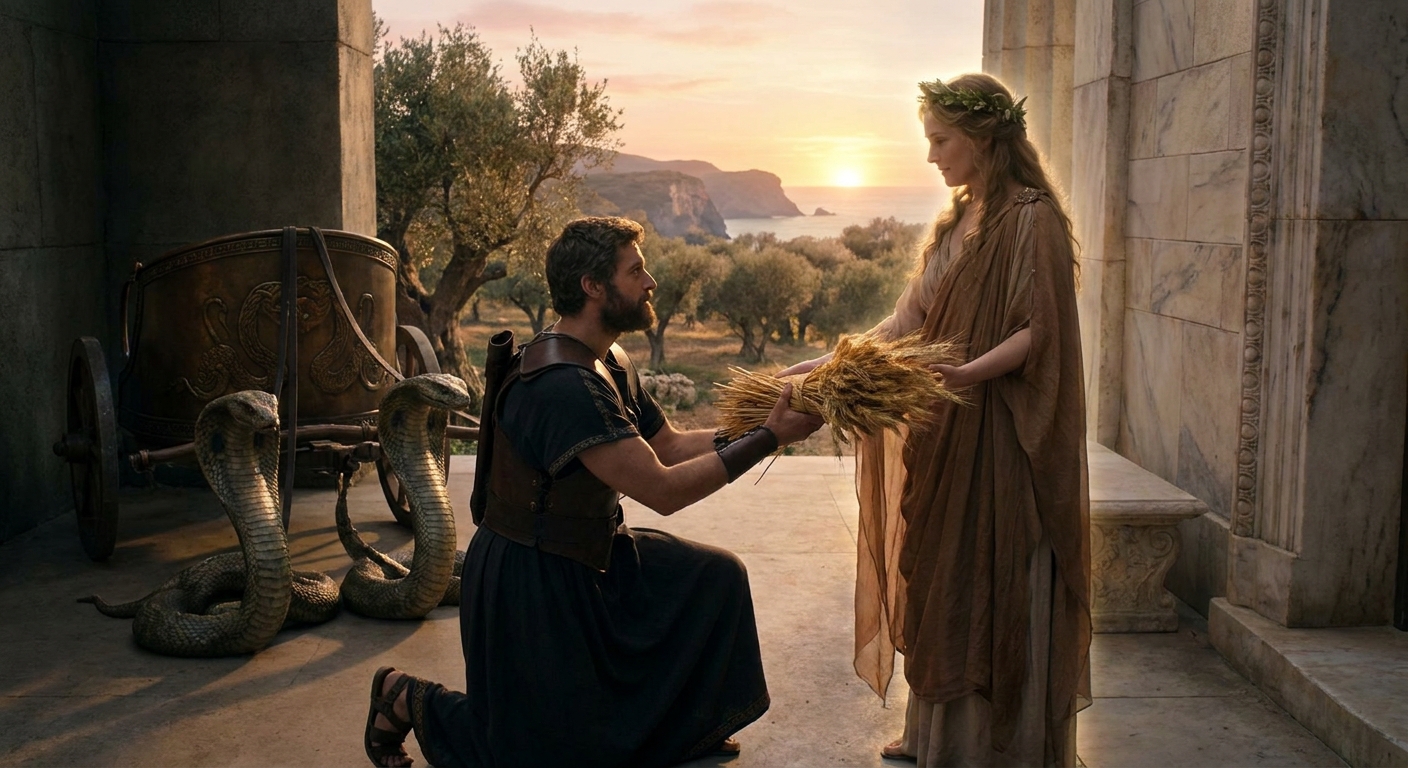
Some Demeter myths widen outward from grief into culture. One of the most important figures here is Triptolemus, an Eleusinian prince or hero favored by the goddess.
Demeter teaches Triptolemus the knowledge of grain and cultivation, then sends him across the world in a chariot, sometimes described as drawn by serpents, to spread agriculture among humanity. The image is strange and gorgeous: a young man carried over seas and mountain ridges, delivering the secret that keeps cities alive.
This is Demeter’s gentler power, but it is not sentimental. Teaching humanity to farm is also teaching humanity to depend. Once you know bread, you cannot go back to ignorance without pain.
Why It Feels Seasonal
It is tempting to flatten Demeter’s story into a tidy seasonal allegory: Persephone descends, winter arrives; Persephone returns, spring blooms. The myth does encode that rhythm, and ancient worship made it practical and sacred at once.
But the story survives because it is more emotionally accurate than a weather chart.
- It understands that love creates vulnerability, even for goddesses.
- It treats grief as force, not weakness.
- It admits that the world’s cycles are not purely natural. They feel negotiated, contingent, and sometimes cruel.
Demeter is the turning year because she is the truth beneath it: nothing that feeds us is guaranteed. The earth is generous, but not obligated. The harvest is a gift, but also a bargain, renewed again and again with every season that returns.
Aftertaste
If grain is civilization, Demeter is also the hand that steadies law and custom around it. In the rites of the Thesmophoria, she is honored as Thesmophoros, the one who bears the sacred order that makes households and cities endure.
Spring, in Demeter’s world, is not just renewal. It is reunion. And reunion, as anyone who has ever lost something knows, is never clean. It is grateful. It is fierce. It is shadowed by the knowledge that the doorway can open again.
The green world returns, and the old fear returns with it, quieter than before.
That is why Demeter still feels close. Not because we all farm, but because we all depend. On seasons, on bodies, on love, on the fragile agreements that keep our lives from going barren.