
Aphrodite Myths: Love, Beauty, and Jealousy on Olympus
Greek Mythology
Aphrodite rarely enters a story quietly. She arrives like salt wind off a moonlit sea cliff, like temple smoke that clings to your hair long after the rite is done. The Greeks did not treat her as a harmless emblem of romance. They treated her as a power, the kind that makes men swear oaths they cannot keep and makes goddesses keep tally of slights that never truly fade.
These myths follow Aphrodite through her most famous appearances: her strange birth, her dangerous affairs, her humiliations and victories, and the moments where beauty stops being decorative and becomes a bargain written into the world.

Born from Sea-Foam
One tradition makes Aphrodite the daughter of Zeus and Dione. But the more unsettling birth comes from Hesiod: when Ouranos is cut down, his severed genitals are cast into the sea. The water whitens into foam, and from that sea-foam Aphrodite rises, already complete, already crowned by the world’s attention.
This is the first clue people miss when they reduce her to softness. Aphrodite is not born from domestic peace. She is born from violence transmuted into beauty, a creation that carries its own shadow.
Hephaestus and the Net
Aphrodite’s marriage to Hephaestus is the kind of Olympian arrangement that looks orderly on a family tree and cruel in practice. Hephaestus, limping god of fire and craft, forges wonders that outlast cities. Aphrodite moves through Olympus like candlelight over polished bronze. Myth does not pretend the mismatch is small.
Enter Ares, the god of war, all heat and impulse. Their affair becomes one of the most infamous scandals on Olympus, not because the gods are modest, but because they are hungry for advantage. Desire is sport until it stains someone’s pride.
Hephaestus answers the way a smith answers: with craft. He makes an unbreakable net, fine as spider silk and nearly invisible in the lamplight, and lays it as a trap. When Aphrodite and Ares meet in bed, the net snaps tight. Then he summons the gods to witness it, turning private fire into public spectacle.
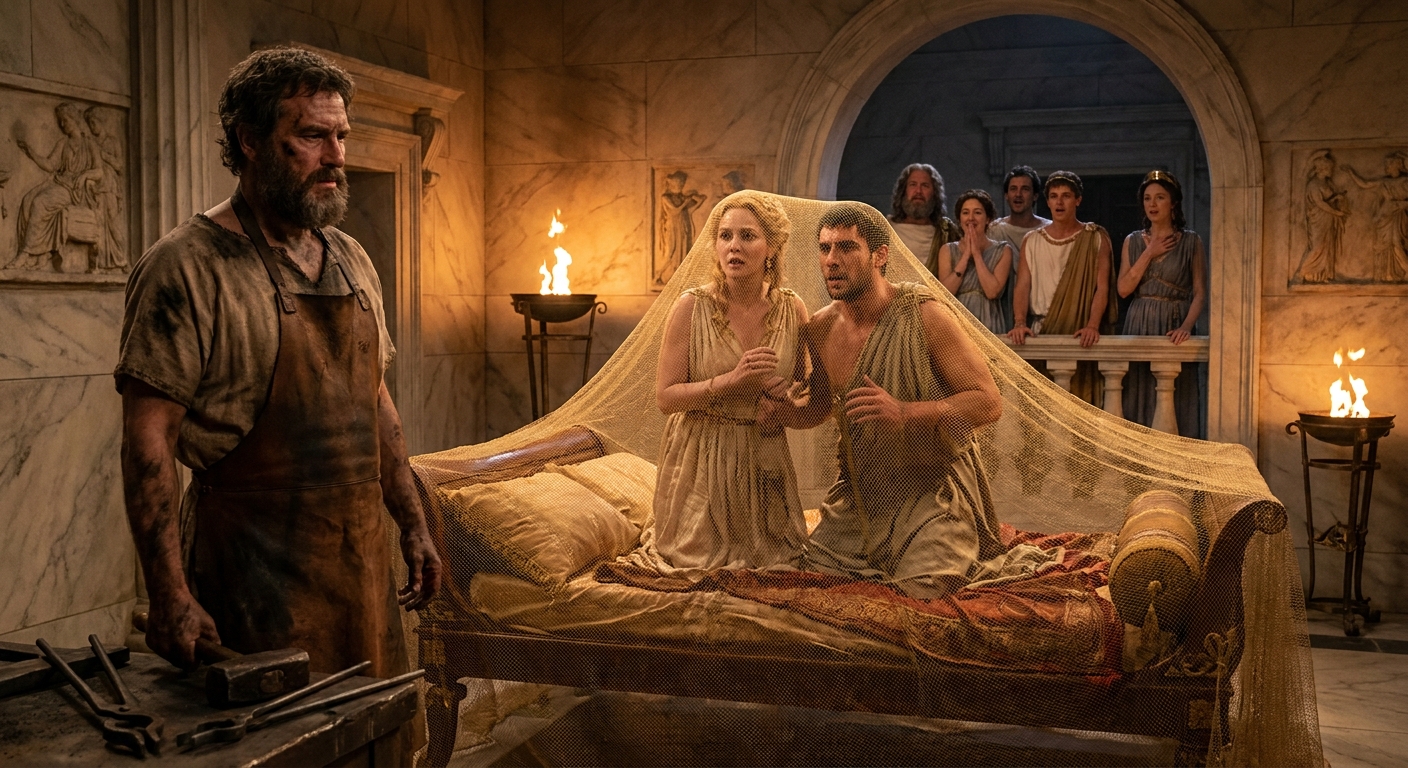
In Olympus, even love can be dragged into the open.
The scene is often played for laughter in ancient telling, but the aftertaste is bitter. It tells you something about Aphrodite’s world: beauty is adored, yes, and it is also policed. Even a goddess can be displayed as a lesson when the audience is powerful enough.
Anchises and the Warning
Aphrodite does not only ruin the lives of enemies. Sometimes she ruins the lives of people she chooses. In the Homeric Hymn to Aphrodite, Zeus designs a reversal: Aphrodite is compelled to desire a mortal man, Anchises, a prince of Troy. It is a myth about a power tasting its own vulnerability and resenting it.
She comes to Anchises disguised as a mortal woman, radiant with glamour that makes the room feel wrong, like daylight inside a temple at midnight. The seduction succeeds. Afterwards she reveals herself, and the air changes immediately. Mortals are not meant to lie with a force that can tip a kingdom with a whisper.
Aphrodite warns Anchises not to boast, not to turn a night of divine attention into a story for other mouths. In some later traditions, Zeus punishes him with a thunderbolt for bragging, leaving him lamed, or worse. Versions differ. The moral weather does not: with Aphrodite, the gift arrives with conditions.

To be chosen by a goddess is honor, and it is also danger.
Their union produces Aeneas, who will carry Troy’s aftermath into new stories and new empires. Aphrodite, for all her volatility, is also a mother of consequences.
Paris and the Apple
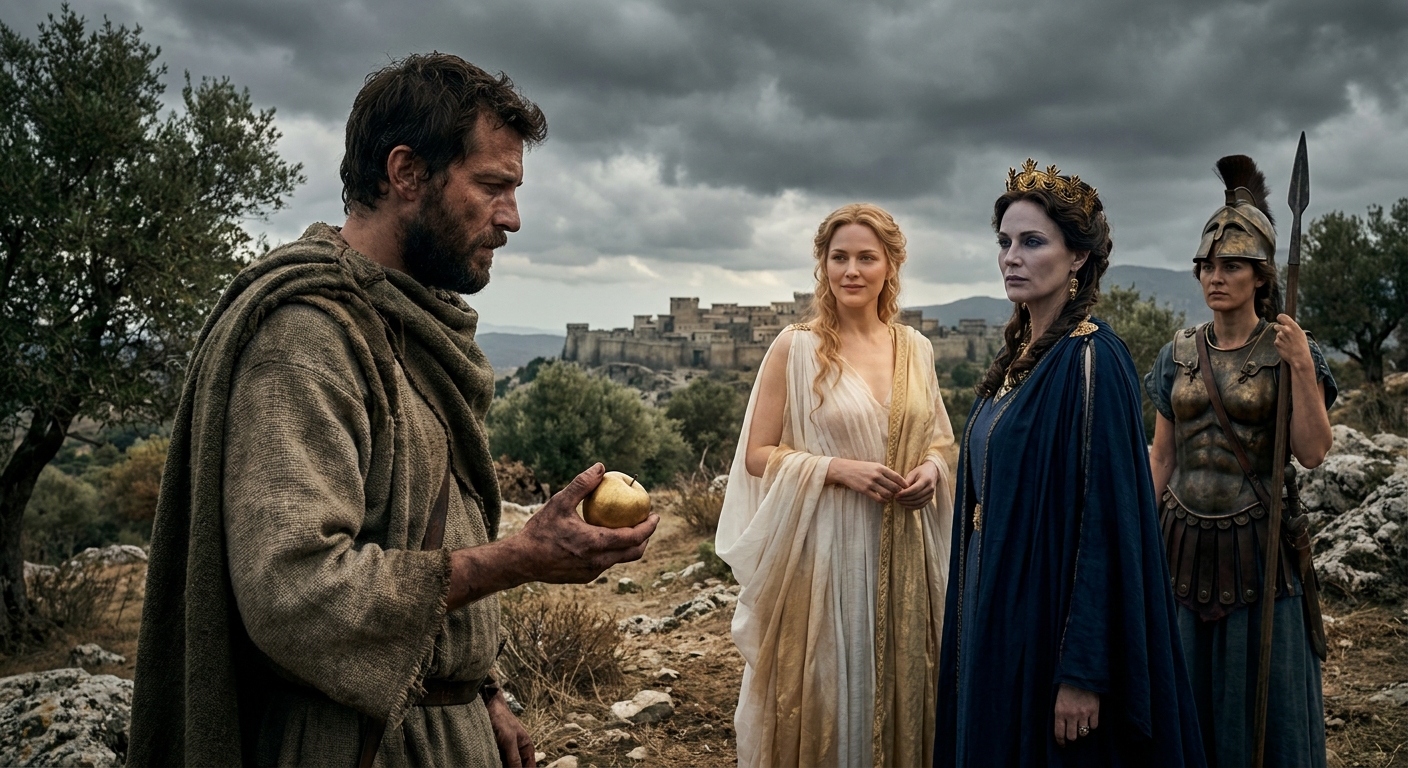
If you want Aphrodite as world-moving force, look to the wedding of Peleus and Thetis, where Eris drops a golden apple marked for the “fairest.” Three goddesses turn toward it like drawn blades: Hera, Athena, and Aphrodite.
They choose a judge who seems safely mortal and therefore expendable: Paris of Troy. Each goddess offers a prize. Hera offers rule. Athena offers victory and clear-minded cunning. Aphrodite offers the most disastrous currency of all: Helen’s love, the love of the most beautiful woman in the world, already bound by marriage and oath.
Paris chooses Aphrodite. The result is not merely an affair. It is the Trojan War, years of bronze and smoke, the kind of myth where every hero discovers what their fate costs.
Pygmalion and the Prayer
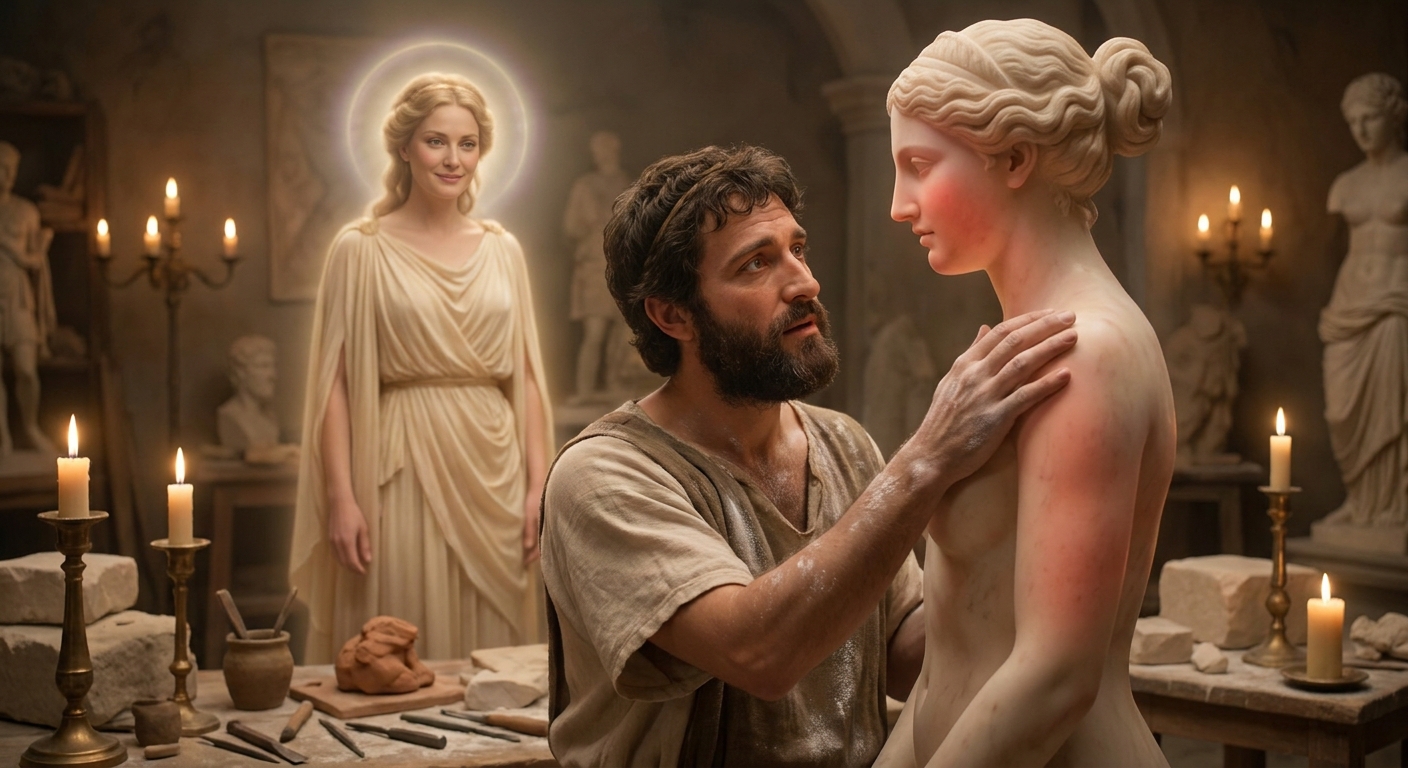
Not every Aphrodite story is a battlefield. Some are quieter, and therefore more unnerving. In Ovid’s Roman telling, it is Venus who answers the sculptor Pygmalion, but the goddess’s face is unmistakable: patron of longing, patron of the image that starts to breathe.
Pygmalion rejects the women around him and carves an ivory statue so perfect it feels like devotion and insult at once. He falls in love with his own work. During the goddess’s festival, he asks for a bride “like” the statue. Venus understands what he cannot say plainly. Desire has already decided its shape.
The statue warms beneath his hands. The myth is often read as romance, but there is a sharper reading too: Aphrodite is patron of projection, of the way humans turn longing into an idol and then beg the universe to animate it.
Adonis and the Boar
With Adonis, Aphrodite’s love turns feral. He is mortal, young, and heartbreakingly beautiful, the sort of beauty that reads like an omen. Aphrodite takes him as a beloved, and the story immediately attracts rivalry because beauty in Greek myth is never private. It draws attention like blood in water.
In many versions, Aphrodite’s attachment pulls in Persephone, who also desires Adonis and draws him toward the Underworld’s colder gravity. A judge must divide him between them, sometimes Zeus, sometimes another arbiter, because even among gods passion becomes a matter of claims and seasons.
The ending is famous. Adonis is killed by a boar during the hunt. Some traditions hint that Ares, jealous, has a hand in it. Others leave the boar as fate’s blunt instrument. Aphrodite runs to him, and her grief is not gentle. From his blood, and sometimes from her tears, spring anemones, delicate flowers with a short season. Love, briefly blooming, and then gone.

Wrath and Punishment
Aphrodite’s gentlest myths tend to be the ones people quote. Her harsher ones explain why she was worshipped with real seriousness. She blesses unions, yes, but she also punishes contempt and denial, especially when mortals treat love as a thing they can refuse without consequence.
Consider Hippolytus, the devotee of Artemis who prides himself on chastity and turns away from Aphrodite’s rites. In response, Aphrodite drives Phaedra, his stepmother, into a desire that becomes a punishment for more than one household. Phaedra collapses under shame and accusation. Hippolytus is destroyed by the false story that follows him like a curse.
The pattern is clear. Someone denies her domain. Someone boasts as if beauty and desire were inventions of the mortal tongue. Someone tries to leash longing like an animal. Aphrodite answers not with a lecture, but with a force that changes what people want, and therefore what they do.
Why She Still Cuts
Modern audiences like to quarantine Aphrodite in the safe part of the museum. Goddess of love. Goddess of beauty. A pleasant marble smile.
The myths disagree.
Aphrodite is the shimmering line where attraction becomes bargain, where longing becomes law, where jealousy becomes history. She is the reason a promise can unmake a marriage, the reason a glance can start a war, the reason a god can feel humiliated and a mortal can feel chosen and doomed in the same breath.
If she feels alive, it is because the Greeks wrote her honestly. Love is gorgeous. Love is irrational. Love is often the first thing we worship and the last thing we forgive.