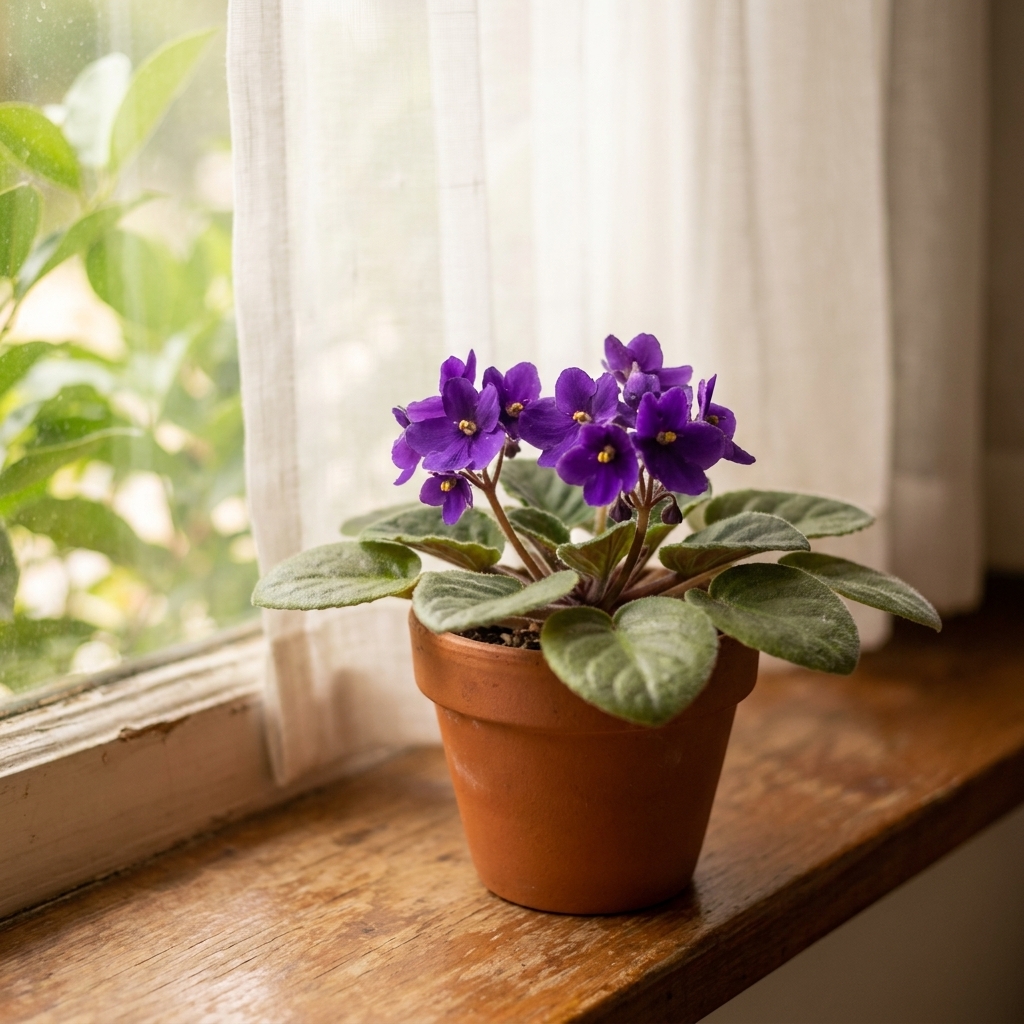
African Violet Care for Beginners
Greek Mythology
There are houseplants that politely exist, and then there are houseplants that perform. African violets are performers. When they are happy, they bloom with the confidence of a deity arriving late to a feast, draped in purple velvet, expecting admiration. When they are unhappy, they do not whisper. They sulk. They droop. They make you question every choice you have ever made near a watering can.
The good news is that African violet care is not difficult once you understand the few rules they consider sacred. Think of this as your beginner initiation: light like a bright courtyard, water like a cautious libation, and soil that drains like a hillside after rain.

What African violets want most
African violets (once Saintpaulia, now reclassified as Streptocarpus section Saintpaulia, though most plant labels still say Saintpaulia) are compact, fuzzy-leaved bloom machines from eastern Africa. Indoors, they thrive when a few conditions line up:
- Bright, indirect light for steady blooming
- Even moisture, not drought followed by a flood
- Airy, fast-draining mix that never turns to swamp
- Warm, stable temperatures, away from drafts
- Light feeding during active growth and bloom
If you can offer those consistently, African violets reward you the way myths reward the brave: with beauty, and with the occasional dramatic twist if you get careless.
One more comfort: they are not “finicky.” They are simply consistent. Meet their basics and they settle into a very cooperative routine.
Light: leaves vs flowers
If your violet is all leaves and no blooms, do not assume it is lazy. Assume it is underlit.
Indirect light means the sun does not hit the leaves directly. Think “bright room, no hot rays on the plant,” or filtered light through a sheer curtain.
Best indoor light
- Ideal: Bright, indirect light near an east window.
- Can work: A bright north window (especially in summer or in lower latitudes). If blooms slow, add a grow light.
- Also works: A few feet back from a south or west window with a sheer curtain.
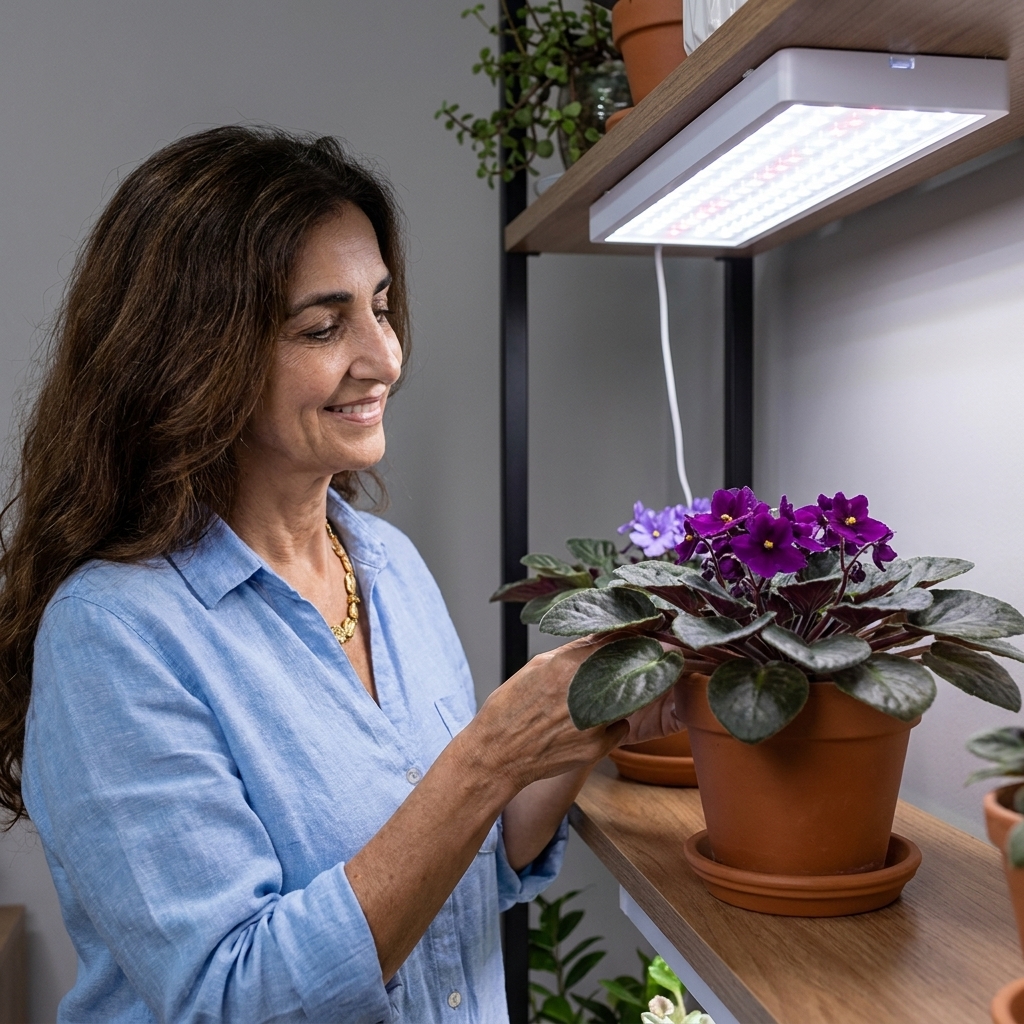
- Great option: Grow lights, especially in darker winters.
How to read the plant
- Too little light: Long leaf stems, leaves reaching upward, few or no blooms.
- Too much light: Pale or yellowing leaves, scorched patches, tight stressed growth.
Aim for a steady glow, not a spotlight. African violets do not want to be sunburned, they want to be admired.
Watering: consistent
Most African violet problems begin with water. Not because they are fragile, but because they have standards. They prefer soil that stays lightly moist, never bone dry, never saturated.
When to water
Touch the top of the potting mix. When the surface feels dry, water again. For many homes, that ends up being about once a week, but your light, temperature, pot size, and mix matter more than any schedule.
How to water
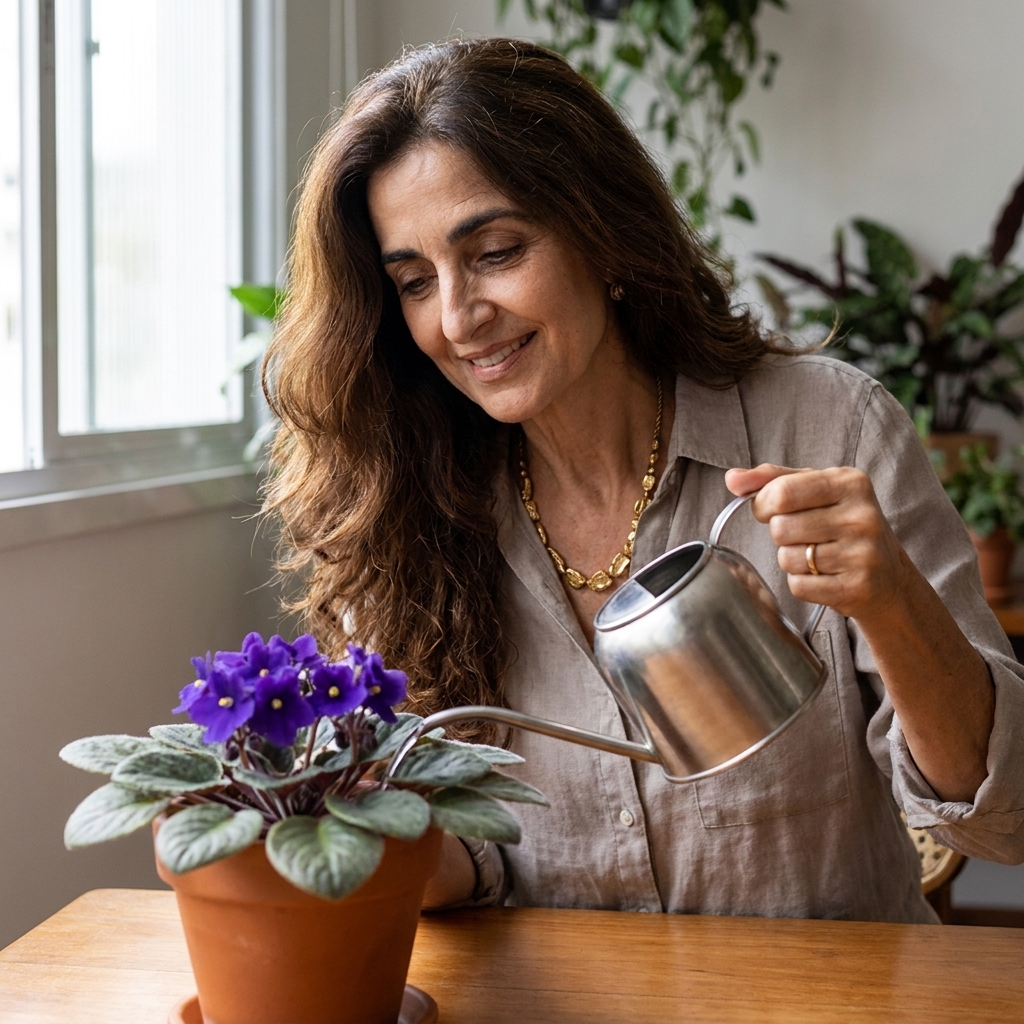
- Top watering: Pour room-temperature water onto the soil until it drains out the bottom. Avoid splashing the leaves and crown. Empty the saucer after 10 to 20 minutes.
- Bottom watering: Set the pot in a shallow dish of water for 20 to 30 minutes, then remove and let it drain fully.
Water quality
Room-temperature water helps prevent spotting and shock. If you can, avoid water that is heavily softened or very salty (it can build up in the soil). If your tap water is hard or your plant gets crusty soil, try filtered or rested water and flush the pot occasionally.
About water on the leaves
You will often hear that water spots the fuzzy leaves. It can, especially if the water is cold or if the leaf stays wet under strong light. If you do splash a leaf, gently blot it with a soft paper towel and keep the plant in good airflow.
Beginner rule: water the soil, not the crown. The crown is where rot begins, quietly, like trouble you invited.
Soil and pots
African violets need an airy mix. Regular potting soil alone is usually too heavy indoors and holds water too long.
Best potting mix
Look for a bag labeled African violet mix, or make a simple beginner blend:
- About 2 parts peat-based potting mix
- About 1 part perlite (for drainage and airflow)
The goal is a mix that drains quickly but still stays lightly moist.
Pot choice and size
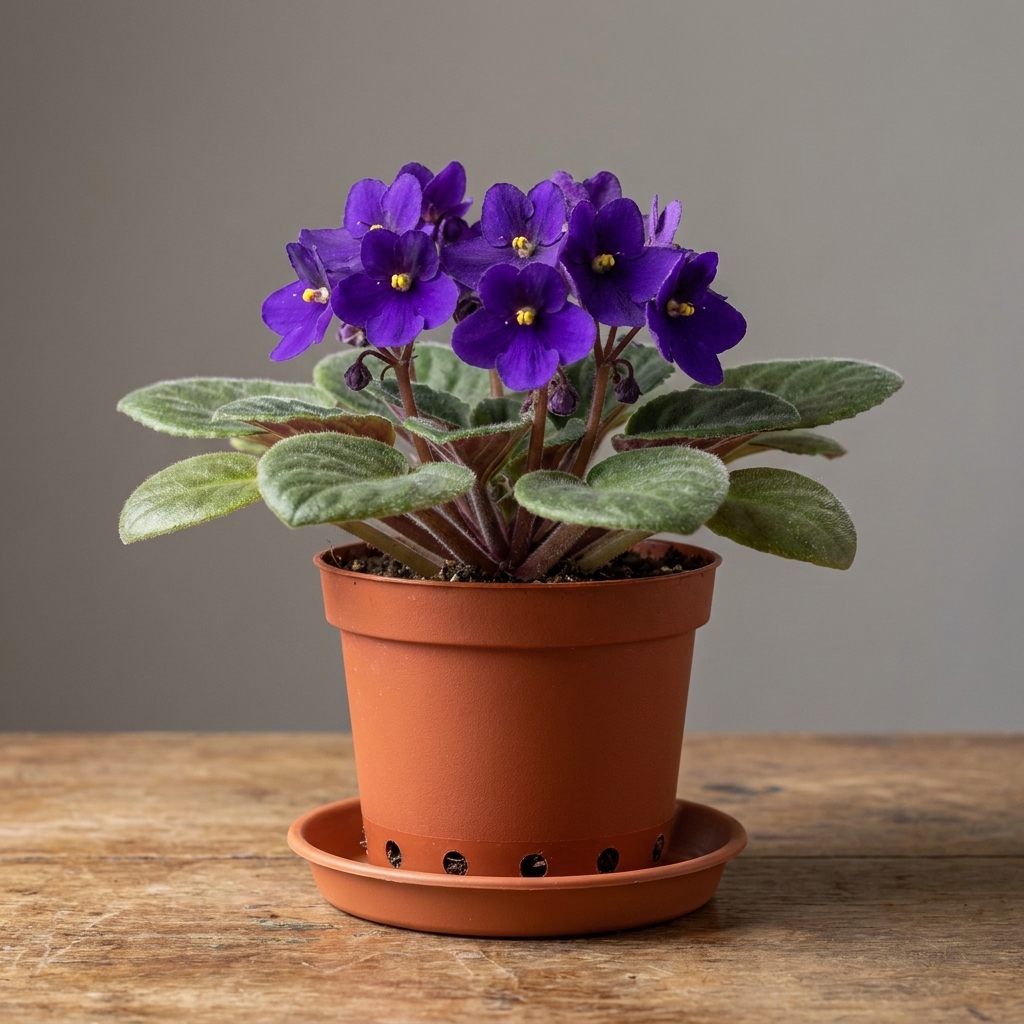
- Use pots with drainage holes. Nonnegotiable.
- Choose small pots. African violets bloom best slightly snug. A common rule of thumb is that the pot diameter should be about one-third the leaf span.
- Plastic is beginner-friendly. It holds moisture more evenly than terracotta, which can dry too fast.
Wick watering
If you see African violets sold with “self-watering” or wick setups, that is not a gimmick. Many growers love them because they keep moisture steady, which violets adore.
- How it works: A wick runs from the potting mix into a reservoir, slowly drawing water upward.
- Key requirement: Use a very airy mix (extra perlite is common) so the soil does not stay soggy.
- Beginner tip: Start with a small reservoir and check the crown often. Consistent moisture is the goal, not a permanent swamp.
Temp and humidity
African violets like the same conditions most humans prefer when they are trying to be their best selves.
- Temperature: Roughly 65 to 80°F (18 to 27°C). Avoid cold window glass in winter and blasting heat vents.
- Humidity: Moderate humidity helps, especially if your home is dry.
Easy humidity boosts
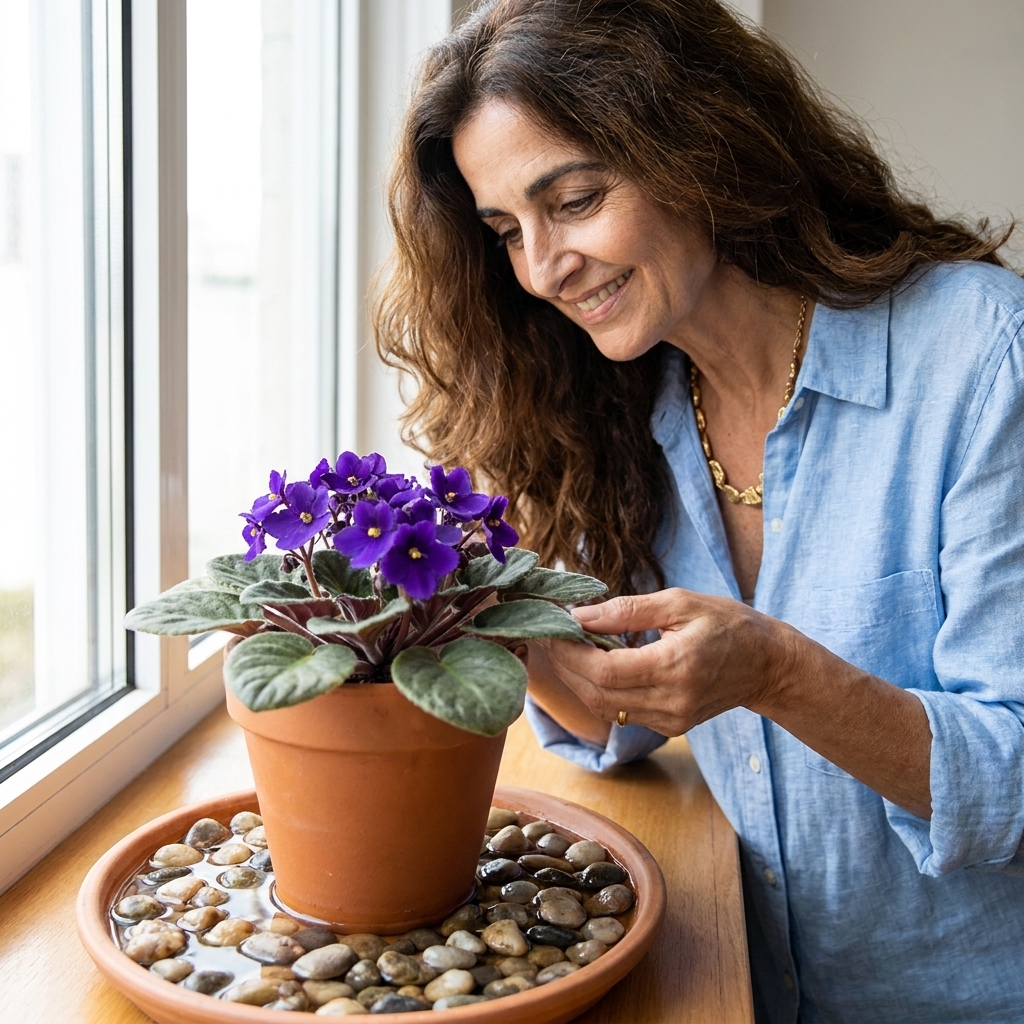
- Place the pot on a tray with pebbles and water (keep the pot above the waterline).
- Group plants together.
- Use a small humidifier nearby.
Misting is not ideal for fuzzy leaves, so think ambient humidity, not spritzing.
Fertilizer: light feeding
African violets bloom repeatedly, and blooming takes energy. Light feeding supports steady flowers and lush leaves.
What to use
- A fertilizer labeled African violet fertilizer or a balanced houseplant fertilizer.
- You will see “bloom” formulas marketed with higher phosphorus. They can be fine, but extra phosphorus is not a magic switch if light is low. Consistent low-dose feeding and good light do more than chasing a number on a label.
- Avoid going heavy on nitrogen if your plant grows a glorious leaf empire and refuses to flower.
How often
During active growth, a simple beginner approach is to fertilize at quarter strength every 2 to 4 weeks. If you prefer, you can also feed more often at a very low dose (the classic “weakly, weekly” style). In lower light seasons, reduce feeding.
If leaf tips brown or the soil develops a crust, you may be overfertilizing or dealing with mineral buildup. Flush the pot by watering thoroughly and letting it drain, then resume more gently.
Repotting: refresh
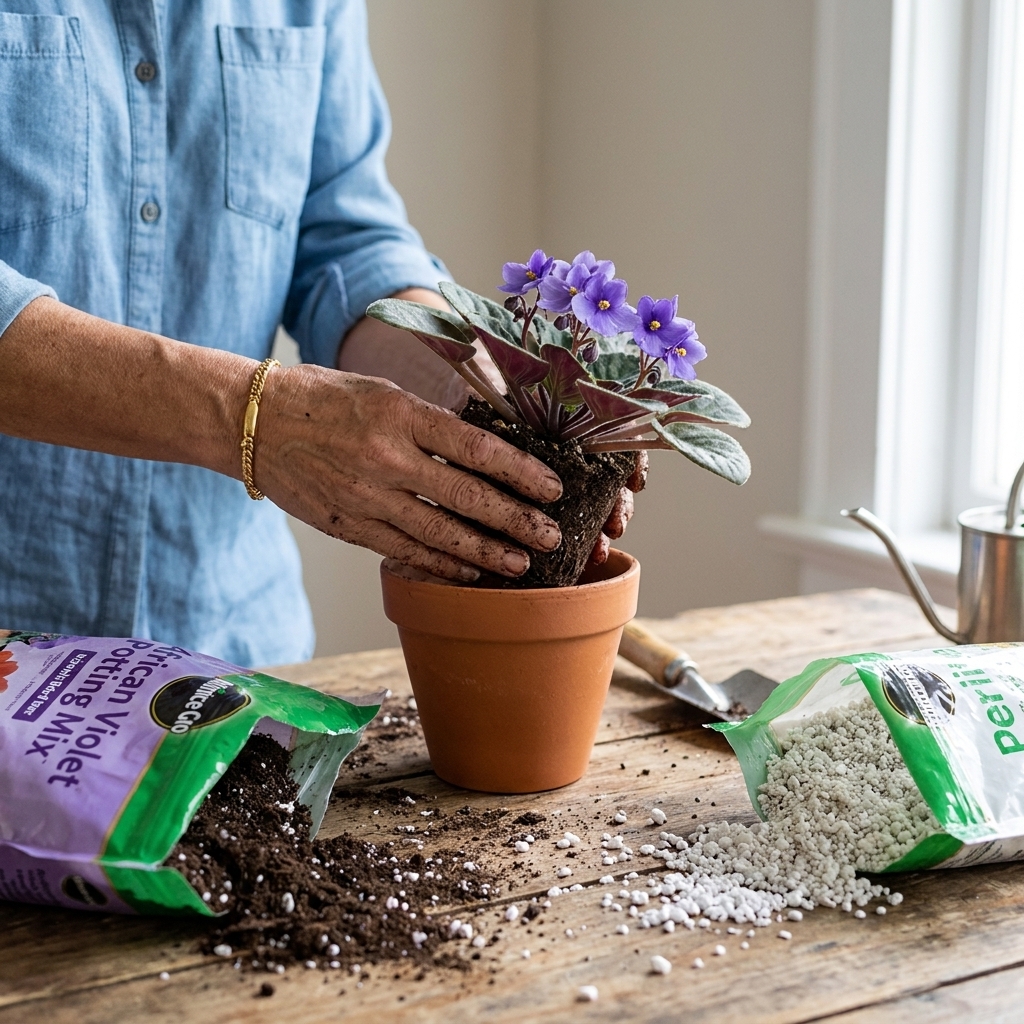
Repotting refreshes the mix, improves drainage, and helps older plants stay vigorous. Many African violets benefit from repotting about once a year, or sooner if the mix compacts, drainage slows, or the plant develops a long bare neck.
How to repot
- Choose a pot the same size or only slightly larger.
- Remove the plant and gently loosen the outer roots if they are tightly circling.
- Add fresh African violet mix to the pot.
- Set the plant so the crown sits just above the soil line.
- Water lightly and keep it in bright, indirect light.
If the plant has developed a long bare “neck” over time, you can bury part of that neck slightly when repotting. Many growers do this to rejuvenate older violets.
Bloom again
When a violet refuses to flower, it is rarely spite. It is usually one of these:
- Not enough light (the most common culprit)
- Pot too large, encouraging leaves over blooms
- Old exhausted soil that stays wet or lacks airflow
- Inconsistent watering causing stress
- Fertilizer imbalance, often too much nitrogen
Try this gentle bloom recipe: move it to brighter indirect light (or add a grow light), repot into fresh airy mix, keep watering consistent, and feed lightly. Then give it a few weeks. African violets are quick to forgive when conditions improve.
Troubleshooting
Droopy leaves
- Likely causes: Overwatering, underwatering, cold shock, or root issues.
- What to do: Check soil moisture and drainage. If the mix is soggy, let it dry slightly and consider repotting into a lighter mix. Keep the plant warm.
Yellowing leaves
- Likely causes: Too much sun, overwatering, old leaves aging naturally, or nutrient issues.
- What to do: Adjust light to bright indirect. Remove only truly spent lower leaves. Evaluate watering and soil.
Brown spots on leaves
- Likely causes: Cold water splashes, sun scorch, or lingering wetness.
- What to do: Use room-temperature water. Keep leaves dry. Filter harsh sunlight.
Mushy crown or stem
- Likely causes: Water sitting in the crown, overly wet soil, poor airflow.
- What to do: If caught early, remove affected tissue and repot into fresh mix, watering more carefully. Severe crown rot is often fatal, but you may be able to save healthy leaves for propagation.
Powdery mildew
- Likely causes: Cool temperatures with high humidity and low airflow.
- What to do: Improve airflow, avoid chilling, and consider a houseplant-safe fungicide if it persists.
Pests to watch
If the plant looks stunted, distorted, sticky, or “off” despite good care, assume something is feeding on it.
- Mealybugs: White cottony clusters in leaf joints and under leaves.
- Thrips: Deformed blooms, pollen mess, streaked petals. Often hitchhike on flowers.
- Cyclamen mites: Tiny and hard to see, but they cause tight, twisted new growth and a generally cursed vibe at the crown.
Isolate the plant, inspect closely, and treat with an appropriate houseplant-safe method (insecticidal soap, horticultural oil, or targeted products depending on the pest). When in doubt, quarantine first. Drama spreads.
Propagation
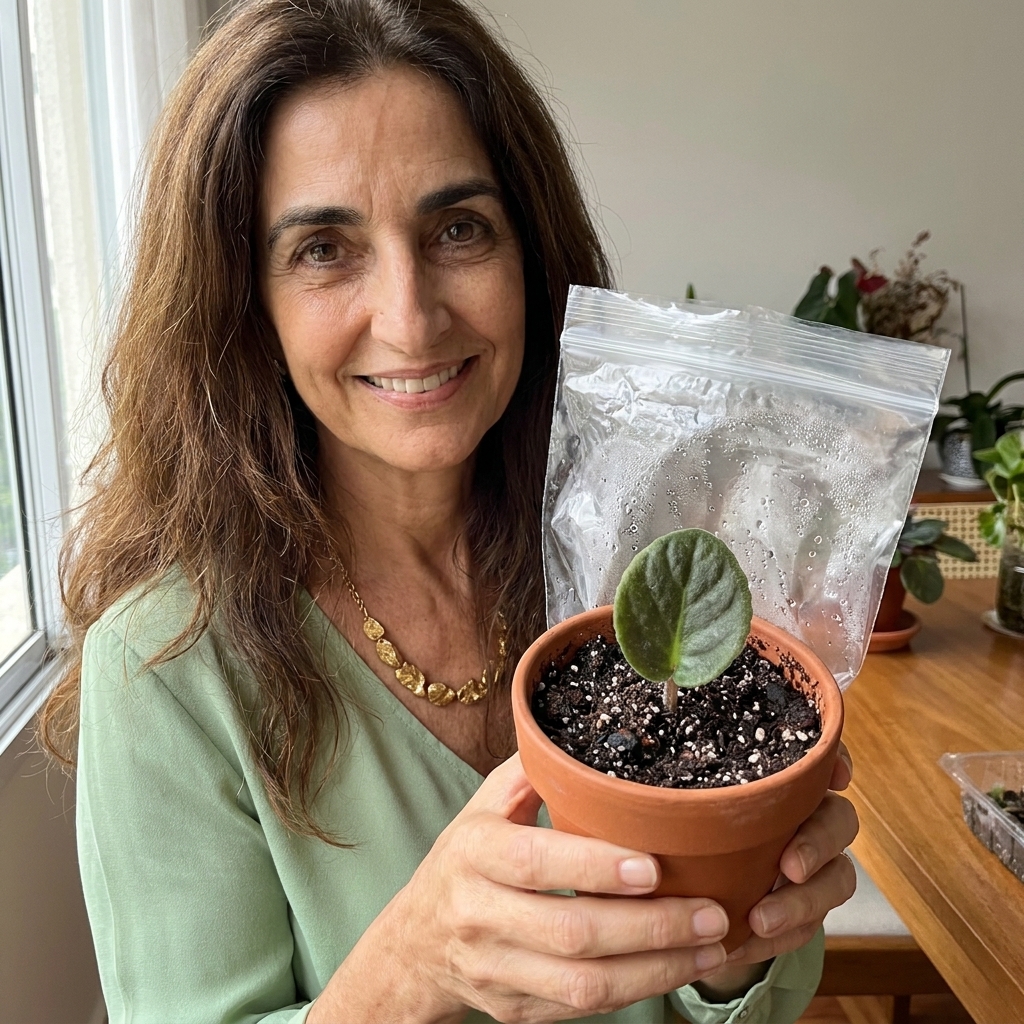
African violets are famously easy to propagate from a single leaf. It feels like mythic alchemy, except it is real and it happens on your windowsill.
Leaf propagation basics
- Choose a healthy leaf from the middle row, not the oldest bottom leaves.
- Cut the leaf stem to about 1 to 2 inches. A slight angle cut helps some growers, but neat and clean matters most.
- Place the stem into moist African violet mix (shallow is fine) or into water until roots form, then pot up.
- Keep warm and bright, with indirect light.
New plantlets can take weeks to months. Patience is part of the ritual.
Simple routine
If you want African violet care to feel effortless, give it a small consistent check-in.
- Once a week: Check soil moisture, water if the top feels dry, rotate the pot a quarter turn for even growth.
- Every 2 to 4 weeks: Fertilize lightly (especially if it is blooming).
- Every few months: Remove spent blooms and any truly yellow lower leaves. If your plant is a single-crown type, pinch off small “suckers” (extra crowns) if you want it to stay symmetrical and bloom hard.
- About yearly: Repot into fresh mix, or sooner if the soil compacts or the neck lengthens.
Do this, and your violet will often bloom as if it has an audience.
An African violet in bloom is proof that small things can be dramatic, luminous, and strangely immortal. Ancient Greece had laurel crowns. Your windowsill has purple velvet.